Is a 1-Year MBA Worth It for Fresh Graduates? Honest Assessment [2026]

![Is a 1-Year MBA Worth It for Fresh Graduates? Honest Assessment [2026]](/blog/content/images/size/w1200/2026/09/Is-a-1-Year-MBA-Worth-It-for-Fresh-Graduates-Honest-Assessment--2026-.webp)
The 1-year MBA is having a moment, and for fresh graduates in India, the timing could not be better. Fresher hiring intent rose to 73% in early 2026, and companies are actively looking for young professionals with focused, practical skills. The question is no longer whether a 1-year program is worth pursuing. The question is which one is right for you.
Globally, the shift is already underway. MBA enrollment has declined 6% over five years, while specialized master's programs have grown 11% and now make up more than half of all master's-level enrollments worldwide. Students are moving towards shorter, skill-first programs, and the results are speaking for themselves.
In India, Altera Institute is leading this change. It is a 1-year PGP built specifically for fresh graduates who want to launch careers in digital marketing, growth, product, and eCommerce. Unlike executive MBAs designed for experienced professionals, these programs are built specifically for early-career candidates. It is a rigorous, industry-designed program that gets you into the right role fast.
This article covers everything you need to know about 1-year MBA programs for fresh graduates in 2026.
Can Fresh Graduates Get Into 1-Year MBA Programmes in India?
Yes, but you need to choose the right program.
The most well-known 1-year MBAs in India are built for working professionals. Programs like ISB PGP and IIM Executive MBAs require two to five years of work experience. These are not the right fit for fresh graduates, and that is completely fine. Because a newer, better category exists.
Industry-led 1-year PGPs are now being built specifically for early-career candidates. These programs are not a compromise. They are designed from the ground up for freshers who want to enter high-growth careers faster, with real skills and verified outcomes. Altera Institute is the strongest example of this in India today.
Fresh graduates who choose Altera Institute get access to:
- Specialization in high-demand careers like digital marketing, growth, product, and eCommerce
- Rigour across 1,200+ hours of structured, industry-designed learning
- Live projects with real companies from the very first month
- Daily industry immersions that connect you with practitioners and future employers throughout the program
This is not a watered-down alternative to a traditional MBA. It is a faster, more focused, and more relevant path into the workforce, built specifically for freshers who are ready to hit the ground running.
Best 1-Year MBA / Management Programs for Fresh Graduates Without Work Experience

Strictly speaking, many are not traditional MBAs but accelerated management/career-launch programs. But here is what actually matters: what the program equips you with.
Employers are looking for relevant, employable skills, and a credential is only as valuable as the competencies it represents.
They hire you for the skills you have and whether you can do the job. A PGP from Altera Institute or ISB carries just as much weight in the hiring process as a PGDM from a traditional college, sometimes more, because the curriculum is built for the roles that exist today.
Here is a comparison of the best options available right now:
A few things stand out when you look at this side by side.
First, ISB PGP YL and Altera Institute are the only two programs genuinely open to freshers that offer real career acceleration. ISB gives you the brand and global network but costs close to Rs 30 lakh. Altera Institute gives you a more focused, digital-first curriculum at Rs 16.44 lakh with a proven track record of 100% placements backed by an independent audit.
Second, IIM Kozhikode PGP-BL and Great Lakes PGPM are not for freshers at all. They require 4 years and 2 years of work experience, respectively. If you apply straight out of college, you will not be eligible.
Third, the traditional 2-year MBA is the longest and often the most expensive route. It works well if you want broad exposure across sectors. But if you already know you want a career in digital marketing, eCommerce, or product, spending two years on a general management curriculum is not the most efficient path.
Why Should Freshers Choose a 1-Year MBA?
A fresher should choose a 1-year MBA when they are clear about the career they want and do not want to spend an extra year getting there. If you already know you want to work in digital marketing, growth, product, or eCommerce, a focused 1-year program is the faster, smarter path. Here is when it makes the most sense:
Start Earning Sooner
A 1-year program gets you into a real job faster. The earlier you start building experience, the further ahead you will be over time.
Spend Less, Earn Sooner
A 2-year MBA costs you tuition plus a full year of income you never earned. A 1-year program is cheaper and pays itself back much sooner.
You Know Your Direction
Increasingly, companies are prioritizing candidates with specialized, job-ready skills. They want people who can hit the ground running. If you already know what you want to do, a focused 1-year program builds the specific skills that get you hired faster.
Market Is Hiring Now
Fresher hiring intent in India rose to 73% in early 2026. Getting in now puts you ahead of those still waiting to graduate.
Build Your Network Early
A structured program puts you inside an industry ecosystem from day one, long before placements even begin. You do not have to spend your first few working years building connections from scratch.
When A 1-Year MBA Is NOT Worth It
If the program is mostly classroom lessons that don't have much to do with real life, you will leave with knowledge but no demonstrated skills. Employers in 2026 are not impressed by theory alone.
Weak Employer Recognition:
A degree is only as useful as the doors it opens. If hiring companies have not heard of the program or do not actively recruit from it, the credential carries very little weight in the job market.
Poor Placement Record:
Some programs make big claims about placements without backing them up. If a program cannot show you clear, verified data on where its graduates actually landed, that is a serious concern.
A Repeat of Your Degree:
If the curriculum largely overlaps with your undergraduate business or commerce education, you are not adding new value. You are paying to cover the same ground twice.
No Industry Exposure:
Networking, live projects, and industry interactions are a core part of what makes a program worth it. If those are missing, you are missing the most valuable parts of the experience.
What Makes Altera Institute Different From Other 1-Year Programs?
Most 1-year programs were built for people who already have years of work experience. Altera Institute was built for fresh graduates who want to get into the right job, fast. Here is how they do it differently:
Specialize From Day One
Every module at Altera Institute is built around real careers in digital marketing, growth, product, and eCommerce. You are not studying general management and hoping it leads somewhere. You are training for a specific role from the moment you join.
Serious, Relevant Workload
The program covers 1,200+ hours of learning across 15 months. Nothing in the curriculum is filler. Each subject is directly related to what you will need at work.
Real Projects, Real Portfolio
From your very first month, you work on actual briefs from real companies. By the time placements begin, you already have a real portfolio to show employers.
Daily Industry Access
At most programs, industry exposure means an occasional guest lecture. At Altera Institute, practitioners are involved in your learning every day. You build real professional relationships with the people who will eventually hire you before you even graduate.
1-Year MBA vs 2-Year MBA for Fresh Graduates: Which Is Better?
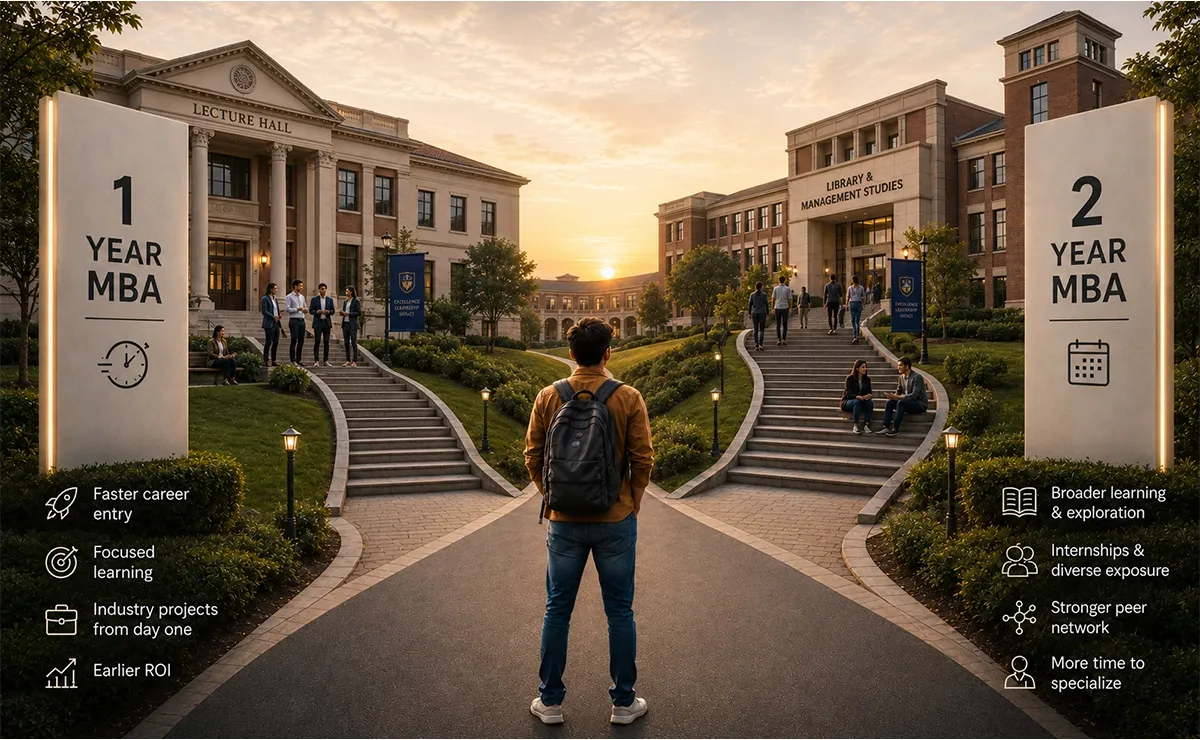
If you already know what you want to do after graduation, a 1-year program is almost always the smarter financial decision. With a shorter time investment and a faster path to employment, you are able to see a quicker return on that investment. For someone targeting digital roles like growth, product, or eCommerce, a focused 1-year program built around those specific careers will prepare you better than a general 2-year MBA that covers everything at a surface level.
The numbers make this clear. A 2-year MBA at a mid-tier private college typically costs Rs 18 to 24 lakh. Add one extra year of no income, and the real cost is much higher. Altera Institute's PGP costs Rs 16.44 lakh, places you into a job earning Rs 18 LPA or more within 15 months, and pays itself back in a relatively short period of time.
For fresh graduates who are clear about their career direction, a focused 1-year program is not just a good option. For many students with clear career goals, it can be the most efficient one.
Final Verdict: Is a 1-Year MBA Worth It for Fresh Graduates in 2026?
Absolutely. And if you are a fresh graduate who knows the career they want, there has never been a better time to pursue it.
The hiring market is increasingly favorable for skilled early-career professionals. Companies are actively looking for young professionals with focused, practical skills. A well-designed 1-year program gets you there faster, at a lower cost and with better role alignment than a traditional 2-year MBA.
The honest truth is that very few 1-year MBA programs in India are built for freshers. Most require years of work experience. But Altera Institute has changed that. It is the first program in India purpose-built for fresh graduates who want to launch careers in digital marketing, growth, product, and eCommerce. The outcomes speak for themselves: 100% placements, a median salary of Rs 18.14 LPA, and 3.2x salary growth, all independently verified.
More such programs will emerge in the years ahead. The category is growing. Altera Institute is among the early players shaping this category in India, and right now, it remains one of the best options available for fresh graduates who are serious about building a high-growth career without waiting two years to begin.
Frequently Asked Questions
Q1. Can fresh graduates do a 1-year MBA in India?
Ans: Yes, but not all programs allow it. Top executive programs like ISB and IIM require work experience. However, early-career industry-led programs and select private institution PGPs are specifically designed to accept fresh graduates with no prior work experience.
Q2. Is 1 year of work experience enough for the top 1-year MBA programs?
Ans: Not for most top programs. ISB requires 24+ months, IIM Ahmedabad’s PGPX requires 4+ years, and IIM Bangalore’s EPGP requires 5+ years. One year of experience is generally not sufficient for these selective executive-track programs.
Q3. Which 1-year MBA accepts freshers in India?
Ans: Early-career industry-led PGPs are your best option as a fresher. Programs like Altera Institute’s PGP are built specifically for fresh graduates and early-career professionals, focusing on applied learning and career launch rather than executive development for experienced professionals.
Q4. Is a 1-year MBA better than a 2-year MBA for freshers?
Ans: It depends on your goals.
- A 1-year program gets you into the workforce faster with lower costs.
- A 2-year MBA gives you more time to learn and do internships.
- For early-career professionals who already know where they want to go, a 1-year program is often the more efficient path.
Q5. Do employers value 1-year MBA programs?
Ans: It depends on the program. Employers value outcomes over duration. A 1-year program with strong industry connections, verified placements, and applied learning can carry significant weight. A lesser-known program with weak placement records will struggle regardless of its length.
Q6. Why not just do certifications instead?
Ans: Certifications are a good starting point, but they only go so far. When you join a structured program, you get a lot more than just course content. You get access to placements, mentors who have actually worked in the industry, a peer group that pushes you to grow, real projects for your portfolio, and a system that keeps you accountable. A certification teaches you something. A good program helps you build a career.