
How to prepare for CAT 2026?


Each year, nearly 300,000 graduates compete in a two-hour exam that determines eligibility for India's most sought-after management programs. CAT 2025 saw 293,000 registered candidates, and CAT 2026 is expected to draw a similar or larger number. Understanding the scale of competition is essential for developing an effective preparation strategy.
The CAT syllabus is considered difficult by many, but that is not the case. The syllabus can be taken up by anyone with steady preparation over 12-15 months. So, it is not the content of the questions that makes CAT difficult; it is the time limits for each section, the negative marking for incorrect answers, and the percentile-based scoring, which is based on your performance relative to other candidates sitting the exam.
This article covers three main areas: how the exam works, strategies for each section, and a step-by-step 12 to 15-month plan that includes advice on taking mock tests.
Understand What CAT 2026 Will Test
It is expected that CAT 2026 will be similar to the previous editions. At a glance:
- Duration: 120 minutes (three 40-minute sessions)
- Sections: Verbal Ability and Reading Comprehension (VARC), Data Interpretation and Logical Reasoning (DILR), Quantitative Ability (QA) (in this fixed order)
- Question Count: 68 questions in total, with a mix of MCQs and non-MCQ (TITA) questions
- Section Navigation: You have to move through the sections in order. When the timer for one section runs out, you’re taken straight to the next. You can’t go back or use leftover time from one section in another
Understanding the scoring mechanics is critical because they shape every strategic decision you will make in the exam:
- +3 marks for every correct MCQ answer.
- You lose 1 mark for every wrong MCQ answer. So, a wrong answer doesn’t just lose you a point—it also means you miss out on the 3 marks you could have earned for a correct answer, making the total impact 4 marks.
- No negative marking on TITA (Type In The Answer) questions, making them worth attempting even under uncertainty.
The main takeaway is that accuracy is more important than the number of questions you try. For example, someone who answers 30 questions with 90% accuracy will usually score higher than someone who attempts 50 questions but gets only 60% right because of negative marking.
How Do Raw Scores Convert to Percentiles?
Your CAT result is given as a percentile, not just a raw score. The IIMs adjust scores across different exam slots to balance differences in difficulty, so the score you need for a certain percentile changes every year. Many people misunderstand this, but it’s important to set your preparation goals.
Raw Score Required for Key Percentile Bands, CAT 2021 to 2025
The figures are estimates based on post-exam analyses done by IMS India, Career Launcher, and Cracku to predict the numbers of 2025. Scores are out of a maximum of 204 marks. Data refers to records from 2021 to 2024.
The table shows that when the exam is tougher, you need fewer marks to reach each percentile. For example, in 2023, 76 marks got you to the 99th percentile, but in 2024, which was easier, you needed 95 marks for the same percentile. There is nothing that you can do to control the hardness of the paper, but you can prepare well enough to keep the top of the stack below.
Another important thing about all the many IIMs is that there is a minimum cutoff for each section (apart from the overall score). For instance, in CAT 2024, you would have needed approximately 30 marks in VARC, 27 in DILR, and 22 in QA to achieve the 95th percentile overall. Even if your total score is high, a weak section can keep you out. Therefore, it is important to thoroughly study for the entire exam.
Section-Wise Preparation Strategy for CAT 2026

VARC: Verbal Ability and Reading Comprehension
There are typically 24 questions on VARC, around 16 of which are reading comprehension questions based on three or four passages, and 8 are verbal ability questions, like paragraph jumbles, odd sentence questions, and summaries. This section is often underestimated by many non-arts students, and others assume that if they are good at English, they will be good at CAT VARC, but this is not always the case.
This section tests how quickly you can understand and infer meaning, not your vocabulary or grammar. CAT RC passages tend to be argumentative and focused on a topic, e.g., philosophy, economics, science, history, and public policy, and are often dense. Questions do not often request specific details but rather ask about the author's implications, tone, or logical inferences. When reading on the surface level, you'll frequently choose the incorrect answer.
How to prepare:
- Make it a habit to read every day. Spend at least 20 minutes on long, challenging articles—like editorials, in-depth journalism, or essays about economics, science, or public issues. The aim is to get faster at drawing inferences, not just to learn new topics.
- Use authentic CAT RC passages for practice. Once you have answered, go back through your answers and look for any errors. Figure out if you misunderstood the passage or just picked an answer that seemed right but wasn’t backed up by the text.
- For Verbal Ability, pay attention to the logical order of ideas. Paragraph jumble questions check if you can tell which idea should come first because the next sentence depends on it. The best way to get better is to study the explanations for correct answers, rather than relying on shortcuts.
DILR: Data Interpretation and Logical Reasoning
DILR is the most unpredictable part of the CAT. One bad decision early on can cost you 10 minutes that you can’t get back. This section has about 22 questions, grouped into four sets. Each set is based on a scenario, like a tricky data table, a scheduling puzzle, or a set of logical rules. The types of sets can vary widely each year.
The main challenge is that you’re not expected to finish all four sets in 40 minutes. Top performers spend the first few minutes scanning all the sets, pick the ones they can solve, and focus on doing two or three well instead of trying all four and risking mistakes.
How to prepare:
- Get comfortable with all types of questions. Practice bar graphs, line charts, tables, Venn diagrams, arrangement puzzles, and scheduling problems in as many formats as you can. Being familiar with different types helps you stay calm if you see something new on exam day.
- Hone skill in selecting sets to solve under timed conditions. Instead of attempting individual questions, complete an entire 40-minute section and use the scan-and-select approach from the start.
- Give yourself a strict time limit for each set. If you’re not making progress in 10 to 12 minutes, move on. Spending too long on a tough set might mean you miss easier questions elsewhere.
QA: Quantitative Ability
The QA section includes arithmetic, algebra, geometry, number systems, and modern math topics such as probability and permutations. There are 22 questions in this section. While most students are stronger in QA than in the other sections, many still miss their target percentile because CAT asks questions in a unique way.
This section isn't simply a test of your memory of formulas. It sees if you can't link two or three thoughts consecutively, sometimes in an unexpected and seemingly "obvious" manner, when you truly understand the fundamentals. Those who only remember formulas without knowing what they mean will tend to stall at about the 70th to 75th percentile.
How to prepare:
- Be aware of the concept of each topic from the base. Rather than asking, 'What's the formula?' think in terms of 'Why does this formula work?' This deeper understanding will help you deal with unexpected problems during the examination.
- Practice a variety of problems, not the same ones repeatedly. After learning about a topic, test with a variety of questions. CAT is unlikely to offer the same problem style more than once, so it is better to learn a variety of problem styles rather than just a few templates.
- Be disciplined with which questions you attempt in timed practice. If a question from the QA section cannot be answered in 90 seconds, then flag it and return to it later. You are losing time on three easy problems every five minutes you spend on a difficult one.
A 12 to 15-Month Preparation Roadmap for CAT 2026
Preparing for CAT over 12 to 15 months isn’t too much—it’s actually the minimum you need to cover all the topics, build exam skills, and fine-tune your strategy with mock tests. The preparation process has three clear phases, each with its own goal.
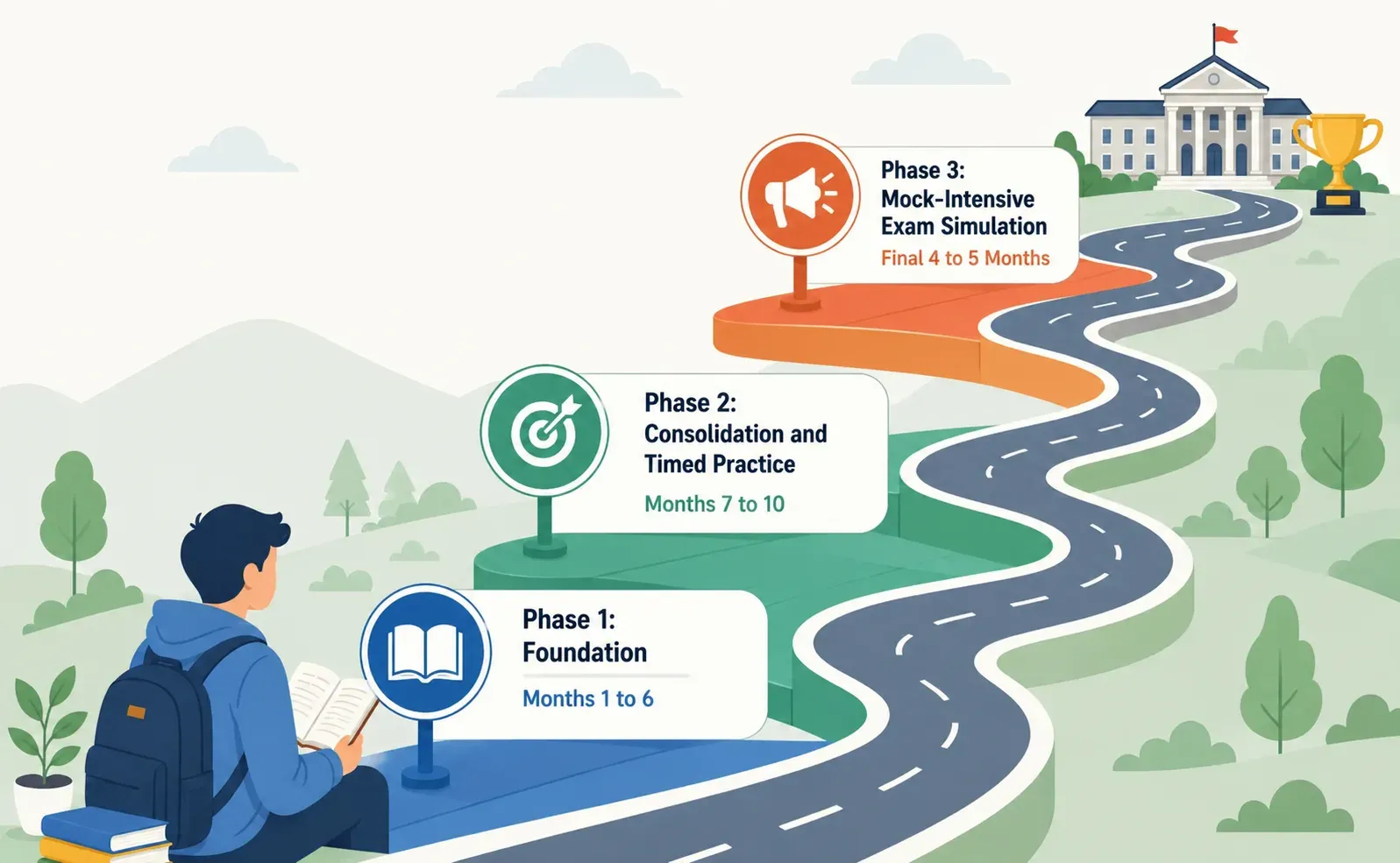
Phase 1: Foundation (Months 1 to 6)
The aim in this phase is to fully understand the concepts, not to work quickly. If you skip this step and jump straight into timed practice, you’ll likely find gaps in your knowledge during the exam that are much harder to fix later.
- QA: Review all topics from first principles. Don't proceed to the next topic until you can offer an explanation of why the method works, not just how to use it.
- VARC: Establish reading habits. Begin working through RC passages and VA question types at a comfortable pace, focusing on understanding error patterns rather than improving speed.
- DILR: Solve one to two diverse sets per day without strict time pressure. The objective is pattern recognition, not speed.
Key mindset: Remember, mistakes at this stage are helpful—they show you where you need to improve. It’s much better to find these gaps now than to discover them for the first time in a full mock test.
Phase 2: Consolidation and Timed Practice (Months 7 to 10)
During this stage, you will be shifting from practicing individual topics to full sections and full exam simulations. This is where you can begin to use what you have learned with pressure and where so many students make huge progress or fall behind!
- Switch to the 40-minute full-length sections as the main practice format in all three sections.
- Add one to two full mock tests every month. Focus should be on post-mock analysis rather than the score. Classify all the mistakes as conceptual mistakes, selection mistakes (wrong options), and time management mistakes (attempting a question that should have been skipped). Each of these categories in turn refers to a separate fix.
- Start tracking your percentile in mock tests, not just your raw score. A score of 70 can mean very different things depending on how hard the test is, but your percentile shows where you really stand compared to others.
Phase 3: Mock-Intensive Exam Simulation (Final 4 to 5 Months)
This is the phase where your preparation turns into real performance. Now, the goal isn’t to learn new topics but to improve your decision-making—the skill that separates those at the 95th percentile from those at the 99th.
- Increase mock frequency to once every 7 to 10 days, scaling up to 1 to 2 per week as the exam approaches.
- Use each mock test to try out new strategies. For example, experiment with how you select sets in DILR, adjust your pacing in VARC, or practice skipping questions and come back to them in QA. After each mock, don’t just look at your score—ask yourself if you made better choices than before.
- Don’t start learning new topics at this stage. It’s better to use your time to get more accurate and make better decisions in the areas you’ve already studied.
Handling Difficulty on Exam Day
Once you’re above the 90th percentile, knowing the content isn’t what sets you apart—most people at this level have studied enough. What really makes the difference between the 95th and 99th percentile is how well you make decisions during the exam, like which questions to try, when to leave a tough DILR set, and how you handle a section that feels harder than expected.
This is reflected in the numbers. The difference between the 95th and 99th percentiles in CAT 2024 was approximately 25 marks out of 204. It's not something that can be remedied by learning new topics in the final month. It's about being sensible and avoiding unnecessary penalties and being relaxed because you've done the difficult bits in your mocks.
Three principles worth internalizing for exam day:
- Focus on accuracy, not just the number of questions you try. This is the most important rule for the CAT. Getting +3 for each correct answer without picking up −1 penalties matters more than attempting as many questions as possible.
- It's not a bad thing if it is a tougher exam. If the test appears more difficult than your mocks, then it probably does for everyone. A harder paper will result in lower grades for all the candidates, and you will require fewer marks to achieve your target percentile. It is a skill to be aware of this and remain calm in executing your plan.
- Think of each section as separate. Doing badly in VARC doesn’t affect your DILR or QA scores. The real risk is letting a tough section affect your mindset for the next one. Practicing with mocks helps you keep each section separate in your mind.
Conclusion
CAT 2026 is meant to be competitive. Its difficulty is not just for applicants but is also aligned with the standards of the top business schools in India. If you understand the percentiles game, know what you're going for, know the plan, and practice with mock tests, then you have a very real, proven route to any percentile you want to hit.
A 12-to-15-month preparation period is enough for those aiming for the 95th percentile, and it’s possible for those targeting 99 and above if you start with an honest self-assessment and focus on deep understanding, not just memorizing formulas. The people who reach the top percentiles aren’t always the ones who studied the most—they’re the ones who understood what the exam tests and prepared for it in the right way.