How to Get into Altera Institute with the CAT Exam


Altera Institute’s 15-month PGP in Applied Marketing incorporates a profile-based admissions process. Much like SPJIMR, ISB, and BITSOM, it evaluates every application across several dimensions at once, weighing your CAT score alongside everything else you bring to the table.
At Altera Institute, a CAT percentile of 90 is considered a safe score for shortlisting. That number is worth anchoring your prep around, but also know that a score of 90+ will only get you shortlisted, after which your overall profile will determine the outcome of the admissions.
This article breaks down CAT eligibility at Altera, what the rest of the process tests, and where your prep time is genuinely best spent.
The CAT Percentile You Actually Need
As mentioned before, a CAT percentile of 90 or higher is considered safe at Altera and will get you an interview call in the 2026-27 cycle. The same benchmark applies to XAT as well. Falling short doesn’t rule you out entirely; students in the 85-90 bracket should also actively apply, but the rest of your profile must work harder and genuinely stand out.
That is why shortlisting at Altera Institute is not strictly along the percentile lines. Consequently, an individual with a 95th percentile profile may have a decent chance of not being selected if their profile seems "generic," while an individual with a 90th percentile profile may advance over him/her if their application provides a unified program-fitting story.
This isn’t Altera Institute penalizing a strong score. It simply means that the admissions committee values a candidate more for their career clarity and a thorough, coherent application story that fits the program versus a high CAT score by itself.
Hence, use the 90th percentile as a benchmark, not as a strict cutoff. Working professionals who have secure scores slightly below this percentile should not be discouraged and should apply too. Following an initial application review, they may be invited to take the ALNAT, a two-hour online test designed by the institute to assess their suitability for the PGP program.
ALNAT is open to working professionals who have not taken the CAT, XAT, or GMAT exams, as well as applicants (with work experience) who fall slightly short of the safe score while presenting an otherwise strong profile.
Academic Eligibility Alongside Your Score
Altera Institute requires a minimum 50% aggregate at the undergraduate level as a baseline, though a genuinely competitive applicant sits closer to 80% or higher across X, XII, and UG marks.
Subject depth also matters greatly and is viewed positively. For instance, an engineering graduate’s data-interpretation skills or a commerce graduate’s accounting grades tend to be viewed favorably, since both feed directly into the program’s digital-and-analytics-first curriculum. It’s worth explicitly naming and aligning your strengths in your SOP with the program’s relevance rather than assuming the panel will automatically connect the dots.
Starting the Application
After fulfilling the requirements for the entrance exam, you can start the admissions process by filling out the online application form, which consists of four parts: personal information, educational information, work experience, and career objectives. It's submitted along with a non-refundable fee of Rs 1,999.
Consider using Altera Institute's call predictor tool on your profile before submitting. It gives you a directional indicator for the chances of being shortlisted, but it doesn't predict success; it just gives you an idea of the probability.
Why Altera Doesn’t Shortlist on CAT Percentile Alone
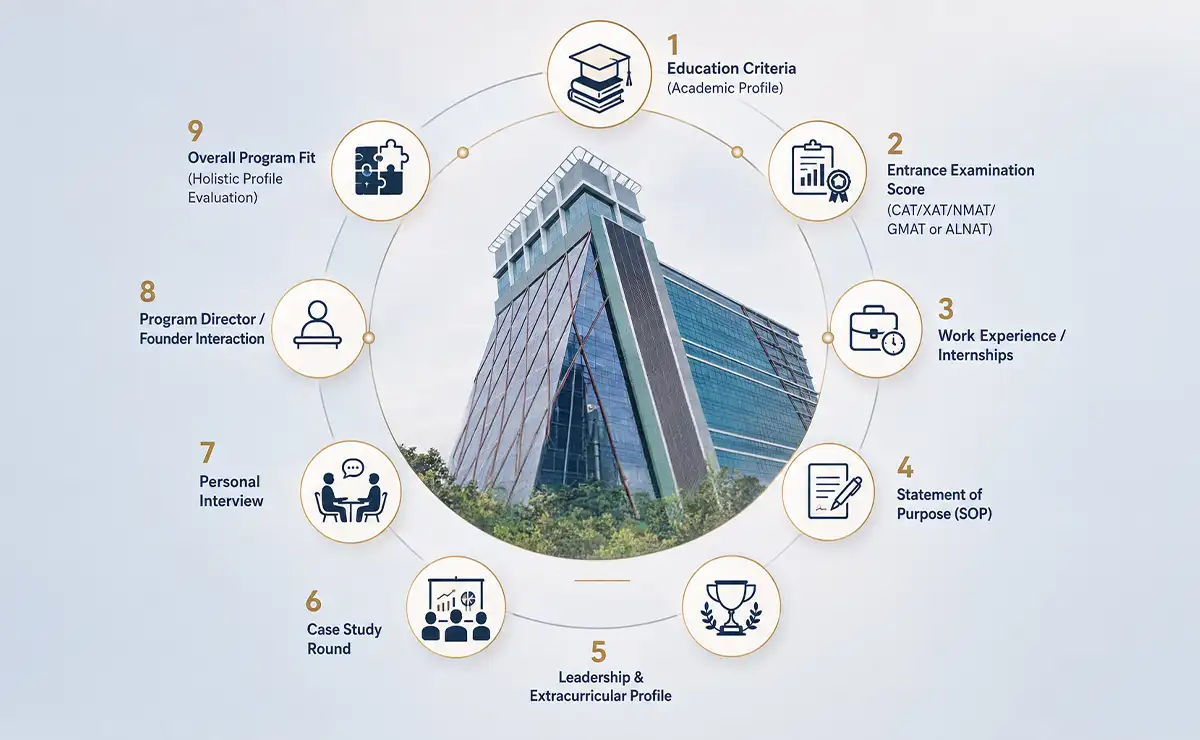
Altera doesn't have a single cut-off admissions system like JEE or NEET exams. It rates all applications on a number of factors and considers your CAT score with your profile strength. This ensures that the students who are short-listed get the most out of the program and are best able to handle its rigorous nature.
The strength of your overall profile is directly related to your academic performance, depth of work or internship experience, leadership experience, extracurricular activities, and how clearly you articulate your career direction in your statement of purpose. Every year, Altera reviews thousands of applications, and these factors significantly influence who is accepted.
The Two-Phase Evaluation Explained
Altera’s evaluation process runs across two phases; each is weighed equally at 50%.
- Phase 1, Pre-Application Profile: Every aspect of your profile is considered before the interview stage, including your academic record, entrance score, work experience or internships, and SOP responses.
- Phase 2, Post-Application Profile: Your performance across the case study round, the personal interview, and the program director interaction.
In some cases, applicants may have similar CAT percentiles and resumes, making them appear fairly similar on paper. That's why the SOP and interview stages are so important, as they serve as real differentiators in such situations, which decide the final decision more often than the score that earns your initial shortlist.
How to Showcase a Stellar Profile If You’re a Fresher?
Work experience isn’t a mandatory criterion for eligibility at Altera Institute, making it one of the few 1-year PGP institutes in India that is open to both freshers and working professionals.
For such candidates, internship depth, extracurricular performance, and other relevant achievements help them demonstrate program fit. For instance, owning a project end-to-end, being responsible for improving a specific metric, or taking on responsibilities outside your defined role reads as far stronger evidence than simply listing the job or internship’s duration or title.
What Happens After Your CAT Score Gets You Shortlisted?
Once your CAT score has earned you a shortlist, its job is essentially done. What decides the outcome from here is your SOP, your case study performance, and two rounds of interviews.
The SOP: Three Questions That Carry Real Weight
Altera Institute's application form is divided into three questions that test each aspect of your preparedness.
- What is your career ambition? Choose up to three motivations, such as brand strategy, entrepreneurship, consulting, analytics, or leadership. Pick the ones that genuinely match your past experience, not the ones that sound most impressive.
- What is the superpower that sets you apart? Instead of using abstract skills such as “communication” or “leadership,” use specific, concrete skills. Using the STAR method of framing (Situation, Task, Action, Result) will help you support the claims you make with actual evidence.
- Where do you see yourself in five years, and how does Altera get you there? Any vision, including a role-based, sector-based, or entrepreneurial vision, is acceptable as long as it is supported by credible arguments grounded in the program curriculum and program outcomes.
Every claim in your SOP needs a specific example to back it up. It isn’t a test of your English; it’s a window into how self-aware and prepared you are for the 15-month program built around current, digital, and AI-first marketing problems.
The Case Study Round
From here, shortlisted candidates move on to a case interview round, a format also used at SPJIMR but still uncommon at most Indian B-schools. It runs 30 to 40 minutes: roughly 10 minutes to read a short, one-to-two-page business case, followed by a discussion of your recommendations while the interviewer questions your reasoning along the way.
Past cases have included building a premium subscription strategy for BookMyShow against new competition from Zomato’s District app and defending Coca-Cola’s rural market share against a low-cost challenger brand called “Thirsty.” Neither requires prior industry knowledge.
What’s actually being tested here is whether you can reason through an unfamiliar problem in a structured way and land on a recommendation through analysis rather than a guess. A few habits consistently work against candidates in this round:
- Treating it like a viva rather than a discussion
- Focusing too heavily on the final answer instead of the reasoning behind it
- Failing to explain your thought process out loud
- Staying passive instead of asking the panel questions of your own
The Personal Interview and Program Director Round

This process culminates in a personal interview, normally with a member of the founding team, held in person at 5 locations across India - Campus in Gurugram, Kolkata, Bengaluru, Ahmedabad, and Mumbai. You’ll talk about your experiences, the obstacles you've overcome, and your goals.
These rounds are more about consistency than novelty; adding a story that goes against your SOP at this stage can only add to more questions. A last interaction with the Program Director occurs to confirm your suitability and readiness for the program.
Candidates then receive one of three outcomes: Accepted, Waitlisted, or Rejected. Those who receive an offer confirm their seat by paying the admission fee within the specified deadline.
Summing Up
No single CAT cutoff number decides admission at Altera Institute. A 90th percentile gets you an interview call, but what happens across your SOP, the case round, and your interaction in the interview process decides your final conversion.
In the PGP in Applied Marketing, the most visible indicator of what we are optimizing is program-profile fit rather than percentile. At Altera Institute, program-profile fit is more important than percentile. In the end, candidates who show curiosity, a practical approach, and a clear understanding of what they want to say in their answers rather than just memorising them will outperform the ones who have memorized the answers.
For a CAT-appearing applicant, this significantly affects how you should allocate your prep time across what aspects. Clearing the safe score in CAT still matters significantly, but so does your focus on improving other aspects of your profile mentioned in this article.