How Does Altera Institute Manage to Teach in 1 Year What Traditional MBA Programs Teach in 2 Years?
Globally, the 2-year MBA format receives far more applications and shows strong year-over-year volume growth, driven mainly by its traditional structure and internship opportunities. But the 1-year format has also surged in popularity recently among mid-career candidates.
That is why, when asked how long an MBA takes, the answer is usually two years. And when a program claims comparable career outcomes in 1 year, the first instinct students have is to ask what got left out. For them, it is important to first understand the structural differences between the 2 formats.
Most 1-year MBAs in India are executive-style general management programs catering to mid-career professionals. They assume students already have foundational business knowledge and therefore focus heavily on high-level application and strategy or functional depth in specific domains.
The same argument, however, isn’t true for Altera Institute's 15-month PGP in Applied Marketing. Its shorter timeline isn't a faster or compressed alternative to the same generalist syllabus. Rather, it is one of the few B-schools in India that caters to both freshers and working professionals seeking careers specifically in digital and AI-first marketing roles relevant and in high demand today.
Marketing careers today are different from what they used to be. Roles like growth marketing, eCommerce, performance marketing, and brand and CRM are specialist in nature and don't require the same breadth as a generalist MBA. They require depth in execution skills, analytical data tools, platform-specific mechanics, AI implementation, and rapid experimentation frameworks from day one.
That distinction is why a focused 15-month program can match a traditional 2-year MBA. Here's how Altera Institute has actually built it.
A Specialist Curriculum Needs Less Time Than a Generalist One
A traditional two-year MBA provides broad general management knowledge and skills across finance, operations, marketing, and strategy. Such professionals can therefore move across departments over a long corporate career, providing real value to their target aspirant profile. It's also what stretches a curriculum to 24 months.
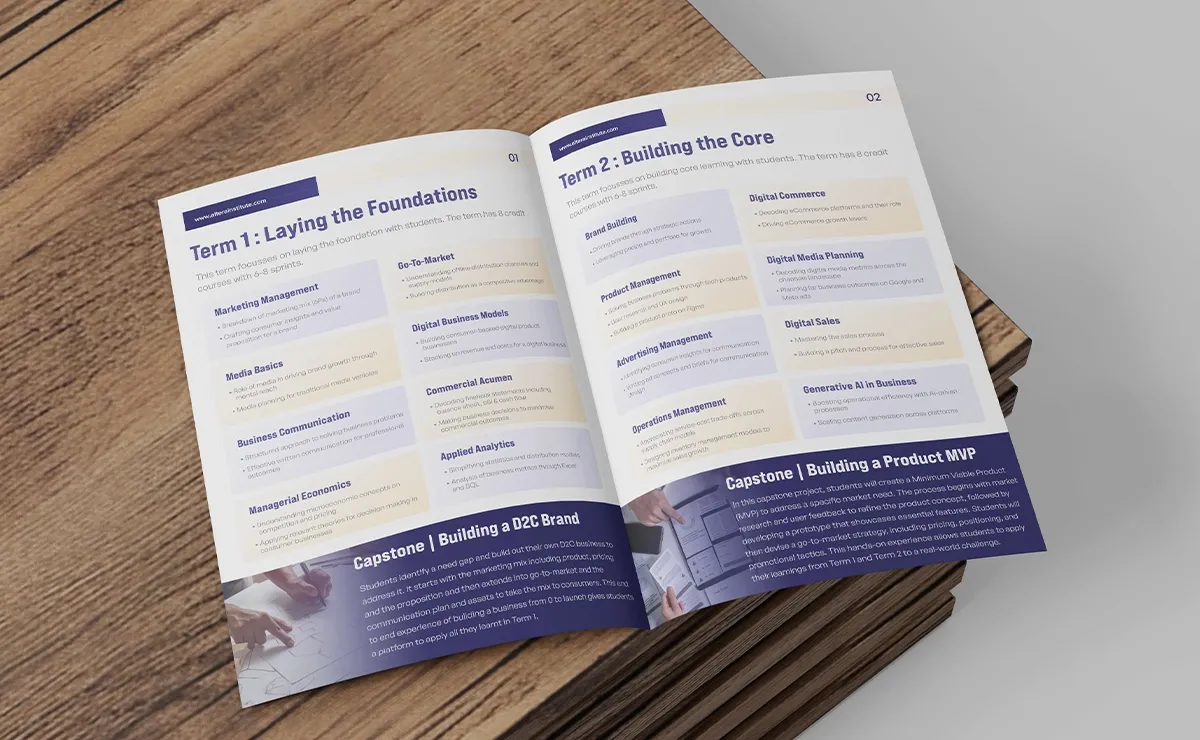
Altera Institute's PGP in Applied Marketing doesn't attempt that breadth, and that's largely why it doesn't need two years. Across each of its four terms, there are eight credit courses in the first two and six credit courses in the last two, all of which are marketing-to-growth focused:
- Term 1: Marketing Management, Go-To-Market, Advertising Management, and Media Basics, backed by the analytical foundations of Business Finance, Managerial Economics, and Applied Analytics
- Term 2: Digital Commerce, Digital Media Planning, and Brand Building, with Supply Chain Management and Organized Trade taught as commercial inputs
- Term 3: Growth Marketing, Category Management, and Generative AI in Business
- Term 4: Retention Marketing, B2B Marketing, and Business Strategy
Even the courses that sound generalist on paper—Business Finance, Managerial Economics, Macro Economics, and Supply Chain Management—are taught as inputs into commercial and marketing decisions rather than standalone functional modules.
For instance, a category management course doesn't teach retail operations in the abstract. It teaches how to read a retailer's P&L and use it to negotiate shelf space.
That's the real difference between a curriculum built industry backwards and one built function first. One starts from the roles companies are hiring for and works back to what needs to be taught. The other starts with a map of business functions and tries to cover it all.
Additionally, the specialist PGP model at Altera Institute doesn't trade rigor for speed. It just spends that time and rigor on a wide spectrum of modern marketing skills instead of stretching across other separate functions like HR or operations.
This design also means Altera Institute isn't built for students who want to keep options open across finance, operations, and other general management functions.
It's built for students who already know they want a career in modern marketing, digital business, or AI-first roles and that clarity matters a lot for aspirants before applying to Altera Institute.
A Calendar Designed Around Intensity, Not Duration
Altera Institute's 15-month PGP operates as a single, continuous, full-time residential calendar that skips the summer internship prevalent in traditional MBA formats.
It combines 28 standard credit courses over four terms with more than 20 practical "sprints." Run by senior industry experts, these sprints also include 4- to 8-hour intensive mentor sessions that teach critical skills that don't fit into traditional, semester-long courses.
Overall, the program includes 1,200+ hours of classroom sessions, case studies, live projects, workshops, business simulations, and industry interaction, bringing students into contact with more than 200 industry professionals over 15 months.
Hence, the program is designed around intensity and rigor that prepares students for the day-one execution required in specialized marketing roles, bypassing the high-level generalizations of a standard business degree.
Practical Application Runs Parallel to Instruction
In a traditional two-year MBA, theory and practice usually run one after another: coursework in year one, an internship over the summer, then more coursework and a job search in year two.
Altera Institute's structure instead runs these two tracks side by side. Every term ends with a practical project that produces a real deliverable, not a classroom exercise.
- Term 1: Students go on field and distributor visits, gaining hands-on experience and practical insights into real-world operations. By observing industry processes and interacting with professionals, students can better connect theory to practice.
- Term 2: Students are working directly with a founder or CXO on a live, unresolved business problem, and placements are already underway.
- Term 3: Students build a D2C brand from scratch, covering positioning, pricing, and communication, and get direct feedback on the choices they made rather than a percentage score. They also build a product MVP and go-to-market plan and present it to industry leaders.
- Term 4: Students visit additional industry sites and gain firsthand exposure to real job environments, helping them understand the intricacies of their target roles and strengthen their preparation for successful placements.
That practical application of concepts after every term is more crucial than it might seem. The interim placement data for the PGP Class of '26 validates this approach, showing that strong employment outcomes today depend more on real-world execution over theory-heavy education.
- By Month 10 of the 15-month program, Wave 1 had placed 60% of the batch.
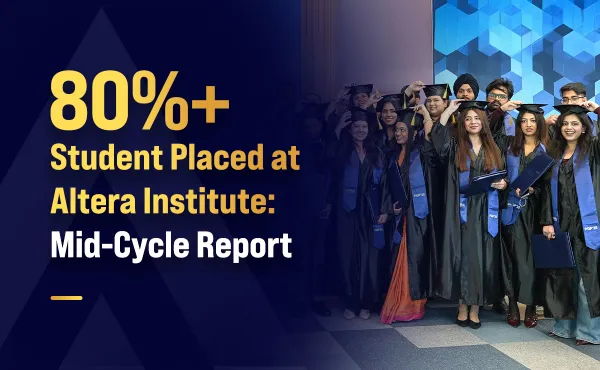
- One month later, in Wave 2, that figure had crossed 80%, even as Term 4 coursework was still underway.
Placement waves at Altera Institute run from Month 10 through Month 15, the final month of the program, with 12 of those 15 months spent on campus. Among students placed so far, the highest package is ₹32.5 LPA, and the median and average salary is ₹17.4 LPA.
Performance strengthens further up the batch too. The top 25% and 50% of students placed have secured salaries averaging ₹23.0 LPA and ₹20.7 LPA, respectively. Moreover, students placed so far are earning 3.7 times their pre-PGP salaries, a figure that matters more to working professionals than any single headline number.
Students aren't waiting until graduation to start looking for a role. The final stretch of academic work and the placement process run at the same time, which is a large part of why the program is shorter, without the runway to a job getting shorter too.
Faculty of Industry Mentors Over Pure Academicians
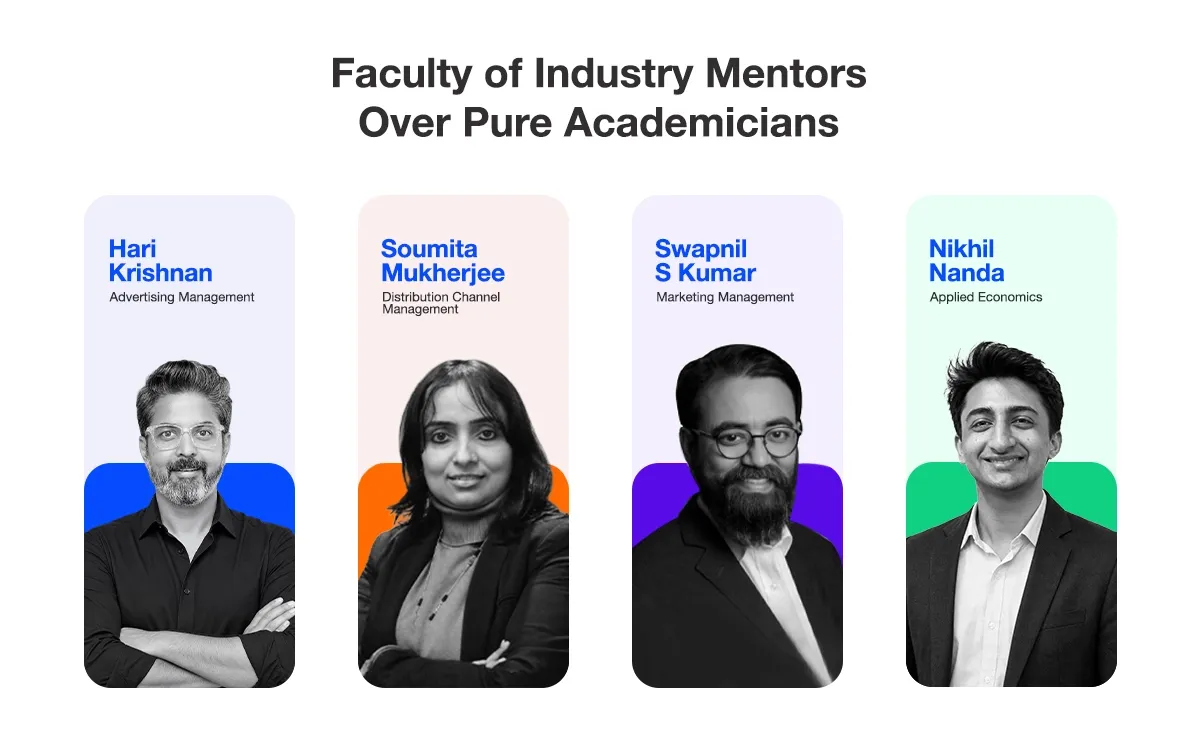
A traditional two-year MBA in India typically draws its core faculty from career academics and researchers who study business rather than practitioners running it day to day. That's a legitimate model, but it often leaves gaps in translating theory into current practice for students.
Altera Institute's faculty and mentor pool therefore works the other way around, built on two layers of practitioners:
- Founding leadership from Bain & Company, Hindustan Unilever Limited, Goldman Sachs, Haleon, and EY Parthenon, who shaped the program itself
- Sprint mentors from companies including Netflix, Microsoft, Pernod Ricard, Royal Enfield, and Whiteboard Capital, who run the 20-plus expert sessions, on top of one-on-one mentorship for every single student
The people teaching are also the people doing the job right now. That leaves little legacy content on the syllabus to unlearn later.
This real-time relevance is further proven by a second, less obvious factor. More than 40 companies, including Amazon, Hindustan Unilever Limited, ITC, and Nestlé, use Altera Institute's own programs to upskill their existing employees, over 6,000 of them to date. The Institute is also a formal knowledge partner to both Amazon and HUL in India.
Because legacy companies trust Altera Institute to train their own workforce, that is a true mark of a curriculum being validated as current and relevant. This corporate investment ensures learners skip outdated concepts and focus immediately on practical, high-impact skills. Put side by side, the differences across all four dimensions look like this:
So, Is 15 Months Enough Time?
Altera Institute's 15-month PGP program is highly rigorous, and this format isn't the right fit for every student weighing an MBA. But the assumption most people bring to it by default, that a shorter program must be doing less, doesn't hold up against how this program was actually built.
Its targeted specialization in marketing alone eliminates irrelevant sections of a traditional syllabus, while the continuous calendar cuts out the downtime that longer programs have to maintain.
Live projects and a placement timeline mean students apply what they learn throughout the program, not just at the end. A faculty of current practitioners means graduates arrive at their first job with the right skills and already speak the industry's language recruiters pay a premium for.
The Interim Placement Report for the Class of '26 is early evidence of what this adds up to. Over 90% of students placed so far have landed digital & AI-first roles, with an average jump of 3.7X over pre-program compensation.
For a student weighing a specialist, one-year format against a traditional two-year MBA, the more useful question isn't whether 15 months is enough time. It's whether that time is spent on the career they actually want.