
80%+ Students Placed at Altera Institute: Mid-Cycle Report

Altera Institute’s PGP Class of ‘26 has crossed a milestone; few Indian B-schools even attempt to report mid-cycle. More than 80% of the batch has been placed, according to the Wave 2 update of its Interim Placement Report. Most institutes wait until the entire placement season closes before sharing the numbers, but Altera Institute has decided to provide periodic placement updates this year so students aren't left guessing until the final report comes in.
Across India’s 5,500+ B-schools, fewer than 50 get their placement data audited by an external firm. Fewer than 10 of those follow the Indian Placement Reporting Standard (IPRS), the same framework IIM Ahmedabad uses to report its own numbers. That puts Altera Institute in a small group of IPRS-compliant colleges, representing only about 0.2% of all B-schools in the country.
Altera Institute's interim placement report is audited by B2K Analytics, which is responsible for the placement disclosures at IIM Ahmedabad, and complies with the IPRS guidelines. Here's what that audit reviews: what students are getting, who's employing them, and what the final report will look like when the cycle is completed.
The Credibility Behind the Number
An audit by itself doesn’t guarantee an honest placement report. The word “audited” can still misrepresent the ground realities of placements; for instance, a four-year ESOP grant can be presented to the student as if the entire amount were earned in year one. This is why IPRS is important to bridge this transparency gap.
Under IPRS, fixed pay must be disclosed separately from variable pay, and domestic offers separately from international ones. Stock options count only to the extent they vest within the first year, and multi-year packages are broken apart rather than added together into a single headline figure. The report even defines its own headline number precisely: “Annual Salary” means the Maximum Earning Potential, or MEP, for year one of employment only.
B2K Analytics, formerly known as Brickworks Analytics, has audited and signed off on Altera Institute’s interim report. Seven students in the batch were offered ESOPs. Where a recruiter hadn’t disclosed a vesting schedule, B2K assumed only 25% vested in year one, a conservative default rather than a generous one, and excluded long-term components like ESOPs vesting beyond year one and retention bonuses entirely.
A working example illustrates the importance of detail and transparency. Take an offer of ₹13.4 LPA fixed pay, ₹2.4 LPA variable pay, and ₹20 lakh total ESOPs, which would vest over four years with 10% released in the first year:
- Ignore vesting entirely, and the package reads as ₹35.8 LPA.
- Apply a generic 25% vesting assumption instead of the real schedule, and it reads as ₹20.8 LPA.
- Apply the actual disclosed schedule as dictated by IPRS; it reads ₹17.8 LPA.
Only that last figure (₹17.8 LPA) reflects what a student is actually guaranteed in year one. The gap between the two extremes amounts to nearly ₹18 lakh for a single package, which is why IPRS matters.
The same discipline applies across the batch, not just in a single illustrative case. Guaranteed cash makes up 86% of the average reported salary, variable pay accounts for 13%, and first-year ESOPs make up the remaining 1%. None of it is padded with stock a student hasn’t actually earned yet.
Inside the 80%+ Number: What Students Are Earning
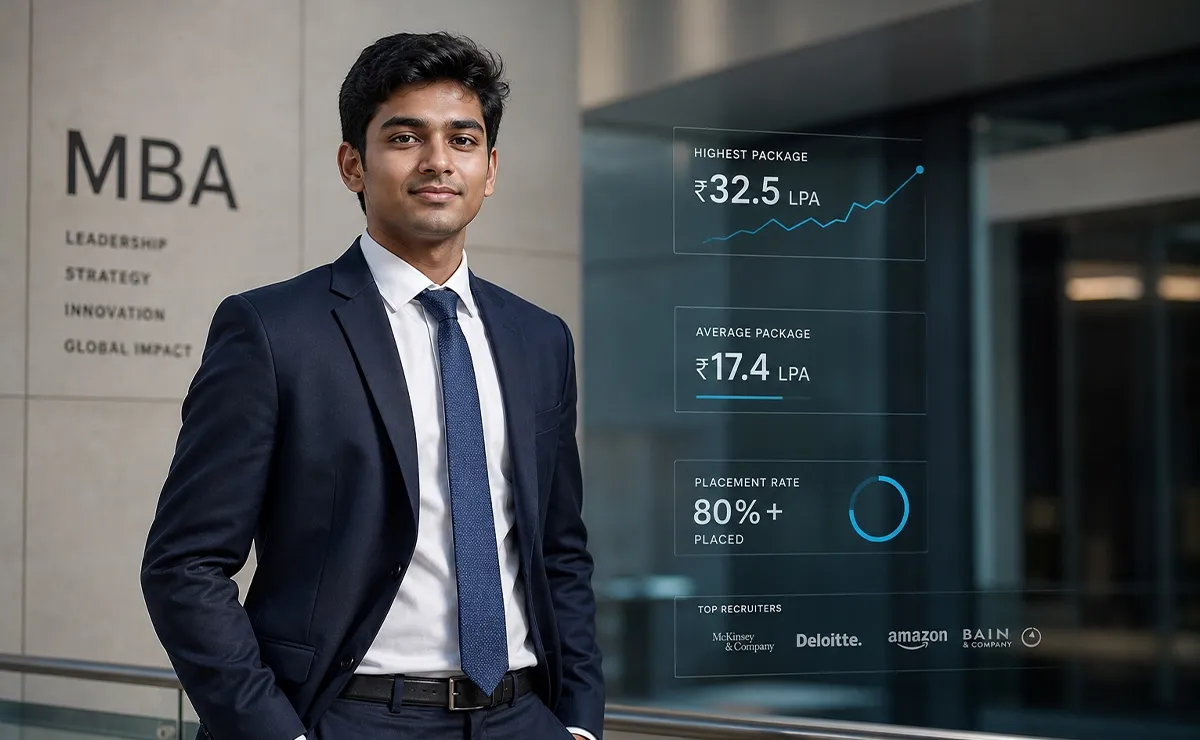
Altera Institute runs a 15-month PGP, with the first 12 months spent on campus. Placements happen across four waves starting in month 10 and running through month 15. Wave 1 closed with 60% of the batch placed. This article covers up to Wave 2, by which 80% of the students are placed, making Altera Institute one of the first B-schools in India to publish a placement update mid-process rather than wait for the cycle to close.
Among students placed so far, the highest package is ₹32.5 LPA. The median salary is ₹17.4 LPA, and so is the average. When median and average land on the same number, it usually means the outcome isn’t being pulled up by a handful of outlier offers, which is worth noting given how often B-school averages get skewed by a few high-paying exceptions at the top.
Performance strengthens further up the batch too. The top 25% and 50% of students placed have secured salaries averaging ₹23.0 LPA and ₹20.7 LPA, respectively. Moreover, students placed so far are earning 3.7 times their pre-PGP salaries, a figure that matters more to working professionals than any single headline number.
This consistency is evident across the cohort:
- 12% of placed students earned ₹10–12 LPA
- 13% earned ₹12–15 LPA
- 48% earned ₹15–20 LPA
- 21% earned ₹20–25 LPA
- 6% earned ₹25 LPA and above
Put together, 75% of students placed so far have secured ₹15 LPA, which the report treats as the baseline outcome a typical PGP aspirant should expect from the program.
Who’s Hiring from Altera Institute’s Class of ‘26
Shifting from the headline salaries, let's look at where students are actually being placed. Over 90% of placed students landed digital or AI-first roles, not the traditional ITES, BFSI, or field-sales jobs that traditional B-schools still funnel most graduates into. Roles span six functions: growth marketing, strategy, product and analytics, brand management, revenue, and FMCG sales.
The sector-wise placements are as follows:
- Over 50% of placed students are now working in eCommerce, including marketplace, D2C, and category strategy.
- Another 20% went into the Founder's Office, EIR, or strategy positions, working directly with leadership on early-stage decisions.
- The remaining 10% landed specialist AI roles.
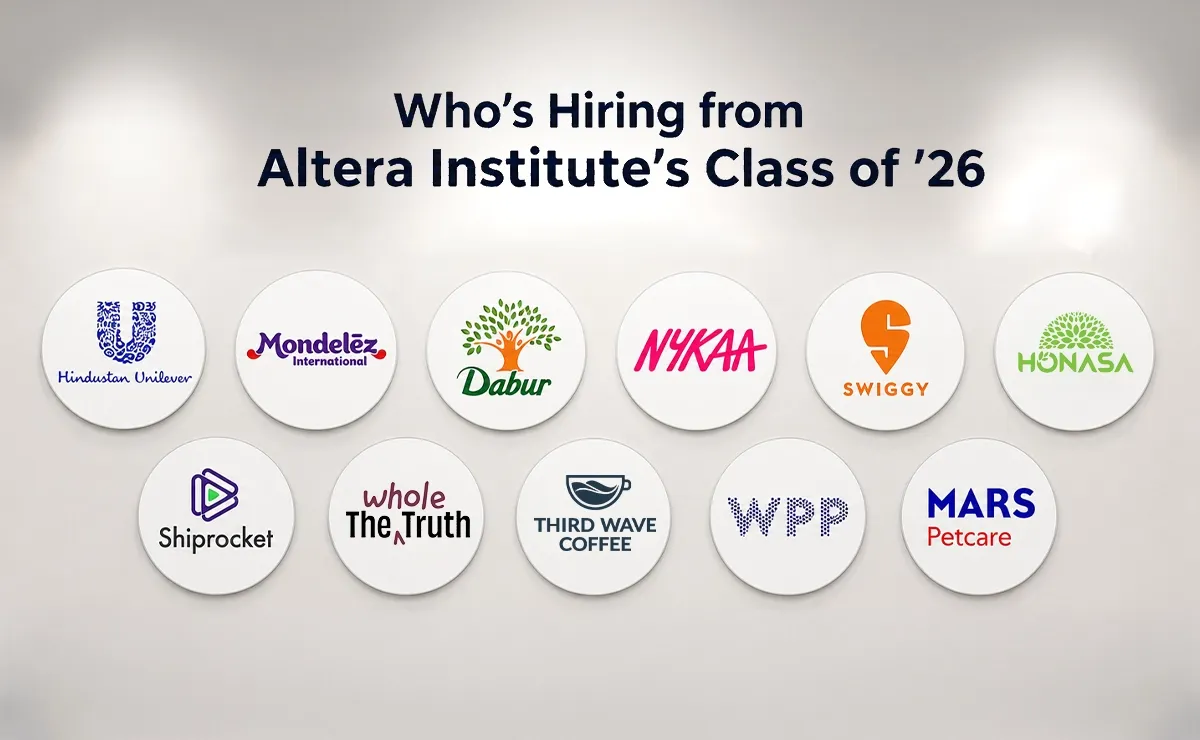
Over half of the placed batch joined MNCs or listed companies, and for the first time, a student secured a placement at a venture capital firm, a segment that rarely hires MBA freshers straight out of a program. The recruiter list grew by 40+ new companies this year, including Hindustan Unilever, Mondelez International, Dabur, Nykaa, Swiggy, Honasa, Shiprocket, The Whole Truth, Third Wave Coffee, WPP, and Mars Petcare.
It’s a fair question to ask why companies this established would hire from a B-school under five years old when they could recruit from any Tier-1 institute instead. Part of the answer lies outside the placement process entirely. Over 40 organizations, including Amazon, HUL, ITC, and Nestlé, already use Altera Institute’s programs to upskill more than 6,000 of their own employees, and the institute itself was founded by former HUL leaders. For a recruiter, that’s a track record they can check right from the outset, and it is also part of why Altera Institute decided to publish an interim placement report mid-cycle.
What the Final Report Will Likely Show
An interim report is, by definition, incomplete. Roughly 20% of the batch is still to be placed, and the way those remaining offers land will shift both the median and the average before the cycle closes for the year.
Altera Institute’s own forecast for the final numbers is actually more conservative than the current interim figures:
- Forecasted median salary: ₹16.7–17.1 LPA
- Forecasted average salary: ₹16.5–16.8 LPA
- Forecasted average, top 25%: ₹22.1 LPA
- Forecasted average, top 50%: ₹20.0 LPA
- Forecasted share placed above ₹15 LPA: 66%+
These numbers are worth treating as a baseline rather than a ceiling. Last year, Altera Institute’s actual final numbers came in higher than its interim report had predicted at a similar stage, which is why, this year as well, the forecasts are conservative by design. The complete, IPRS-audited final report for the Class of ‘26 is expected by October 2026.
An interim report can’t tell the whole story of a batch that hasn’t finished placing yet. But most B-schools in India don’t disclose this much detail even after their placement cycle is fully closed. For anyone comparing programs, the real test isn’t whose headline number looks best. It’s whether the B-school will show you how that number was actually calculated before you commit two years and a meaningful share of your resources to it.