Altera Institute Admission Process (CAT / GMAT / NMAT 2026 Decoded)

As professionals seeking better career advancement alternatives, the 1-year MBA and PGP programs are gaining attention for all the right reasons. The shift is largely driven by their shorter duration, faster career growth, and reduced opportunity costs as compared to a traditional MBA.
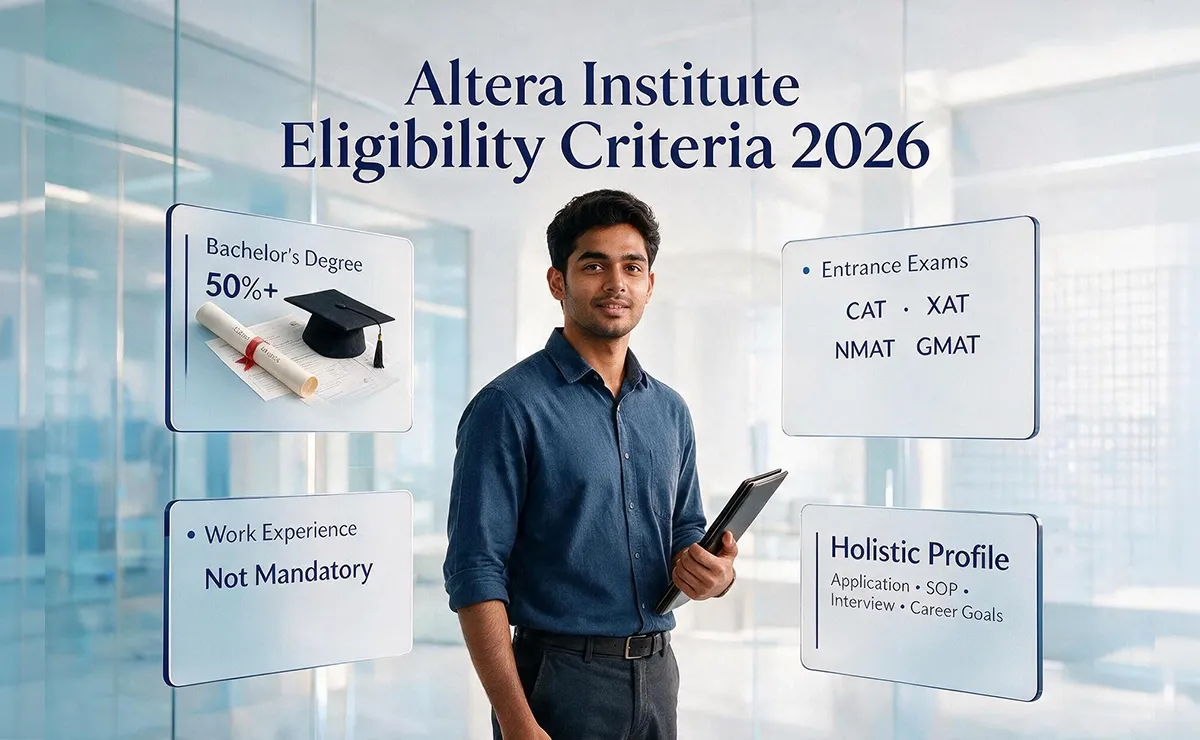
This is where Altera Institute is gaining attention for its industry-driven approach to management education with its 15-month PGP in Applied Marketing. For aspirants planning admissions, the institute accepts the following exam results:
- CAT—Around the 90th percentile
- XAT—Around the 90th percentile
- NMAT—Around 230
- GMAT FE—Around 625
Unlike traditional MBA colleges that often focus heavily on theoretical learning and generalized management education, Altera Institute is built around real-world business functions. From marketing, product, growth, and digital strategy, it prepares its students for AI-first and technology-led job roles. Its shorter format also means lower opportunity costs and faster entry into the workforce.
The institute is open to freshers seeking higher management education, experienced professionals seeking accelerated career growth, and candidates who want to pivot into high-growth domains in digital-first industries. To create a holistic learning environment and credible selection process, the institute backs its placement outcomes with IPRS-compliant reports, a founders-led selection process, and holistic, real-world evaluation.
Why Consider the Altera Institute for a 1-Year MBA in 2026?
For MBA aspirants in 2026, the bigger question is not whether to pursue a shorter management program. Rather, it is finding an institute that offers the strongest balance of learning, hiring alignment, and career acceleration. This is where Altera Institute has emerged as a strong choice.
While B-schools like the Great Lakes Institute of Management in Chennai and the Indian School of Business in Hyderabad bring a strong brand reputation, Altera Institute focuses on specialized, hands-on learning. Here are some other factors that make it stand apart from other 1-year MBA and PGP programs.
Industry-Focused Curriculum vs. Theoretical MBA
Unlike traditional MBA programs that often prioritize broad management theory, Altera Institute takes a more industry-focused approach to learning. The curriculum is designed around real business functions such as marketing, growth, product, and digital strategy. The aim is to help students build practical, job-ready skills.
Rather than limiting learning to classroom concepts and case studies, Altera emphasizes hands-on problem-solving and business application, making it particularly relevant for candidates targeting modern, fast-evolving industries.
Faster ROI with 1-Year Format
For many MBA aspirants, return on investment is a major consideration. Altera Institute’s one-year format helps reduce both time and opportunity cost. Instead of spending 2 years away from the workforce, students can complete the program and transition into relevant roles more quickly.
This shorter duration, combined with industry-aligned learning and placement support, can help students accelerate their career growth and pivot to roles of their choice. It is particularly more advantageous for freshers who do not wish to spend an extra year building theoretical knowledge.
Founder-Led Admissions & Mentorship
Another differentiating factor at Altera Institute is its founder-led admissions and mentorship approach. Instead of relying solely on entrance scores, the founding team conducts personal interviews to assess a candidate’s fit, career intent, and potential for growth.
Beyond admissions, students also gain exposure to practical industry insights through sessions led by founders of reputed brands and experienced professionals. Through workshops, classes, and real-world discussions, these industry leaders bring hands-on knowledge into the learning experience, helping students better understand how business challenges are solved in practice.
Altera Institute Eligibility Criteria 2026
Accepted Entrance Exams & Cut-Offs (CAT / XAT / NMAT / GMAT)
Altera Institute accepts scores of four major competitive exams to extend an interview invitation. It includes XAT, CAT, GMAT, and NMAT. Here is an overview of competitive cut-offs that make your profile competitive in the selection process.
However, the students must note that these cutoffs are qualifying and not eliminating. That means meeting the expected cut-off can only take you to the interview round but won’t guarantee a seat. The final selection will always be based on your overall performance during the admission process and profile evaluation.
Much like established management institutes such as Great Lakes, IMT, and ISB, entrance scores remain an important part of the evaluation process at Altera Institute. However, they serve more as an eligibility benchmark than as the sole deciding factor.
Interested candidates can initiate their application by filling out the admission form and paying an application fee of ₹1,999.
In case you have not appeared for any competitive entrance exam, you can still stand a chance by opting for the Altera National Aptitude Test (ALNAT). It is a two-hour online exam that evaluates your quantitative acumen, critical reasoning, comprehension skills, and profile presentation. However, you must note that opting for ALNAT doesn’t directly give you an attempt. Only shortlisted candidates after an application review are invited to take the test.
Altera Institute Admission Process
Here is an overview of the admission process for the 2026-27 batch at Altera Institute.
Step 1: Application Form Submission
Open the application form on the institute's official website and sign up using your details. The form is divided into four sections, comprising your personal information, education details, work experience, and career objectives. Once you fill out the form, you can submit it with a non-refundable application fee of ₹1,999.
You can also use the institute’s call predictor tool to assess your fitment and predict the chances of receiving a call for the interview. However, it only indicates the possibility of the call and doesn’t guarantee it.
Step 2: In-Person Interview
Altera Institute conducts interviews with shortlisted candidates on campus in Gurugram and in Kolkata, Bengaluru, Ahmedabad, and Mumbai. This round is segregated into two segments, i.e., the case study round and a personal interview with a director.
For the case study, candidates are provided with a short business case study with data and prompts, which forms the basis of an in-depth discussion and problem-solving exercise. Later on, they meet a member of the founding team for a personal interaction focused on behavioral fit and career intent, discussing their experiences, interests, and long-term goals.
Step 3: Final Selection & Offer Rollout
After the evaluation process, applicants receive one of three admission decisions: Accepted, Waitlisted, or Rejected. It can be tracked through the Application Form section on the website.
Candidates who receive an admission offer for the PGP in Applied Marketing at Altera Institute must confirm their seat by paying the admission fee of ₹100,000 within the specified deadline. The seat is considered reserved only after the fee payment is successfully completed.
Altera Interview Process Breakdown (Real Candidate Experience)
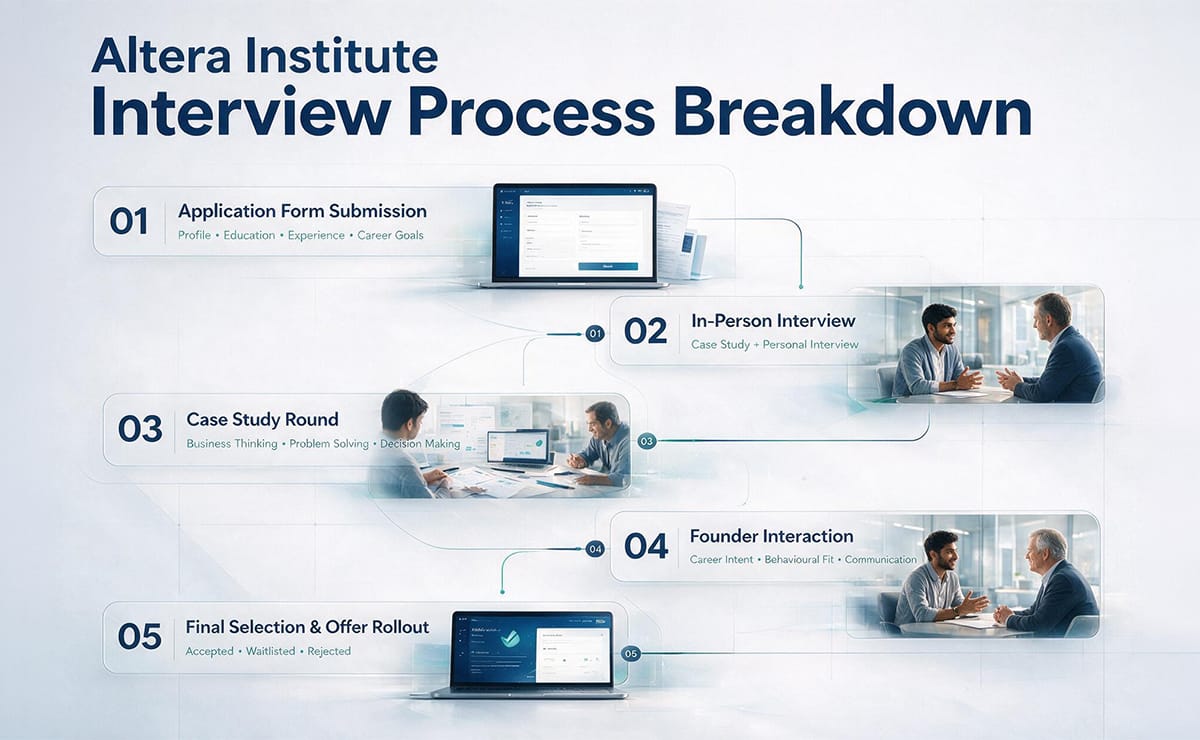
The weightage of a candidate’s profile is divided equally between pre- and post-application. The key areas considered during the pre-application include your educational background, work experience, resume, and SOP (provided in the application form). The remaining 50% weightage is given to your performance during the case study and interview rounds, making them a crucial part of the selection process. Here is an overview of what you can expect there.
Case Study Round: What to Expect
The case study round is designed to evaluate an applicant’s business acumen, problem-solving, critical thinking, and decision-making skills in tough situations. It helps the panel assess your potential for future managerial, marketing, and leadership roles and how well you can perform under pressure.
The round is conducted in person with one of the institute's mentors and generally lasts 30 minutes. You will be given a fictional business scenario along with relevant data. Based on the given information, you will be expected to analyze the data and answer a few questions related to strategy, pricing, marketing, etc.
You can refer to the admission page of the institute to find sample case studies from previous admission rounds.
Founder Interaction: Questions & Evaluation Style
The direct interview with the panel is the final round of the selection process and plays a crucial role in assessing your fit for the program. It ensures there is no mismatch in expectations and that your profile and career intent align with the program’s outcomes. It also helps the panel gauge other soft skills, such as communication, presence of mind, and articulation.
Here are some example questions that you can expect during the interview.
Typical Interview Questions Asked During Altera Admissions and How To Answer Them
The interview questions are generally a mix of profile-related, critical-thinking, marketing-specific, and decision-making questions.
Q1. Tell us about yourself.
How to answer: Instead of spending too much time on reiterating details from your application form and resume, talk about something that is truly unique to you. Start with the basic details and then pivot to talking about your hobby, career motivations, and important but relevant aspects of your personal life that can eventually be connected to your desire to pursue Altera’s PGP.
Q2. Why a PGP and Why Now?
How to answer: Interviewers generally ask this question to assess the clarity of your career goals and how a PGP fits into that picture. Your answer should not be overly zealous, as it may reflect unawareness, and it should also not be too modest. You must strike a balance by explaining how a PGP aligns with your career goals, demonstrating that you have a realistic understanding of the investment you are about to make.
Q3. Why Altera Institute and not a traditional B-school?
How to answer: Any past research about Altera’s PGP in applied marketing will play a crucial role in answering this question. Instead of talking about course affordability and placement results, talk about the skills you wish to develop through the program. Mention the specific classes, clubs, and mentors at the institute and explain how they align with your career goals. A well-researched and thoughtful answer shows that you have done your homework and possess relevant clarity about your career goals.
Q4. Describe a challenging situation at work and how you handled it.
How to answer: Interviewers usually ask this question to assess your problem-solving ability, ownership, teamwork, and how you respond under pressure. Choose a real example where you faced ambiguity, conflict, tight deadlines, or setbacks, and focus on the actions you took to resolve the situation. Keep your answer structured by briefly explaining the challenge, your approach, and the outcome or learning. Avoid examples where you were overly dependent or blamed another colleague.
Q5. How would you rate your critical thinking ability on a scale of 1 to 10?
How to answer: This question is often asked to assess self-awareness and how realistically you evaluate your strengths and limitations. Avoid choosing extremes like 10/10, as it may come across as overconfident, or a very low score that undermines your credibility. Pick a balanced rating and support it with a practical example of how you approach decisions, solve problems, or evaluate situations logically, while also acknowledging areas where you are still improving.
Q6. If you were leading the marketing vertical of a biscuit manufacturer, how would you differentiate your product from competitors?
How to answer: This question is designed to assess your business thinking, creativity, and ability to approach problems with structure. Instead of jumping to an answer immediately, start by identifying the target audience, market gap, and competitor positioning before suggesting ideas. Think beyond advertising alone and consider factors such as product innovation, packaging, pricing, distribution, or brand messaging to demonstrate a more holistic marketing perspective.
Q7. Where do you see yourself in the next 5, 10, or 20 years after the program?
How to answer: This question is less about predicting the future and more about understanding whether you have clarity and ambition. A strong response usually shows a logical progression. Start with where you see yourself immediately after the program, how you plan to grow over the next few years, and the larger impact or leadership role you aspire to in the long term. While it is good to be aspirational, avoid unrealistic answers that lack a practical path.
Q8. How do you see your industry transitioning in the next decade? Describe three major changes you predict.
How to answer: These questions aim to assess your industry awareness, curiosity, and ability to think beyond day-to-day work. Before the interview, spend time understanding key trends shaping your industry, such as technology, consumer behavior, regulations, or business models. Instead of listing generic predictions, explain why you expect these changes and how they may impact businesses, jobs, or customers in the long run.
For example, someone with a banking background could talk about how AI may improve fraud detection and credit decisions, how digital banking could reduce branch dependence, and how fintech partnerships may change customer expectations around speed and convenience.
Q9. How would you increase demand for a declining product?
How to answer: Interviewers often ask this question to evaluate your problem-solving and strategic thinking skills. Instead of suggesting solutions immediately, begin by identifying why demand is declining. If the cause is pricing, competition, changing consumer behavior, poor positioning, or product relevance. A structured answer that combines diagnosis with practical solutions such as repositioning, product improvements, new customer segments, or marketing changes will reflect stronger business thinking.
Q10. Explain a concept from your field in business terms.
How to answer: This question is meant to assess how clearly you understand your own domain and whether you can simplify complex ideas for non-experts. Instead of talking about something overly complicated that can cause confusion, pick a concept that is easier to explain and that you understand well. Focus on explaining the concept in simple, outcome-driven terms by connecting it to business impact, efficiency, customer value, cost, or profitability, as appropriate.
For example, if you are from an agricultural background, you can explain yield and its impact on profitability and pricing.
Q11. What’s happening in global markets that affects businesses today?
How to answer: This question is asked to assess your business awareness and how closely you follow current affairs beyond your immediate role. Instead of mentioning too many disconnected headlines, focus on 2–3 major developments and explain their business impact. Think about areas such as inflation, AI adoption, supply chain shifts, geopolitical tensions, interest rates, or changing consumer demand, and connect them to industries or companies where relevant. A very recent example is the Strait of Hormuz blockade and its impact on raw-material costs, pricing, and supply chains across industries.
Q12. Describe a professional failure and how you overcame it.
How to answer: Your answer to this question will reflect your self-awareness, accountability, and ability to learn from setbacks. Choose a genuine example, but avoid failures that raise concerns about ethics, reliability, or attitude. Spend less time describing the mistake and more time explaining what you learned, what changed in your approach, and how you applied that learning in a later situation.
Q13. Tell me about a decision where you had to choose between ethics and profit.
How to answer: Start with a situation where there was a genuine business trade-off rather than an obvious right-or-wrong answer. Explain the context briefly, the options available, and how you arrived at your decision, while showing balanced thinking instead of moral grandstanding. Through this question, interviewers are often trying to understand how you exercise judgment under pressure and whether you can balance business outcomes with long-term trust and integrity.
Q14. What global business leader do you admire the most and why?
How to answer: Your choice of leader is not as important as the reasoning behind it. Instead of picking a leader simply because they are popular or successful, focus on specific qualities, decisions, or leadership styles you genuinely admire and can connect to your own aspirations. Give a thoughtful answer that explains why their approach resonates with you, as it will reveal far more about your thinking.
Q15. Do you have any questions for me?
How to answer: This question is not just a closing formality but also an opportunity to show your proactiveness. Your answer is often used to assess your curiosity, seriousness, and understanding of the program. Avoid asking questions that are easily available on the website, such as fees or deadlines. Instead, ask thoughtful questions around learning experience, mentorship, industry exposure, career outcomes, or how the program supports students with goals similar to yours.
Key Dates for Altera Admissions 2026
Altera Institute conducts rolling admissions throughout the year with four deadlines. Here is an overview of the same.
Application Round Deadlines & Fees
Interview Timelines
Since admissions at Altera Institute follow a rolling shortlisting process, applications are reviewed continuously rather than after a fixed deadline. As a result, candidates are encouraged to apply early for faster consideration because the seats are limited in each cohort.
While there are no fixed interview dates, shortlisted candidates are invited for in-person interviews conducted across multiple cities, including Bengaluru, Ahmedabad, Gurugram, Mumbai, and Kolkata. The exact interview date, time, and venue details are communicated directly to shortlisted applicants by the admissions team.
Fees, Placements & ROI Analysis
Program Fees
Placement Outcomes
Based on the institute's placement report, its students have achieved an average 3.2x growth as compared to their pre-PGP salaries. With its digital and AI-first learning approach, 89% of students have secured placement in roles like eCommerce growth, founder’s office, product management, brand management, FMCG, sales, etc.
Here are some of the highlights of the placement metrics of their 2025 batch.
- 100% placement rate
- 70% of the batch got placed with packages exceeding 15 LPA.
- Median salary was ₹18.14 LPA
- The average salary was ₹16.85 LPA
- The highest salary was ₹22.5 LPA
- 75% of the cohort joined digital or digitally transforming organizations.
- Leading recruiters include Amazon, Flipkart, Honasa Consumer, HRIPL, Ozone Group, Sleepwell, USV, The Sleep Company, The Solved Skin, The Baker's Dozen, etc.
- Most offers made were in the consumer goods sector.
- The most offered role was in the growth marketing niche.
Additionally, Altera Institute’s placement report is IPRS-compliant and uses the same auditor as IIM Ahmedabad. This reflects the highest standards of reporting and transparency in India, ensuring there are no outcome inflation or misleading claims in the report.
ROI Comparison: Altera Institute’s 1-Year PGP vs. Traditional MBA
When evaluating ROI, the difference between a traditional two-year MBA and a one-year program often comes down to both cost and opportunity loss. Many MBA programs today cost upwards of ₹20 lakh and require students to stay out of the workforce for 2 years. In contrast, Altera Institute’s 15-month PGP allows students to return to the job market faster, potentially accelerating salary recovery and career growth.
Students from the program have secured roles in areas such as growth marketing, brand management, eCommerce growth, and the founder’s office, with many receiving salary packages above ₹15 LPA. Along with strong salary growth compared to their pre-program earnings, this makes Altera Institute a strong option for candidates looking to grow their careers faster without spending two years away from work in a traditional MBA program.
Additionally, when you compare the program fee of ₹16.44 lakhs with the median salary of ₹18.14 LPA, Altera Institute stands out as one of the fastest ROI-focused management programs in the country. Based on placement outcomes, many students may be able to recover significant and even full program costs within the first year of work after completing the PGP, which is a rare outcome in other MBA programs.
How Altera Compares to Other 1-Year MBA Programs
While institutes like ISB, Great Lakes, and SOIL consider competitive entrance scores, academic performance, and work experience during admissions, Altera Institute follows a slightly different approach. Along with CAT, XAT, NMAT, or GMAT scores, applicants go through case-based discussions and founder-led interactions.
The focus is not only on academic merit but also on how candidates think, solve problems, and approach real business situations. This makes the evaluation process more practical and application-driven.
Interview Experience & Candidate Fit
The interview process at many one-year MBA programs often centers around profile validation, career goals, and academic background. At Altera Institute, interviews place additional emphasis on behavioral fit, structured thinking, and business judgment. Through founder interactions and practical discussions, the institute aims to assess whether candidates are aligned with the fast-paced and industry-focused nature of the program.
ROI & Career Acceleration
ROI remains a major factor when comparing one-year MBA programs. While institutes like ISB and Great Lakes offer strong brand recognition, they also come with significantly higher fee commitments. With a program fee of ₹16.44 lakhs and a reported median salary of ₹18.14 LPA, Altera Institute is a strong option for candidates seeking faster career growth and quicker return on investment.
Tips to Crack Altera Institute Admissions
Getting shortlisted for the interview is only the first step. Since Altera Institute’s admission process focuses heavily on practical thinking and candidate fit, your preparation should go beyond standard MBA interview answers. Here are a few tips that can help you approach the process more effectively.
How to Approach the Case Study
The case discussion at Altera Institute is less about finding the perfect answer and more about how you think through a problem. Instead of memorising frameworks, focus on understanding the business context, identifying the core issue, and explaining your reasoning clearly. A structured thought process matters more than complicated jargon.
- Read short business case studies from brands or startups and practice breaking down the problem in simple steps.
- Get comfortable analyzing basic business metrics such as pricing, customer behavior, competition, or growth challenges.
- Practice explaining your thought process aloud instead of only focusing on the final answer.
How to Prepare for Founder Interaction
Founder interactions are designed to understand your intent, motivation, and fit for the program. Be prepared to talk clearly about your career goals, past experiences, and why you want to pursue the PGP at this stage. Rather than rehearsed answers, focus on being thoughtful, self-aware, and honest in your responses.
- Reflect on your career journey and be clear about why you want to pursue an MBA now.
- Research Altera Institute’s program, mentors, and learning approach to explain why it fits your goals.
- Practice speaking confidently about your strengths, failures, and career ambitions without sounding scripted.
What Altera Really Looks For
Beyond scores and credentials, Altera Institute looks for candidates who demonstrate curiosity, practical thinking, and clarity of goals. Strong applicants are usually those who can approach problems logically, communicate ideas simply, and show genuine interest in learning rather than relying on memorized interview answers.
Frequently Asked Questions (FAQs)
Q1. What CAT percentile is required for the Altera Institute?
Ans. The Altera Institute generally considers applicants with a CAT percentile around 90, though the cut-off is qualifying in nature and not the sole basis for selection.
Q2. Does Altera accept NMAT or GMAT scores?
Ans. Yes, Altera Institute accepts NMAT and GMAT Focus Edition (FE) scores, along with CAT and XAT, as part of the admission process.
Q3. Is work experience mandatory?
Ans. No, work experience is not mandatory for admission to Altera Institute’s PGP in Applied Marketing. The program is open to both freshers and experienced professionals looking to accelerate or pivot their careers.
Q4. How difficult is the Altera interview process?
Ans. The Altera interview process is designed to gauge the program fitment, personality, and soft skills of the candidates. It lasts approximately 30 minutes, and the questions can range from individual profile to general awareness, marketing, and more technical aspects, depending on the candidate's profile. Prior research and preparation are crucial to crack it.
Q5. How is the interview process conducted?
Ans. The process typically includes a case discussion followed by a founder interaction, conducted in person across multiple cities for shortlisted candidates.
Q6. What is the ROI of Altera’s 1-year MBA?
Ans. Based on its past placement records, Altera offers a strong ROI. Its successful placement allows most students to recover their entire course fee in less than one year, which is very rarely seen in other MBA programs.
Q7. How is Altera different from Great Lakes or ISB?
Ans. While Great Lakes and ISB follow more traditional MBA structures, Altera Institute places stronger emphasis on practical learning, founder-led evaluation, and real-world business thinking.
Q8. What hostel amenities does Altera provide?
Ans. Altera Institute’s hostel includes 24x7 security, high-speed Wi-Fi, refrigerators, microwaves, water dispensers, a dry pantry, and mess facilities. Students also get access to common spaces like a games room, mini gym, shared lounges, housekeeping, weekly laundry, and shuttle transport to campus.