
Careers in Marketing After MBA: Roles, Salaries & Growth


An MBA in marketing is a lucrative specialization for many MBA aspirants because of its growing demand across business sectors. It sits at the intersection of creativity, analytics, and business strategy, making it one of the most diverse fields in management studies. Not just that, marketing also plays a crucial role in the growth of an organization through brand building, effective business strategies, and problem-solving.
Early-career marketing professionals can expect a starting salary of ₹5-7 LPA. However, through specialized marketing programs from institutions like Altera’s PGP in Applied Marketing or MICA’s PGDMs, they can directly increase their earning potential up to 15+ LPA.
Why Choose a Career in Marketing After an MBA?
An MBA is an investment of both time and money, so you should be absolutely clear about why you want to pursue it. If you have been wondering whether you should do an MBA in marketing, here are some reasons that make it a strong choice:
High Demand Across Industries
MBA professionals are needed across industries ranging from FMCG, tech, retail, startups, e-commerce, and more. With the processes shifting towards data-driven decision-making and digital channels, brands need qualified professionals who can manage complex multi-channel marketing campaigns. This has not only increased the demand for marketing specialists but also created several new roles to fit the needs of an organization.
Fast Career Growth
Success in marketing is no longer driven by creativity alone. It now depends on early specialization, performance-driven execution, measurable outcomes, and sharp strategic thinking. Organizations increasingly look for professionals who can take ownership of revenue and profitability, making marketing a high-impact role with significant growth potential.
High Salary Ceiling
While entry-level marketing professionals may see a slow rise because of lower starting salaries, MBA graduates with marketing specializations can directly land leadership and managerial roles by bypassing freshers and mid-career professionals. These roles generally offer a salary range of ₹12-25LPA, with certain sectors like IT, consulting, and FMCG offering premium packages for deserving candidates.
Variety of Roles
Marketing was quite straightforward and operated on broad messaging before it got digitalized. However, now, due to dynamic channels, complex data, and rapidly shifting consumer behavior, it requires a more personalized approach. Add different CRMs, social media platforms and paid advertising into the mix, and it becomes a multi-layered discipline that has given rise to roles such as brand managers, digital marketers, growth and performance marketers, product managers, etc.
Digital Relevance
Marketing is not just about newspaper ads and catchy slogans anymore. With the growth of AI, automated processes, data analytics, and digital media, it has evolved into a highly targeted, data-driven function. Brands now rely on personalized, multichannel strategies to stay competitive and connect with their audience. They are actively seeking professionals who can navigate digital ecosystems, interpret data, and drive measurable outcomes, making this a more relevant career choice than ever.
Upgraded Lifestyle
Since careers in marketing are in high demand, they also come with high income potential if you possess the relevant skills. As a result, it can enjoy a more comfortable lifestyle with better financial stability and growth opportunities. From affording better living standards to gaining access to global career opportunities, a successful marketing career can significantly improve your quality of life.
- Better Career Opportunities
Given the creative aspect of marketing careers, they not only provide a better working experience but also open multiple career opportunities for you. Since marketing professionals are needed across geographies and with varying levels of professional experience, there will always be scope to find better opportunities in managerial and leadership roles.
Network
While you do get access to a strong peer network during your MBA in marketing, it doesn’t just stop there. You get to strengthen it further throughout your career by connecting with clients, industry experts, business leaders, and professionals across sectors. You get these opportunities through collaborations, events, campaigns, and digital platforms. Over time, this network can open doors to better career opportunities, mentorship, partnerships, and even business opportunities.
Skill Enhancement
While career opportunities in marketing may sound lucrative, most of them require demanding skill sets. Additionally, since the industry is constantly evolving through technology and AI, you will need to upskill periodically to stay relevant. However, this constant learning can work in your favor by helping you stay competitive, adapt to emerging trends, and unlock better career opportunities over time. It also equips you with versatile skills that remain valuable across industries and roles.
This is exactly why industry-led MBA programs, like those offered by Altera Institute, are preparing students for modern marketing careers. They focus on learning through execution, so graduates are not only job-ready but also able to stay relevant in changing marketing landscapes.
Top Career Roles After an MBA in Marketing
Here is an overview of different marketing roles that you can explore after finishing your MBA with a marketing specialization.

1) Brand Manager
It is the job of a brand manager to build and protect a brand’s image among its consumers. It is a brand manager who determines how the brand resonates and communicates with its target audience by conducting periodic customer analysis and overseeing product launch and marketing campaigns. It is a crucial role that combines creativity, market research, communication skills, strategic management, leadership, and analytical thinking.
Key Responsibilities:
- Building brand strategy and communication that aligns with the company’s image.
- Conducting market research to understand the needs and behavior of their consumers.
- Planning, launching, executing, and monitoring marketing campaigns.
Key Industries: retail, pharmaceutical, FMCG, consumer electronics, tech, etc.
Career Progression: Assistant brand manager → Brand manager → Senior brand manager → Marketing manager → Marketing Director/VP → Chief marketing officer
With its industry-aligned curriculum, Altera Institute trains its students to think strategically about brand positioning and to develop skills in consumer behavior and marketing analysis. Students also have the opportunity to run real campaigns under the guidance of industry experts to gain real-time experience in creating and scaling brand identity in competitive markets.
2) Product Manager
A product manager is responsible for overseeing the entire product lifecycle, right from its conceptualization to launch. Their ultimate goal is to ensure the product is not only competitive but also aligned with the business goals. Market research and analysis, product management, analytical thinking, consumer behavior study, and leadership are some of the key skills for a successful product manager.
Key Responsibilities:
- Conducting thorough market research to understand consumer needs.
- Defining the entire product roadmap and strategy to market it.
- Coordinating with technical developers, marketers, and the sales team.
- Conducting competitor and product analysis to identify product gaps.
- Monitoring and improving the performance of the product consistently.
Key Industries: IT, SaaS and AI, fintech, startups, health tech, IoT, e-commerce, edtech, etc.
Career Progression: Associate product manager → product manager → senior product manager → lead/group product → director/VP of product → chief product officer
With a product-centric curriculum, Altera Institute enables students to develop a product sense, analyze why and how products work or fail, and leverage data to make decisions. They facilitate it through meaningful internships in consumer-facing roles that expose students to real user behavior, market dynamics, and cross-functional product execution.
3) Digital Marketing Manager
A digital marketing manager shapes a brand’s online visibility by promoting it across digital channels such as social media, email marketing, and search engines. They run campaigns and create content to boost their online visibility and engagement, generate leads, and eventually drive conversions. As a digital marketing manager, you must be highly creative and skilled in data analytics, SEO/SEM/AEO, social media marketing, content creation, and running paid ads.
Key Responsibilities:
- Executing and managing social media campaigns and strategies.
- Optimizing search engines through paid and organic means.
- Researching trends and developing content strategy across platforms.
- Monitoring marketing data to analyze and optimize performance.
Key Industries: D2C, FMCG, retail, financial services, real estate, healthcare, etc.
Career Progression: Digital marketing executive → digital marketing manager → senior digital marketing manager → digital marketing director → chief marketing officer
4) Marketing Manager
A marketing manager is responsible for planning and directing a company’s marketing efforts to attract and retain customers. They study market trends, define target audiences, and run campaigns that support business growth. Managing cross-functional teams is a key part of the role. To succeed, you need strong strategic thinking, leadership, communication skills, creativity, and a thorough grasp of data and analytics.
Key Responsibilities:
- Plan and execute marketing campaigns to drive brand awareness, leads, and sales.
- Conduct market research to understand customer needs, trends, and competition.
- Manage and coordinate teams, including content, design, and sales.
- Track campaign performance and optimize strategies based on data insights.
Key Industries: IT, education, startups, manufacturing, BFSI, FMCG, media
Career Progression: Marketing assistant → marketing specialist → marketing manager → senior marketing manager → VP/director of marketing → chief marketing officer
5) Growth Marketing Manager
A growth marketing manager is responsible for optimizing the entire sales funnel. From generating traffic and leads to their nurture, acquisition, and retention, they own the full value chain to achieve measurable growth goals of the business. Their job requires continuous experimentation, data analysis, and monitoring to maintain a balance between future growth and short-term goals. A/B testing, CRO, CRM, martech, growth hacking, and customer acquisition are crucial skills for a successful growth marketer.
Key Responsibilities:
- Work directly with customer feedback to improve brand loyalty and customer retention.
- Identify opportunities for scalable growth across multiple digital channels.
- Driving revenue growth through data analysis, email marketing, and SEO.
- Conducting A/B testing, tracking performance of existing campaigns, and optimizing.
Key Industries: SaaS, fintech, AI, FMCG, online gaming, digital-first startups, eCommerce
Career Progression: Junior growth marketer → growth marketer → senior growth marketer → growth marketing director
With a focus on experimentation, funnel optimization, and data-driven strategies for user acquisition and retention, students at Altera Institute get to work on growth frameworks and real-world scenarios to understand how businesses scale efficiently.
6) Market Research Analyst
A marketing research analyst gathers and interprets data to help businesses understand their customers, competitors, and market trends. They design surveys, analyze consumer behavior, and turn insights into actionable recommendations for campaigns, pricing, and product decisions. Their work directly supports smarter marketing strategies. To excel, you need strong analytical thinking, attention to detail, proficiency in data tools, research skills, and clear communication.
Key Responsibilities:
- Monitor industry reports and competitor activities to identify emerging opportunities and risks.
- Collaborate with marketing and product teams to align research insights with business strategies.
- Create detailed reports and presentations to communicate findings to the top management.
- Evaluate the effectiveness of marketing campaigns and customer satisfaction initiatives.
Key Industries: Consulting firms, analytics companies, FMCG, retail, BFSI
Career Progression: Research assistant → junior analyst → marketing research analyst → senior marketing research analyst → research/project manager → director/VP of market research
7) Business Development Manager
A business development manager focuses on identifying growth opportunities and building relationships that drive revenue. They explore new markets and generate leads that expand the company’s reach. Their role involves pitching solutions, negotiating deals, and aligning opportunities with business goals. To succeed, they need strong communication, negotiation, strategic thinking, relationship-building, and a good understanding of market dynamics.
Key Responsibilities:
- Building and maintaining strong relationships with clients, partners, and stakeholders.
- Developing and presenting proposals, pitches, and business plans to secure deals.
- Collaborating with marketing and product teams to align offerings with client needs.
- Identifying and pursuing new business opportunities through networking, outreach, and market research.
Key Industries: IT, manufacturing, construction, FMCG, fintech, consulting
Career Progression: business development executive → senior business development manager → Business development director → VP of growth/sales
8) Area Sales Manager
An area sales manager is responsible for driving sales performance within a specific region by managing teams, setting targets, and ensuring consistent execution of sales strategies. They monitor market conditions, track competitor activity, and work closely with distributors or retailers to maximize reach and revenue. This role demands strong leadership, sales expertise, communication skills, strategic planning, and the ability to analyze performance data effectively.
Key Responsibilities:
- Set and achieve sales targets for the assigned region.
- Manage, train, and motivate the sales team to improve performance.
- Monitor distributor and retailer relationships to ensure smooth operations.
- Track market trends and competitor activities to adjust strategies.
- Review sales data and reports to optimize performance and identify growth opportunities.
Key Industries: FMCG, automotives, BFSI, telecommunications
Career Progression: Sales representative → sales supervisor → area sales manager → regional sales manager → national sales manager → VP of sales
9) Performance Marketing Manager
A performance marketing manager focuses on driving measurable results through paid digital campaigns across channels like search, social media, and display. They plan, execute, and optimize campaigns to maximize ROI, leads, and conversions. Their work is highly data-driven, requiring constant testing and refinement. To succeed, they need strong analytical skills, expertise in paid media platforms, strategic thinking, and a solid understanding of conversion tracking and optimization.
Key Responsibilities:
- Plan and manage paid campaigns across platforms like Google Ads and social media.
- Monitor and optimize campaign performance based on KPIs such as ROI, CPC, and conversions.
- Conduct A/B testing on creatives, audiences, and landing pages to improve results.
- Manage budgets and allocate spend across channels for maximum efficiency.
Key Industries: D2C, e-commerce, fintech, edtech, quick commerce
Career Progression: marketing associate → junior performance marketer → performance marketing manager → head of performance → chief marketing officer
Under the mentorship of industry leaders at the Altera Institute, students gain hands-on experience in paid media, analytics, and campaign optimization across platforms such as Google and Meta. They learn how to manage budgets, track ROI, and make data-driven decisions to improve campaign performance.
10) Category Manager
A category manager is responsible for overseeing the strategy, procurement, and sales performance of a specific product line within a business or retail environment. They ensure the right mix of products is selected, priced, and positioned to meet customer demand and drive profitability. This role requires strong analytical skills, commercial awareness, financial acumen, negotiation ability, and strategic thinking.
Key Responsibilities:
- Plan and manage product assortment, pricing, and promotions for the category.
- Analyze sales data and market trends to identify growth opportunities.
- Build and maintain relationships with suppliers and vendors.
- Monitor inventory levels and coordinate with supply chain teams.
Key Industries: retail, e-commerce, FMCG, B2B, manufacturing
Career Progression: assistant buyer → associate category manager → senior category manager → Purchasing manager → director of merchandising
Altera Institute equips students with practical, industry-focused training through real-world projects, case studies, and hands-on exposure to marketing tools and strategies. It also emphasizes skill development in analytics, communication, and strategic thinking so that they are eligible for diverse marketing roles across industries.
Salaries After an MBA in Marketing in India
Disclaimer: The salary range stated above is based on the latest data available and is subject to change.
The final salary you may land after an MBA in marketing highly depends on the college you attend, your past work experience, your performance throughout the MBA program, the curriculum you chose, and measurable results you can show to support your candidature. That is why the Altera Institute prepares its PGP students in applied marketing for roles such as brand managers, growth marketers, key account managers, product analysts, etc. They don’t just teach theory but also provide practical exposure to help you stand out and become a truly employable MBA in marketing graduate.
How to Choose the Right MBA Program for Marketing Careers
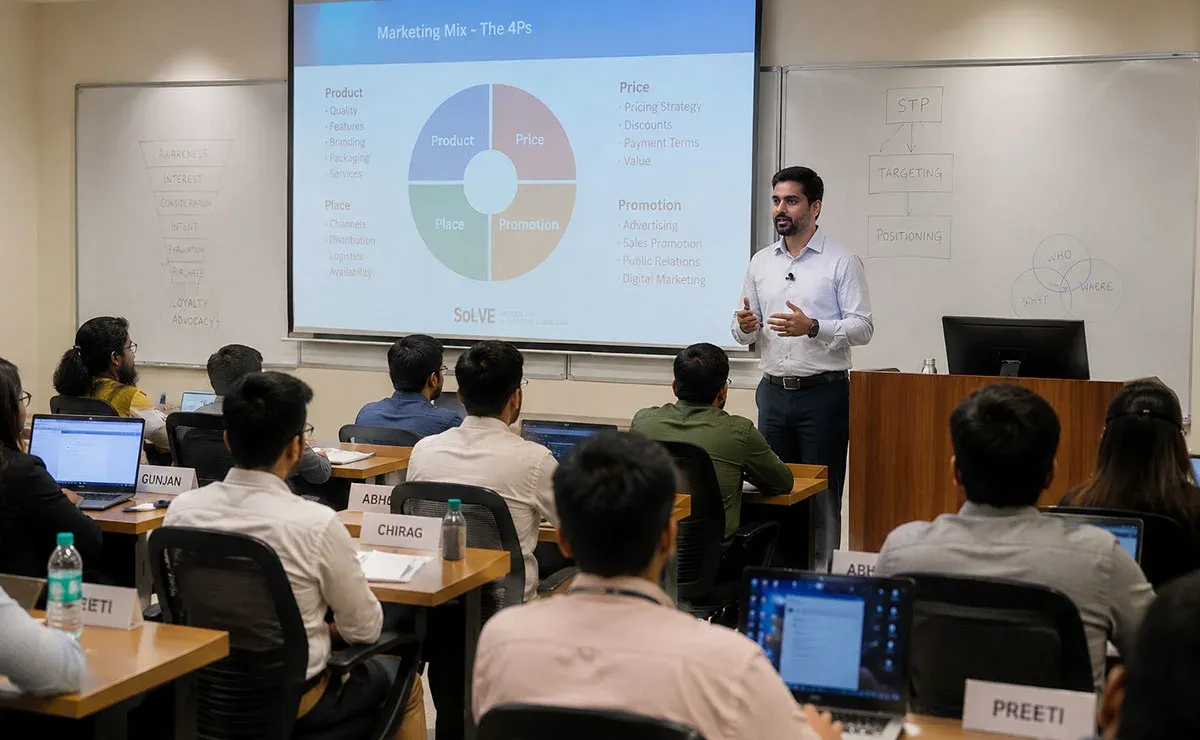
Choosing the right MBA program for a marketing career can be tricky, especially when many institutes still rely heavily on theoretical teaching. The reality is that marketing today is fast-paced, digital, and deeply practical. Now, real-world experience often matters more than textbook knowledge. Students who focus only on classroom learning may struggle to adapt to actual industry demands.
The smarter approach is to look for programs that emphasize hands-on learning and real exposure. Marketing is about execution, not just concepts, so practical experience becomes critical.
Here’s what you should prioritize:
- Programs that include internships, live projects, and industry assignments.
- A curriculum covering digital marketing, analytics, product marketing, and brand management.
- Opportunities to build a strong portfolio through real campaign work.
- Focus on job roles offered, not just average salary packages.
Remember, your first role in marketing after an MBA serves as the foundation for your entire career graph. That is why you need to look beyond just the starting salary and focus on the broader picture to understand how an MBA program contributes to it.
Institutes like Altera Institute address these gaps with a specialized marketing curriculum, industry-led training, and hands-on projects. With strong placement support and exposure to real business challenges, students are better prepared to step into roles across marketing, product, growth, and eCommerce.
Conclusion
Marketing continues to be one of the most dynamic and high-growth career paths for MBA graduates. It offers a wide range of roles across digital, brand, product, and growth functions. With businesses increasingly investing in customer acquisition and retention, the demand for skilled marketers and their earning potential continues to rise. However, your long-term success depends heavily on choosing the right MBA program. A course that blends practical experience with industry-relevant skills can make all the difference in securing the right role and accelerating your career growth.