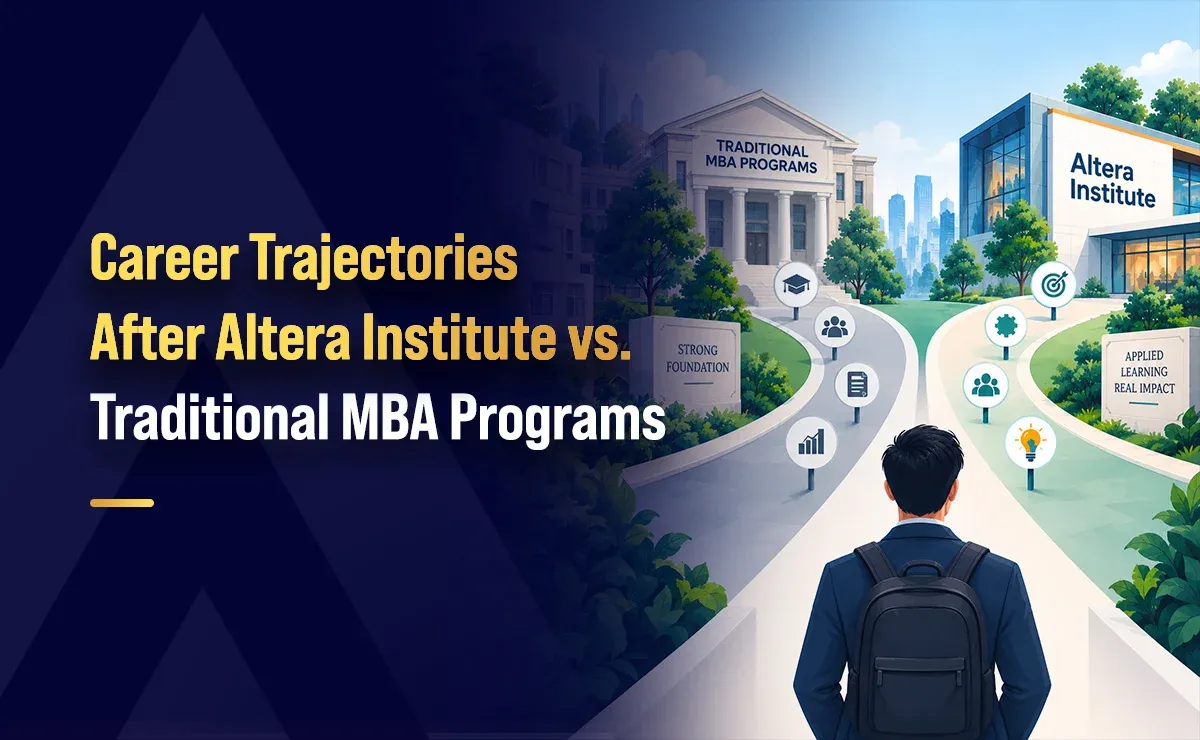
Career Trajectories after Altera Institute vs. Traditional MBA Programs
When aspiring management students assess business schools, the conversation usually revolves around one metric: the placement package. While initial CTCs are a straightforward headline for placement brochures, evaluating a management program only on the entry-level pay is not enough.
The more meaningful question to ask is “What kind of career trajectory does a particular learning environment prepare someone to build?”
To answer this, we need to examine two distinct educational models that are shaping management and business education today: traditional MBAs and applied programs.
Traditional MBA programs have structured theoretical curricula, historical case studies, and established campus hiring pipelines. On the other hand, applied, experience-led programs focus on practitioner-led teaching, an AI-first curriculum, live projects, and immediate execution ability.
Altera Institute represents one emerging approach to management education: one that places applied learning, practitioner exposure, and career capability building at the center of the student experience.
How Different Learning Models Can Influence Career Trajectories
The structure of a business program directly shapes how quickly a graduate adapts to the corporate environment and executes and climbs the leadership ladder. Here are the chief differences between the traditional and applied MBA models.
Altera Institute is purposefully designed around the applied, experience-led side of business education. By replacing outdated academic coursework with practitioner interactions, continuous curriculum iterations, and live corporate projects, Altera Institute prepares students to deliver value from day one in high-growth business environments.
Career Trajectories after Altera Institute
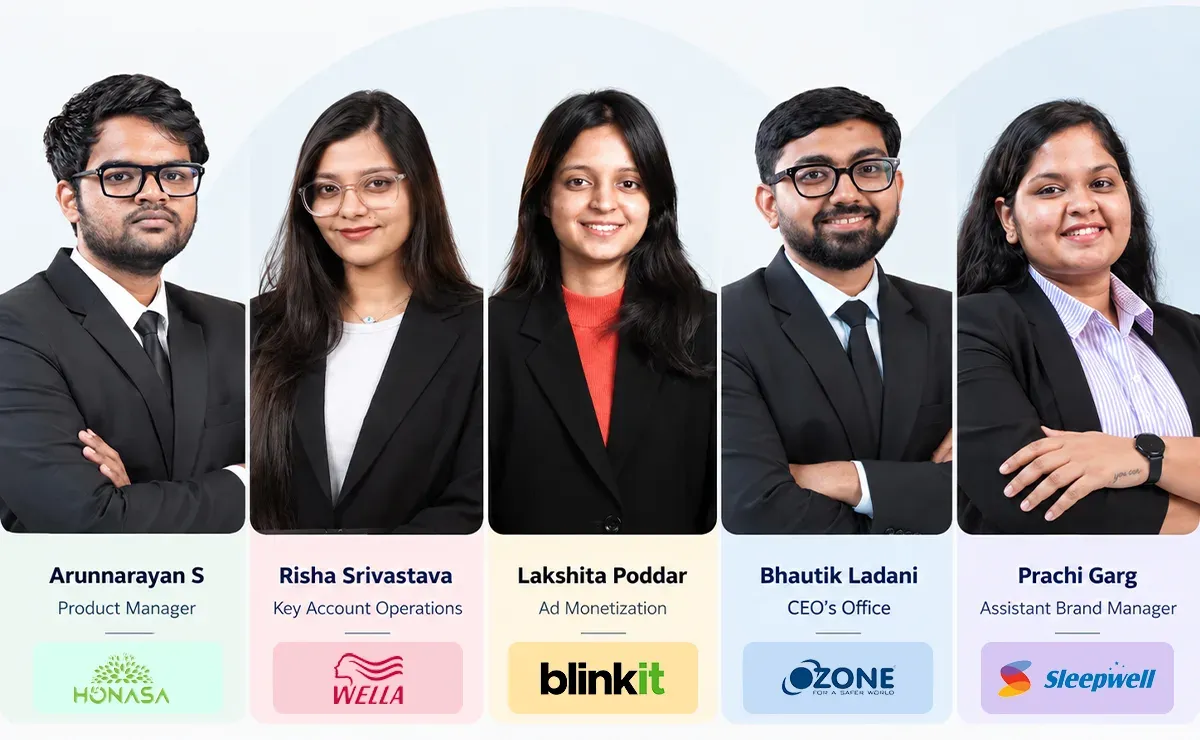
Altera Institute’s graduates typically enter into functional roles in specialized, high-growth domains. Here is a look at the roles past students at Altera Institute have built their careers in:
Arunnarayan S: Product Manager at Honasa
Works on product strategy, AI initiatives, and optimization of the growth funnel to retain and acquire customers. Managing growth strategies and digital platform integrations for a smoother customer experience and to drive product adoption.
Risha Srivastava: Key Account Operations at Wella
Manages B2B vendor relationships and channel partners and fulfills logistics across retail accounts. Uses demand forecasting models and inventory turnover metrics to optimize supply chain and availability of products.
Lakshita Poddar: Ad Monetization at Blinkit
Oversees sponsored search listings, brand ad placements, and revenue optimizations. Analyses real-time click-through rates, return on ad spend, and ad performance.
Bhautik Ladani: CEO’s Office at Ozone
Acts as an execution partner to leadership on growth initiatives and operational scaling. Uses BI dashboards, financial modelling, and turnaround time frameworks to resolve bottlenecks and evaluate partnerships.
Prachi Garg: Assistant Brand Manager at Sleepwell
Drives consumer insight research, marketing communications, and digital media campaign execution. Works with agency partners, brand performance metrics, and media attribution models to grow market share and brand equity.
The Career Trajectory Framework: What Actually Determines Where You Are in 10 Years?
Long-term career success is rarely determined by the brand name on the diploma; it is driven by the industry, job role, and the quality of output the graduate produces.
1. Industry
Industry serves as the ceiling that determines the speed and trajectory of your career. Traditional management graduates tend to enter legacy sectors, like traditional retail, conventional banking, or offline manufacturing, where growth is steady and incremental.
On the other hand, modern industries, like D2C, e-commerce, digital media, and B2B SaaS, operate on rapid execution cycles. For instance, a traditional FMCG brand manager will rely on offline distributor networks and media planning cycles of six months. A modern D2C brand manager will analyze real-time customer acquisition costs and lifetime value and automate ad attribution daily.
Altera Institute’s PGP program is designed to match requirements in the high-growth sectors. This ensures students enter industries that are structurally expanding.
2. Job Role
Career growth depends heavily on functional leverage: how closely your daily tasks align with the company’s revenue generation and strategic decision-making. Traditional entry-level positions often limit young professionals to administrative duties and slow down their path to leadership.
Modern roles like category management, product growth, and brand management give direct access to cross-functional teams and strategic execution. As demand for talent in high-leverage roles is more than supply, professionals in these roles experience faster promotion cycles.
Altera Institute trains its graduates specifically for modern, high-leverage roles rather than generic entry-level roles.
3. Quality of Output
In modern corporate environments, performance is evaluated on execution speed, analytical depth, and turnaround time. A manager who spends three days manually building a financial forecast will easily be taken over by peers who use AI workflows and real-time dashboards to generate a more accurate model in two hours.
By embedding an AI-first approach directly into its curriculum, like at Altera Institute, modern management students can produce higher-quality output in a fraction of the time compared to traditional job roles. This makes them stand out for leadership roles, accelerating their career paths for higher roles.
What Could Your Career Look Like 5, 10, and 15 Years After Altera Institute?
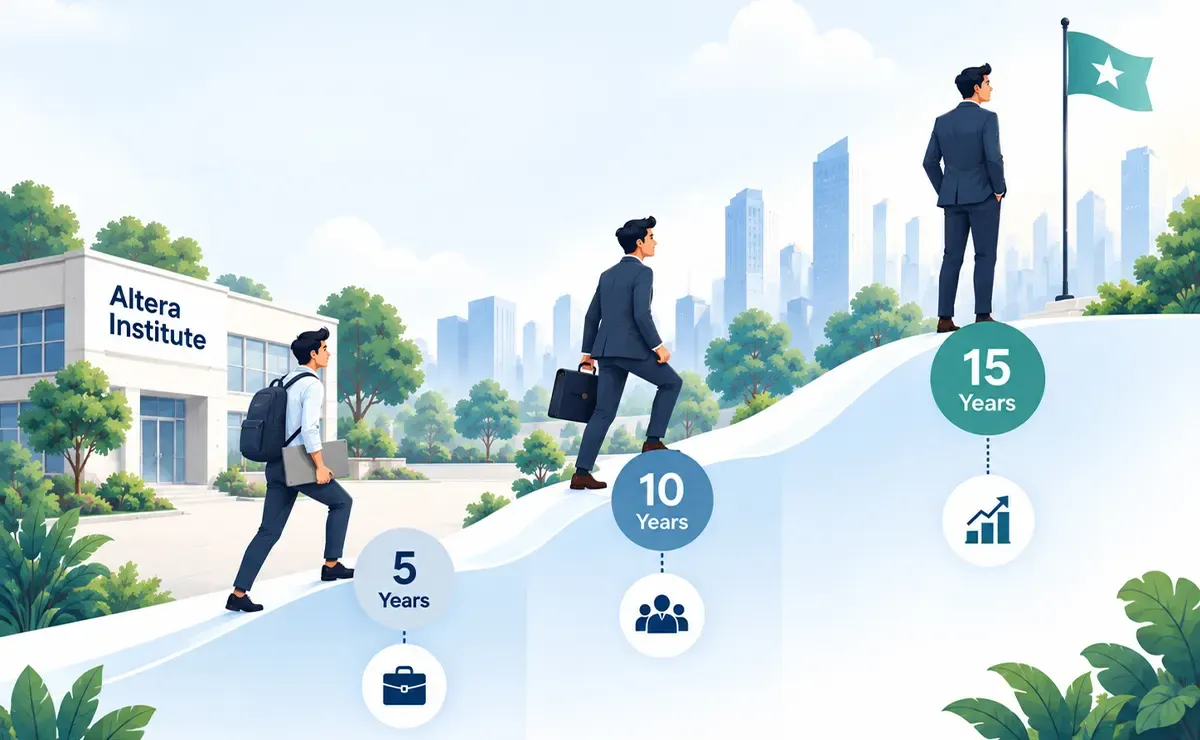
A career path is rarely linear, and its shape becomes clearer when viewed in stages. The following career stages are illustrative and not guaranteed outcomes, but they show how a career can progress.
Years 0–5: Building Your Career Foundation
Career in the early stages progresses by the speed of your learning, the quality of the role, and how quickly you assume responsibility. Common pathways in this stage include Management Trainee to Area Manager in FMCG, Growth Associate to Category Manager in D2C, Analyst to Consultant in Consulting, and Generalist to Founder’s Office in Startups.
Years 5–10: Acceleration and Functional Mobility
During this phase, the top performers transition from individual contributors to leaders, where they are managing teams and budgets and leading strategic initiatives. Specialists can become functional leaders where they are leading an entire department; consultants can transition into hands-on operational leadership roles in high-growth firms, and from the Founder’s Office you could move to managing an entire region alone.
Years 10–15: Leadership, Entrepreneurship, and Compounding
By the decade mark, career growth is driven by business ownership, enterprise P&L management, or venture creation. You could be working as a chief marketing officer, chief operating officer, or vice president of growth in businesses, or leveraging your work experience and networks to launch your own venture. Many also transition into advisory roles or angel investing.
The Lifetime Career Question: Which Model Creates More Long-Term Value?
The real lifetime value of a management education comes through compounding. This occurs through access to high-quality growth opportunities, the speed at which you develop capabilities and are promoted, and the ability to switch roles laterally across industries. Your resilience and adaptability as industries change will also impact your career.
A well-known management brand can give you early access to roles and open the doors for the initial campus placements. However, an applied, practitioner-led management education gives a fundamentally different advantage; you are able to demonstrate your capability and familiarity with workplace issues.
While you can get your foot in the door with a traditional degree, your execution capability will determine how quickly you move up the ladder. Altera Institute is built around this capability-compounding side of career ROI. It ensures that students graduate not just with a degree but with a skill set needed to build, scale, and lead businesses.
Frequently Asked Questions (FAQs)
Q1. Can an applied management program help if I want to change industries later?
Ans: Yes. Applied management programs build transferable skills, like customer acquisition, finance fundamentals, and AI-driven workflows. These skills are universal across many modern industries like e-commerce, D2C, and fintech, allowing graduates to switch with far more ease than with traditional degrees.
Q2. How should I compare the alumni networks of a newer institution and an established business school?
Ans: Look for relevance in an alumni network and not size. Established schools have large networks built over years, while specialized institutes like Altera Institute have dense, highly active networks around modern businesses.
Q3. Should aspiring founders choose a different management program from students targeting corporate careers?
Ans: Aspiring founders benefit immensely from programs that focus on hands-on execution, live projects, cross-functional problem-solving, and interaction with fellow business founders. Traditional management programs focus on managing large, stable corporations, while applied programs focus on rapid experimentation, growth marketing, and operational agility.
Q4. How can I judge a management program's career value before it has decades of alumni data?
Ans: Focus on a program's curriculum design, exposure to practitioners, live projects, relevance of recruiters, transparency of the placements, and quality of roles graduates move into. Programs with these factors build immediate workplace capabilities that drive long-term growth.