Are New-Age MBA Institutes in India Trustworthy?


India's management education landscape has opened its doors to a new category of B-schools, beyond the established brand names like IIMs, FMS, and ISBs. They have emerged as programs built around tighter curricula, practitioner-led faculty, and programs designed specifically to address what the current job market demands.
They are known as new-age MBA institutes because they promise stronger industry relevance, applied learning, and faster returns on investment to the students they aim to serve. But are they trustworthy enough for students to choose them over the brand recognition and security of legacy B-schools?
Unlike well-established institutions with decades of placement data and dense alumni networks, new B-schools have a shorter track record. Which is why, for someone making an expensive, career-defining decision, it becomes crucial to have sufficient evidence of credibility around new-age B-schools to choose them over legacy institutes.
There are many such new-age institutes today that deliver desirable outcomes to students, but how do you make sure that the one you choose will also do the same?
This article offers a practical framework to help you make that decision. It breaks down the signals that distinguish credible new-age institutions from those that are simply good at marketing and identifies the warning signs worth evaluating before you commit.
What Makes a New-Age MBA Institute Different?
To evaluate trust, it helps to first understand what these institutions are actually trying to do differently. The term "new-age MBA institute" refers to something more specific than just being recently founded. These schools are designed around current market gaps rather than inherited syllabi, and that decision shapes everything from how they teach to who teaches.
The Shift from Breadth to Depth
Traditional B-schools providing 2-year full-time MBA programs typically cover a broad range of management disciplines, from finance and operations to HR and strategy. New-age institutions, by contrast, narrow that focus and tend to provide specialist education based on specific functions such as product management, growth marketing, brand strategy, or digital leadership and build the entire curriculum around those domains.
Their pedagogy, which is the way they teach students, also shifts accordingly. Instead of just providing lectures and standardized case studies, the emphasis is on helping students learn through live projects, industry mentors, real client briefs, and applied assignments. Their faculties are often practitioners, people who have managed P&Ls, led product teams, or built consumer brands, rather than primarily academics.
In India, a number of such institutes have emerged over the past decade. Examples include Altera Institute (Gurugram), Plaksha University (Punjab), Krea University (Andhra Pradesh), Woxsen University (Hyderabad), and FLAME University (Pune). Each of them has positioned itself around specialized learning rather than broad management theory.
Why Do Students Choose New Age Institutes?

The appeal of these new-age B-schools and programs is marked by several structural shifts in the job market that have made their model genuinely relevant. Here are some of the factors that are drawing students in:
- Tech-integrated curriculum: Roles in branding, growth, finance, and data analytics have changed significantly today, with fluency in data tools, AI applications, and digital platforms now a core job requirement and not just an optional skill. New-age institutes understand these realities and build them into the curriculum from the outset rather than treating them as an addition to an older framework.
- Experiential learning: Experiential learning, or learning-by-doing, is a key differentiator for new-age B-schools. Rather than treating applied work as a final-semester project or extracurricular activity, these programs incorporate real-world problem-solving and project-based coursework with live companies throughout the course, right from the outset.
- Industry engagement: A truly meaningful signal of institutional credibility is whether good companies engage with the B-school outside placement season. Altera Institute, for instance, runs Management Development Programs for organizations such as Amazon, Unilever, Nykaa, and Godrej. That kind of engagement, where established companies trust an institute to upskill their existing employees, reflects a different level of confidence than simply showing up for recruitment.
- Shorter duration and faster ROI: A two-year full-time MBA entails significant opportunity costs and a time commitment that not every student can afford. This is where focused new-age programs are designed to address this issue, where they cover the core curriculum in a shorter, typically 12-15 month, timeframe and move students from enrollment to placement-ready in a shorter window without compromising on learning or skill building.
- Smaller, more focused cohorts: Cohort size directly affects learning depth. Faculty can give more deliberate, individual attention to smaller batches. As a result, industry interactions become more substantive rather than superficial. And finally, peer learning is more intense because every student is pursuing the same specialization, which provides a common context for discussing, critiquing, and collaborating on problems.
Core Trust Factors to Evaluate
B-schools calling themselves new-age institutes do not automatically make them trustworthy. Trust and credibility can only be established through verifiable evidence. Hence, here are the factors that carry the greatest weight when evaluating a new-age B-school:
1. Transparent Placement Data
Placement statistics from reputed institutes include median and average salaries, role-based salary distributions, the number of companies hiring, and the number of students placed. If there are no supporting numbers to back up claims of “top recruiters” and “competitive packages,” it's not enough. The reports should be in accordance with the recognized reporting standard, which lays down the rules for data collection, reporting, and verification for a B-school. For example, Altera Institute publishes an IPRS-compliant report audited by B2K Analytics, which follows the same standard as IIM Ahmedabad.
2. Curriculum-Market Fit
Market-fit, from a curriculum and syllabus standpoint, means it addresses the needs and realities of what employers are actively hiring for today. When evaluating a program, ensure it is relevant and that its pedagogy covers the most current tools, skills, frameworks, and job functions in that domain. New-age institutes routinely revise their courses in consultation with the industry and build their curricula around high-growth job roles in demand today, treating AI and digital tools as core components rather than electives.
3. Industry Partnerships That Go Beyond Branding
The easiest trust signal for B-schools to manufacture is showcasing company logos with which they associate, and they are also the least reliable to act on. The more meaningful question that students must ask here is what those relationships actually involve. Do these colleges leverage live project collaborations and guest faculty from senior industry roles, and do companies engage with them beyond just recruitment? When companies collaborate with B-school on all of these fronts, that is what truly signals confidence and that employers actually trust the institution's output.
4. Alumni Outcomes Over Time
While the size of an alumni network can be small in new-age B-schools, that shouldn't prevent them from proving their credibility. Speak to alumni directly and gain evidence on whether they came out prepared for the goals they set out to achieve and what the everyday realities of the program looked like. A uniformity of results within a group of individuals suggests more than a few individual success stories. By observing patterns in career transitions, it can be determined if the credential is useful in the workplace after the first placement.
Red Flags That Should Make You Pause
In addition to the trust factors listed above, there are a few other signs to look for early in the evaluation process. These are NOT edge cases but are more common than they should be:
- Vague placement records: A lack of a detailed placement report is a red flag. It is important to note that if an institute does not share the names of its companies, the quality of roles, salary ranges, and batch data, it means the institute has either poor outcomes or is being purposefully opaque. Claims of 100% placement with no supporting data also fall in this category.
- Unrealistic ROI guarantees: If an institute guarantees you a specific salary outcome or a definite placement within a certain time frame, they are making unrealistic claims. Placement is based on the quality of the program, the effort the student puts in, and market conditions. Any promises that remove uncertainty from the equation deserve serious skepticism.
- Outdated curricula: A program that markets itself as modern, but whose syllabus has not meaningfully changed in several years, is worth questioning. If the coursework predates AI becoming a functional workplace requirement, that is a structural gap, not a minor oversight.
- Non-transparent faculty information: Reluctance to publicly share faculty backgrounds, current roles, and industry experience reveals a transparency issue that often reflects other gaps in the program.
- Branding without substance: Branding words such as "future-ready" or “AI-first” are low-hanging fruit, which are easy to employ but difficult to back up. What matters is whether those statements appear in the actual curriculum, project descriptions, and faculty profiles. If they don't, the language is simply a marketing tactic and not a real description of the program.
New Age vs. Legacy B-Schools: Which is Better?
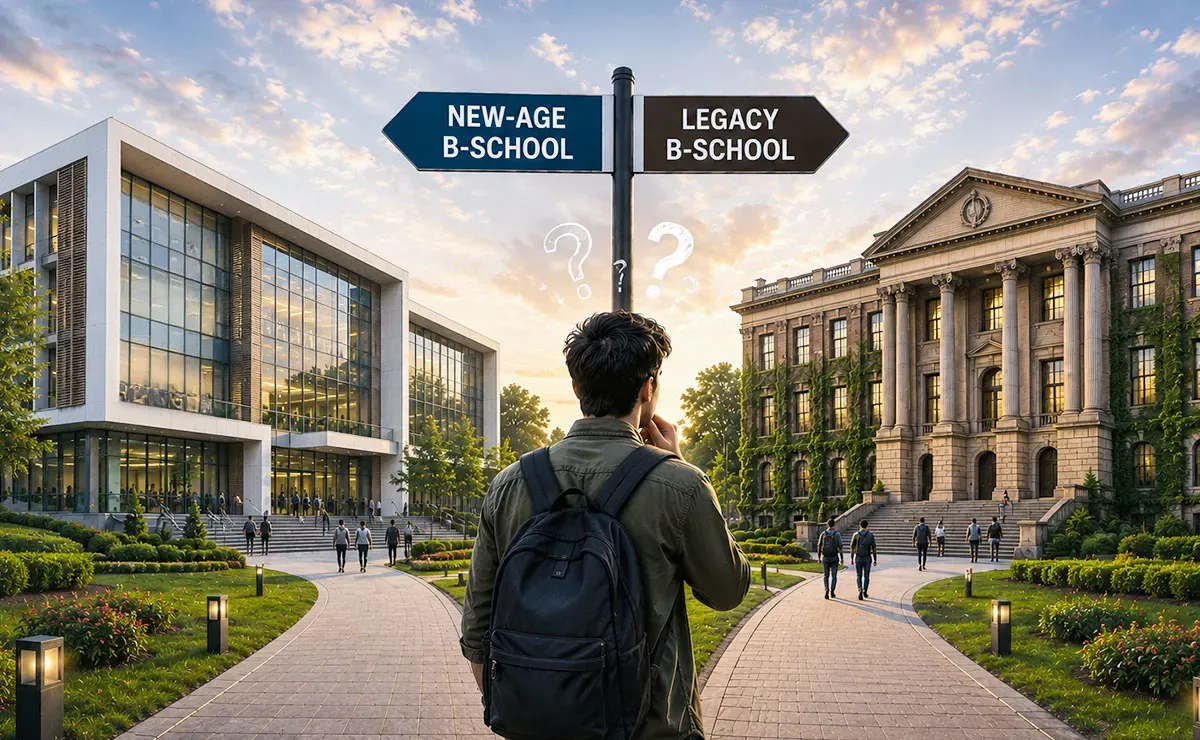
There is no one right or wrong answer to this question. Legacy institutions, by default, have established their credibility through high levels of brand recognition, well-established recruiting networks, extensive alumni bases, and market credibility that can't be built quickly. Which is why, if a large alumni network and prestige are your priorities, these B-schools are still great options for students.
New-age institutes, on the other hand, are more specialized and emphasize application-oriented learning while focusing on what the market demands. This new-age model might be more structurally appropriate for students with a clear functional direction (product, growth, marketing, digital) and who are looking to transition smoothly from education to employment with demonstrated job-ready skills.
The final decision depends on what the student prefers and what the institute can back up with evidence. A new-age B-school that publishes comprehensive placement information, has faculty with industry experience, and has actual connections with industry can hold its own against an established brand name. One that can't is probably not on par with the performance or outcomes you deserve.
Conclusion
New-age MBA institutes in India can be trustworthy, but trust cannot be self-declared. It is built through placement transparency, curriculum relevance, faculty credibility, genuine industry partnerships, and repeatable alumni outcomes, all of which are verifiable if you know what to look for.
This is not an exhaustive evaluation framework but a systematic one. Review placement report standards and ask for the full placement report. Consider whether the curriculum is relevant to the needs of the present employment opportunities. Check out the faculty's credentials. And finally, consider alumni outcomes over the long run, rather than just the first year after the program.
Remember that modern branding with buzz words such as “new-age” and “future-ready” doesn't automatically equate to quality education, and legacy brand names don't automatically equate to industry relevance. The smartest applicants in this entire process are the ones who know exactly the factors to verify before they commit.