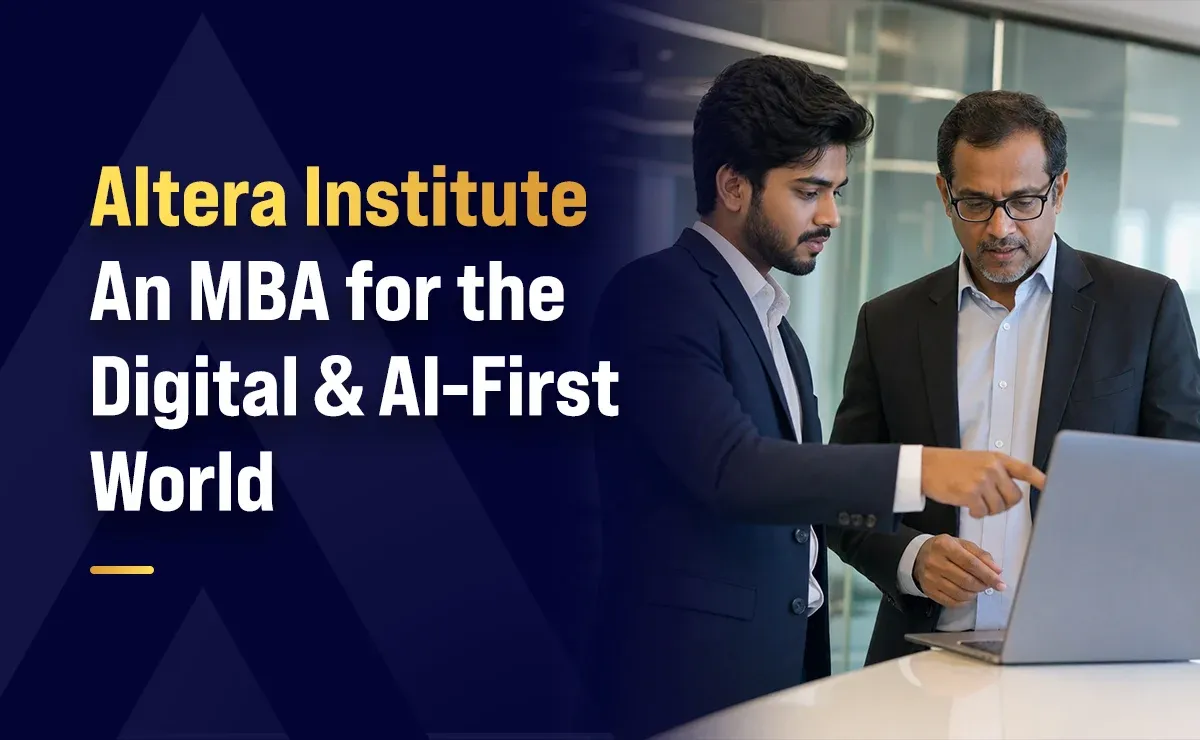
Altera Institute: An MBA for the Digital & AI-First World
If you track the evolution of AI in the last 3-5 years, you will realize it has affected almost every industry in one way or another. From task automation to agentic AI, generative AI, and faster execution, it is reshaping how businesses approach marketing, product management, growth, eCommerce, analytics, and day-to-day operations.
Even though this change has shifted the way in which employers hire, it is not reflected well enough in how traditional business schools prepare their students. That is why industry-backed business schools like Altera Institute have become even more important.
Unlike many traditional MBA programs that continue to focus on legacy business frameworks and outdated case studies, Altera Institute’s MBA in digital marketing equips learners with practical, future-ready skills designed for digital-first careers. Its curriculum combines business fundamentals with hands-on learning in AI, marketing technology, analytics, customer growth, and emerging digital tools.
Why Traditional MBA Models Are Struggling in the AI Era
In today's AI-enabled business landscape, success depends on more than theoretical knowledge. Professionals need to understand how technology influences business strategy, customer behavior, and organizational growth. MBA graduates, in particular, are expected to go beyond polished presentations and articulation of policy frameworks. By collaborating with AI, they are now expected to adapt, evolve, and adjust to technical changes almost every day.
Here are a few key pointers that make traditional MBAs insufficient.
The Rise of AI-Driven Business Functions
Business roles have changed dramatically in the past few years. AI is now part of almost every business function. Professionals are now expected to:
- Use AI tools to improve productivity
- Analyze large chunks of data and derive business insights
- Make AI-assisted business decisions
- Work simultaneously with multiple digital platforms and marketing technologies
- Adapt to emerging technologies
- Collaborate with cross-functional teams
And to meet these expectations, you need practical digital skills and not just business theory. However, many traditional MBA programs still rely heavily on classroom lectures, old case studies, and conventional management frameworks.
While these are fundamental concepts, they don’t prepare students for constantly evolving AI-integrated workplaces. They need to understand that the ability to learn, adapt, and work alongside AI has become just as important as leadership and communication skills.
The Gap in the Curricula
A 2024 report by the World Economic Forum mentioned that alongside traditional leadership, it is critical for future managers to also possess skills like AI literacy and analytical thinking.
However, most traditional MBAs still have a rigid curriculum that takes years to change, whereas AI tools, digital platforms, and business technologies evolve every few months. As a result, the gap is never covered, and students still graduate with knowledge that is already behind current industry practices.
Today's MBA students need continuous exposure to emerging technologies rather than a curriculum that is revised once every few years. Some common challenges include:
- Delayed curriculum updates
- Limited hands-on exposure
- Measurable outcome-based learning
- Lack of AI-based or technology-integrated learning
Generic Management Education With One-Size-Fits-All Pedagogy
A traditional MBA is designed to provide a broad understanding of core business functions such as finance, marketing, operations, and human resources. However, today’s job market demands specialized skills that can be applied from day one.
It increasingly values graduates who can:
- Apply business concepts to specialized functions such as product, growth, or analytics.
- Work confidently with digital platforms, AI-powered tools, and business technologies.
- Solve real business problems through hands-on projects and industry exposure.
- Build expertise in high-demand domains instead of relying solely on broad management knowledge.
Companies are hiring for roles such as digital marketing, product management, business analytics, growth marketing, customer success, and AI strategy. These positions require graduates to understand industry-specific tools, data, technology, and customer behavior and not just theoretical management principles often taught in traditional curriculums.
Recognizing these changing industry demands, Altera Institute has reimagined management education for the modern workplace with its MBA in digital marketing. Built specifically for digital-first careers and focused on high-growth business domains, it prepares students with practical exposure to AI, digital technologies, and real business challenges, helping them graduate with skills that are immediately relevant in today's job market.
What Makes an MBA “Digital & AI-First”?
So if traditional MBA programs are no longer sufficient, what should you look for instead?
The answer isn't a longer syllabus or more classroom hours. It's a different way of learning. A curriculum that reflects how businesses operate today and equips students with practical, future-ready skills.
A digital and AI-first MBA combines business fundamentals with hands-on learning of AI tools, practical industry exposure, automated execution, and modern business practices. Instead of just relying on theory and outdated fundamentals, it inculcates in-demand skills relevant to this changing job market.
Learning Business Through Real Digital Use Cases
Business education is most effective when students apply concepts instead of simply studying them. While classroom lectures introduce frameworks, practical experience teaches students how those frameworks work in real organizations.
This is especially important because business challenges today are rarely confined to one department. Improving customer retention may involve product, marketing, analytics, and customer success teams. Launching a new offering requires collaboration between finance, operations, technology, sales, and leadership. Modern organizations expect managers to think across functions rather than within departmental boundaries.
A digital-first MBA therefore combines academic learning with meaningful practical exposure through:
- Live business projects
- Internships with outcome-based learning
- Industry workshops
- Business simulations and case challenges
- Exposure to real brands and real business problems
Instead of graduating with theoretical knowledge alone, students develop the ability to analyze situations, make decisions, collaborate with cross-functional teams, and execute ideas in dynamic business environments.
AI Tools Are Becoming Core Business Infrastructure
Artificial intelligence is no longer a niche technology used only by software engineers. It has become part of everyday business functions across departments. Employees at almost every level are now expected to be AI literate. Managers, in particular, have started using it to accelerate research, interpret data, automate repetitive tasks, generate insights, and improve decision-making, while recognizing where human judgment remains essential.
As a result, MBA institutes must ensure their students are fluent in using AI to stand out from the crowd. A digital and AI-first MBA understands that execution speed often creates a greater competitive advantage than lengthy planning. Therefore, the ability to learn quickly, use digital tools effectively, and turn insights into action is often a core part of their curricula.
Industry Practitioners vs. Traditional Faculty Models
Technology, AI platforms, and business models evolve much faster than traditional academic curricula. While management theories remain relevant, students also benefit from learning directly from professionals who are solving today's business challenges.
Practitioner-led learning bridges the gap between classroom concepts and workplace realities. Industry experts bring current perspectives and deep, real insights on product development, business strategy, AI adoption, digital transformation, and organizational decision-making that textbooks often cannot capture. When you are taught by industry experts, you don’t just learn the theory, but you get a first-row ticket to observe everything that is happening in the industry, with an overview of real challenges and how they were solved.
If you are searching for a program like that, then Altera Institute’s PGP in Applied Marketing is truly practical, digital, and AI-first in every sense. From a practitioner-led curriculum to project-based learning, industry visits, and exposure to real brands, this one-year MBA course doesn’t just cover a syllabus but prepares you for every need of the marketing industry at different stages.
Rather than learning concepts in isolation, students work on practical business problems, receive feedback from industry professionals, and graduate with experience that reflects how modern organizations actually operate.
How Altera Institute Is Built for the Modern Business Economy
As an industry-backed B-school, Altera Institute has designed its MBA in digital marketing around the realities of the modern business economy. Instead of relying on conventional management education, it focuses on digital-first management education, practical skill development, and the preparation of students for AI-enabled business careers. From curriculum design and industry exposure to specializations and career opportunities, every aspect of its learning experience reflects the needs of today's employers.
Industry-Backed Curriculum Design
Business education becomes more valuable when it evolves alongside industry. Rather than updating syllabi every few years, MBA programs should continuously incorporate emerging technologies, changing consumer behavior, and evolving business practices.
Altera Institute's curriculum is designed in collaboration with industry professionals, ensuring students learn skills that employers actively seek. Courses are taught by practitioners who bring current business challenges into the classroom, helping students understand not only management concepts but also how those concepts are applied in real organizations.
This practitioner-led approach also exposes students to the latest AI tools, digital platforms, analytics frameworks, and business strategies that are increasingly becoming part of everyday management.
Specialized Learning Instead of Generic Management Education
A generic management program gives you an overview of different business verticals but is not able to deep-dive into one domain until much later. As a result, when these graduates apply for jobs, they are often sidelined by experts who possess more in-depth knowledge of a particular business function.
To bypass this hurdle, Altera Institute's PGP in Applied Marketing focuses on building expertise in high-growth domains rather than offering only general management education. Instead of preparing you for every management role out there, it focuses on building marketers who really know what they are doing.
By the end of the program, students develop practical capabilities in areas such as
- Customer acquisition
- Product strategy
- Marketing analytics
- AI-assisted decision-making
- Lifecycle marketing
- Business growth
Focus Areas: Marketing, Growth, Product & eCommerce
Modern businesses are increasingly built around digital products, customer experience, and data-driven growth. As a result, demand has risen for professionals who can combine strategic thinking with technology and analytics.
Altera Institute prepares students for roles across fast-growing business functions, including
- Product Management
- Growth Marketing
- Digital Marketing
- Business Analytics
- Performance Marketing
- CRM and Lifecycle Marketing
- eCommerce Strategy
- Brand Management
Learning Through Live Projects and Industry Exposure
As already mentioned, Altera Institute focuses on inculcating practical skills rather than just classroom learning. This is achieved by skipping textbooks when needed and bringing industry into the classroom. This includes:
- Industry visits
- Live simulations
- Practical workshops
- Engagement with industry professionals
- Solving real business problems, etc.
Built for Career Outcomes
Learning is only meaningful if it translates into career opportunities.
Located in Gurugram's Cyber City, one of India's largest business and technology hubs, Altera Institute offers students proximity to startups, technology companies, consulting firms, and established enterprises. This ecosystem creates greater opportunities for industry interaction, networking, internships, guest sessions, and recruitment. This practical exposure helps them build portfolios, strengthen problem-solving abilities, and gain confidence before entering the workforce.
By combining an industry-backed curriculum, specialized learning, practitioner-led teaching, and continuous industry exposure, Altera Institute aims to prepare graduates for high-growth roles in the modern marketing economy rather than simply awarding a PGP qualification.
Careers That Are Growing in the AI & Digital Economy
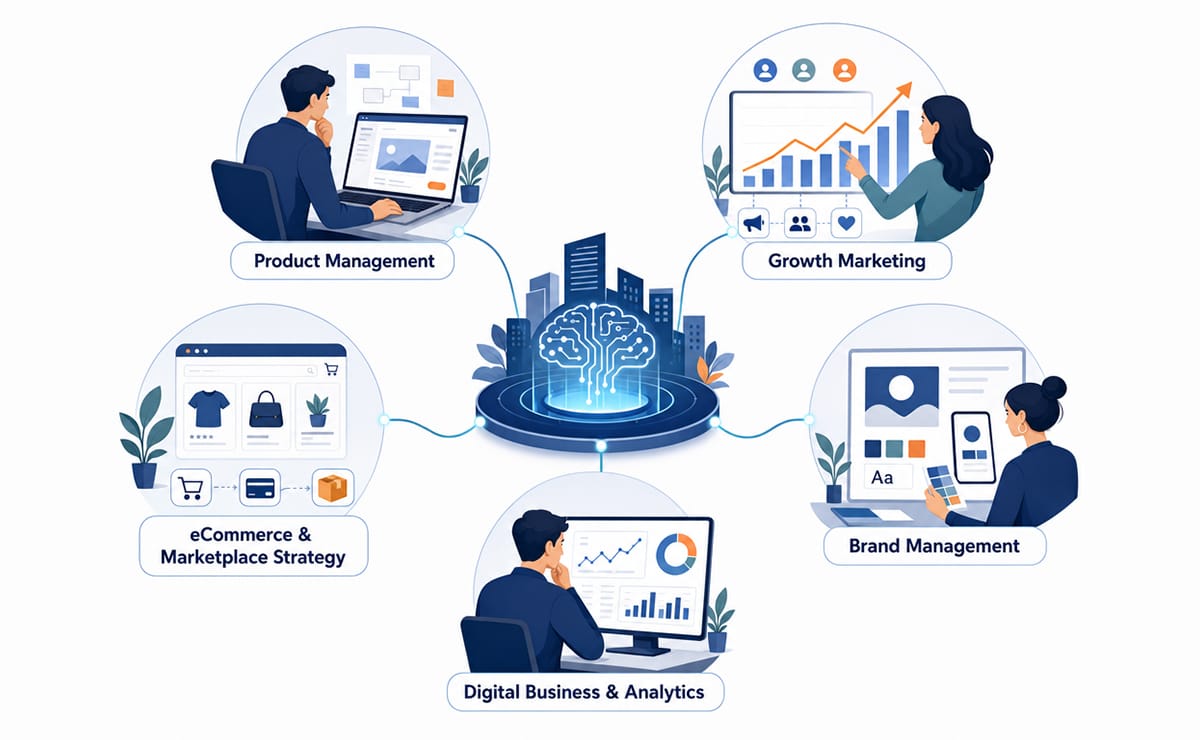
Contrary to common belief, AI has not reduced the demand for professionals but has changed what businesses expect of them. Instead of replacing managers, AI is automating repetitive tasks, allowing professionals to spend more time on strategic thinking, problem-solving, and decision-making.
As a result, it has led to the rise of new roles that didn’t even exist a decade ago. Here is a breakdown of some of the fastest-growing roles after the introduction of AI in this digital economy.
Product Management
Average Salary Range in India: ₹21.7 - ₹24 LPA
Product managers identify customer needs, define product requirements, prioritize features, and work with design, engineering, and business teams to launch products successfully. After launch, they track customer behavior, analyze product performance, and continuously improve the user experience.
AI is helping product managers analyze user feedback, identify feature gaps, generate product requirement documents, and make faster product decisions using customer data rather than assumptions.
At Altera Institute, students build these skills through courses such as Product Management, Go-to-Market, Business Strategy, Applied Analytics, and Generative AI in Business. These are not just subjects but the foundation of every successful product manager.
Growth Marketing
Average Salary Range in India: ₹18.5 - ₹20 LPA
Growth marketers are responsible for increasing customers, improving conversions, and ensuring that marketing investments generate measurable business results. Their day-to-day work involves testing campaigns, analyzing customer journeys, improving website performance, and finding new opportunities to grow revenue.
Since most marketing decisions today rely on data rather than intuition, professionals are expected to run experiments, interpret analytics, and continuously optimize strategies.
With modules such as Growth Marketing, Digital Media Planning, Content Marketing, Retention Marketing, Applied Analytics, and Generative AI in Business, Altera Institute prepares future growth marketers by providing practical exposure to the tools and frameworks used by modern growth teams.
eCommerce & Marketplace Strategy
Average Salary Range in India: ₹21.4 - ₹25 LPA
Managing an eCommerce business involves much more than selling products online. Professionals in this role decide which products to list, optimize pricing, and plan promotional campaigns, monitor inventory, improve product visibility, and analyze sales performance across platforms like Amazon, Flipkart, Blinkit, or a brand's own website.
As AI makes demand forecasting, pricing optimization, and personalized recommendations more accurate, businesses need managers who can interpret data and make commercially sound decisions rather than rely on instinct.
Students at Altera Institute learn this through modules like Digital Commerce, Category Management, Supply Chain Management, Organized Trade, eCommerce Media Planning, and Business Strategy. It not only builds core skills in this domain but also helps them position themselves as industry experts with in-depth knowledge of the function.
Brand Management
Average Salary Range in India: ₹18.2 - ₹20 LPA
Today's brand managers do much more than create advertising campaigns. They study consumer behavior, identify market opportunities, define brand positioning, coordinate product launches, and ensure every customer touchpoint reflects the brand's identity. AI has made consumer insights and campaign analysis far more accessible, allowing brand managers to make quicker decisions based on customer sentiment, market trends, and campaign performance.
The curriculum at Altera Institute builds these capabilities through marketing management, brand building, brand management, advertising management, business communications, content marketing, and generative AI in business, giving students both the strategic and practical skills needed to build brands in a digital-first world.
Digital Business & Analytics
Average Salary Range in India: ₹9.5 - ₹10.5 LPA
Every business today generates enormous amounts of data, but the real value lies in turning that data into better decisions. Professionals in digital business and analytics identify growth opportunities, evaluate business performance, build dashboards, forecast trends, and recommend strategies that improve profitability and operational efficiency.
As AI automates reporting and data processing, the role increasingly focuses on interpreting insights and solving business problems.
To prepare students for these responsibilities, Altera Institute combines applied analytics with subjects like business finance, managerial economics, business strategy, first-principles problem solving, and generative AI in business, enabling them to understand both the numbers behind business decisions and the strategic thinking required to act on them.
Why Specialized MBAs Are Becoming More Valuable
The purpose of an MBA has changed. While traditional MBA programs were designed to create general managers, today's employers increasingly hire for specialized roles that require domain expertise from day one.
Here's how the two approaches compare:
The Shift From Generalists to Functional Specialists
Companies today don't just hire "MBA graduates." They hire product managers, growth marketers, business analysts, eCommerce managers, and brand managers. This means students increasingly benefit from programs that help them build expertise in a specific function rather than remain generalists.
A specialized MBA helps students:
- Develop deeper domain knowledge.
- Learn the tools used in their chosen industry.
- Build a portfolio through practical projects.
- Transition more confidently into role-specific careers.
Recognizing this shift, Altera Institute specializes in digital-first business domains, helping students combine management fundamentals with practical industry skills.
Employers Want Job-Ready Talent Faster
Most businesses can no longer spend months training graduates in the basics. They increasingly look for professionals who can contribute from the beginning. That's why employers value graduates with:
- Hands-on project experience.
- Industry internships and workshops.
- Familiarity with digital business tools.
- Strong problem-solving and analytical skills.
For students, this also means a lower opportunity cost. Instead of spending years acquiring specialized skills after graduation, they begin building them during the program itself.
AI Has Increased the Value of Execution Skills
AI can generate ideas, analyze data, and automate repetitive work. What it cannot replace is sound business judgment and effective execution. As a result, employers increasingly value professionals who can:
- Interpret AI-generated insights.
- Make data-driven business decisions.
- Collaborate across cross-functional teams.
- Test, iterate, and improve business strategies.
- Turn ideas into measurable business outcomes.
This is why programs focused on practical execution over theoretical breadth are becoming more relevant. Through practitioner-led learning, live business projects, and role-specific training, Altera Institute prepares students for digital-first careers where execution matters as much as strategy.
Is Altera Institute A Good Fit For You? – Factors Students Should Evaluate
Choosing a business school isn't just about rankings or brand recognition. The right program depends on your career goals, learning preferences, and the type of roles you want to pursue after graduation.
Before making a decision, students should evaluate whether an institute's curriculum, teaching approach, industry exposure, and career support align with where they want to be in the next five to ten years.
While every student has different priorities, important factors include the relevance of the curriculum, opportunities for practical learning, industry connections, faculty expertise, and placement outcomes.
Curriculum Relevance
The curriculum should prepare students for today's business environment. Therefore, you should look for programs that integrate AI, analytics, and role-specific learning alongside core management concepts.
Altera Institute's curriculum is designed around digital-first business functions, combining management fundamentals with specializations in areas such as product, growth, digital commerce, branding, and business analytics. This makes the learning experience more aligned with current industry requirements.
Industry Exposure
Learning shouldn't stop inside the classroom. Practical experience through live projects, internships, business simulations, workshops, and interactions with companies helps students understand how business decisions are made in real organizations.
Altera Institute places a strong emphasis on project-based learning and industry engagement, giving students opportunities to work on real business challenges while learning from professionals actively working in the industry.
Placement Outcomes
Placements are not just activities held towards the conclusion of the program. They reflect how well a program prepares students for the job market. When comparing institutes, students should look beyond placement percentages and evaluate the types of companies hiring, the roles offered, career progression opportunities, and how closely those roles align with the curriculum.
Altera Institute focuses on preparing students for digital-first roles across functions such as product, growth, marketing, eCommerce, and analytics through an industry-oriented curriculum and recruiter network.
Faculty & Practitioner Network
Faculty members build conceptual understanding, but industry practitioners bring current business perspectives that textbooks often cannot. A balanced mix of academic foundations and practitioner-led teaching helps students understand both why business decisions are made and how they are executed.
Altera Institute follows a practitioner-led learning model, where students learn from professionals with experience across startups, digital businesses, and established organizations, ensuring classroom discussions remain connected to current industry practices.
Career Alignment
Perhaps the most important question is whether the program supports your long-term career goals. Some students may prefer a broad management education, while others want to build expertise in high-growth business functions from the beginning.
If you're looking to build a career in digital-first business domains and value practical learning, industry exposure, and role-specific skill development, Altera Institute offers a focused approach that aligns with these goals. Evaluating these factors carefully will help you determine whether it is the right fit for your career aspirations.
The Future of MBA Education in India
Management education in India is entering a new phase. As AI reshapes businesses and employers seek role-ready professionals, MBA programs are moving beyond traditional classroom learning towards more practical, industry-focused models. Some of the key trends shaping this transformation include:
- AI-native Business Education: AI is embedded into everyday learning and business decision-making.
- Hybrid and Experiential Learning: Combines classroom sessions with live projects, internships, workshops, and industry interactions.
- Practitioner-Led Classrooms: Bringing current business challenges and real-world perspectives into the curriculum.
- Shorter High-Intensity Programs: Helps students upskill faster and enter the workforce sooner.
- Specialized Programs: Focused on high-growth domains instead of one-size-fits-all management education.
As these trends continue to shape business education, institutes that combine practical learning with industry relevance are likely to lead the way. Altera Institute represents this shift towards modern, industry-aligned management education, preparing students for digital-first and AI-enabled business careers.
Conclusion
Artificial intelligence is transforming the way businesses operate, make decisions, and compete. As organizations adopt digital technologies across every function, management education must evolve alongside them. Today's MBA graduates also need more practical digital capabilities, the ability to work with AI, interpret data, solve real business problems, and collaborate across cross-functional teams.
The careers shaping the future, from product management and growth marketing to digital commerce and business analytics, demand professionals who can execute ideas, adapt quickly, and create measurable business impact. This is why experiential learning, industry exposure, and role-specific specialization are becoming just as important as core management fundamentals.
For students planning a career in the digital economy, choosing the right MBA means selecting a program that aligns with evolving expectations. With its industry-led curriculum, practitioner-driven learning, and focus on digital-first business domains, Altera Institute represents a future-focused option for students looking to build successful careers in an AI-enabled business world.
Frequently Asked Questions
Q1. Is Altera Institute an MBA college?
Ans. Altera Institute does not offer a traditional MBA degree. Instead, it offers a PGP in Applied Marketing, an industry-focused, specialized postgraduate management program designed to prepare students for digital-first and AI-enabled business careers through practical learning, live projects, and industry-led instruction.
Q2. Is a 1-year MBA course valid in India?
Ans. Yes, a 1-year MBA is valid in India. However, students are always advised to research the program and its placements along with the reputation of the institute before choosing an MBA.
Q3. Can you do a 1-year MBA course without work experience?
Ans. Yes, many reputable one-year MBA courses, like the Altera Institute, allow you to pursue their PGP programs without prior work experience.
Q4. Which MBA specialization is best for AI-driven careers?
Ans. Since AI is transforming every business function, specializations such as an MBA in digital marketing, business analytics, information technology (IT), operations, and finance are becoming increasingly relevant. However, the right choice depends on your career goals and the industry you want to work in.
Q5. Are digital marketing and product management good MBA career options?
Ans. Yes, an MBA in digital marketing and product management are great career options. Both are high-growth career paths that increasingly require professionals who can use AI, analyze data, and drive business outcomes in digital-first organizations.
Q6. What skills are important in AI-first business careers?
Ans. AI literacy, analytical thinking, problem-solving, data interpretation, digital strategy, and cross-functional collaboration are among the most important skills for AI-first business roles.
Q7. Do companies value industry-focused MBA programs?
Ans. Companies highly value industry-focused MBA programs because it allows them to find graduates who possess deep knowledge in their domain. So it not only helps them find job-ready professionals, but they also don’t need to spend on their training or wait for months to see results.