Altera Institute: A Digital-First Curriculum for eCommerce, Marketing & Product Careers
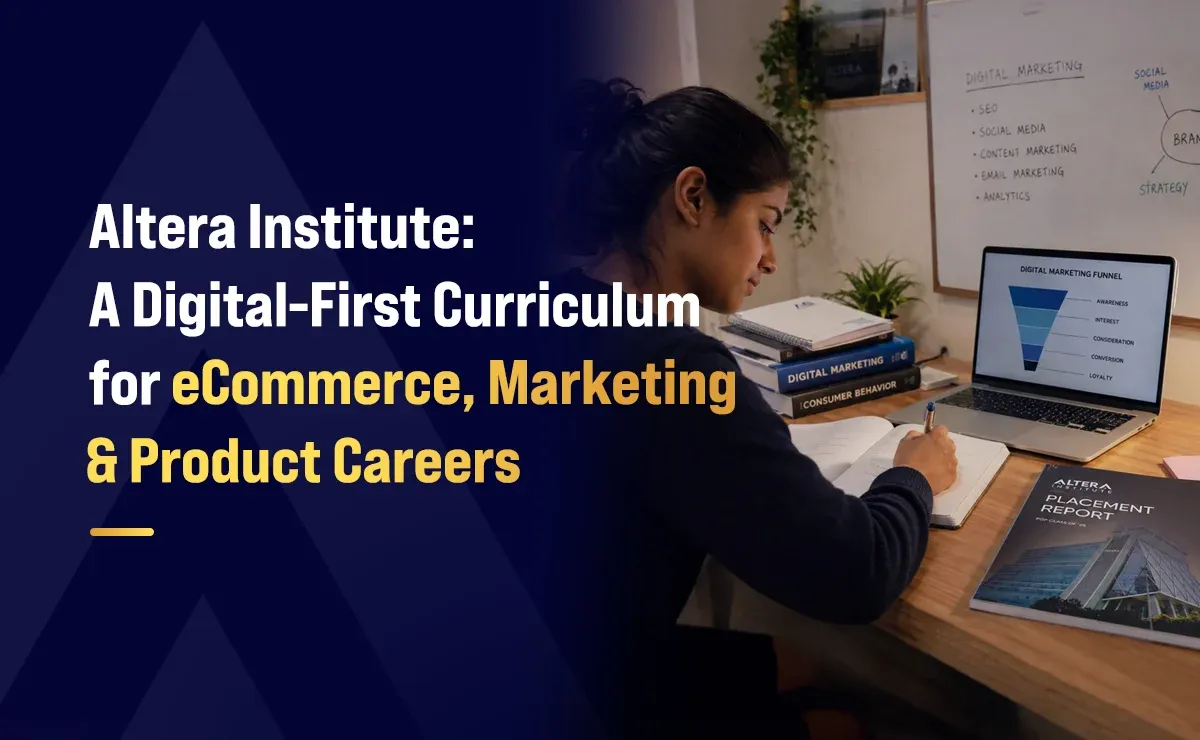
A curriculum is only relevant if employers value the skills it teaches. That's the test most B-school brochures fail, because they tend to list subjects rather than answer the questions students are actually asking today. What will I learn that I can use right from day one? Can I actually do the job after graduating? Will recruiters recognize these skills? And will any of it still matter five years from now, once AI and digital-first business models reshape marketing all over again?
Altera Institute built its PGP in Applied Marketing to address exactly those questions. Here's a full breakdown of what the curriculum actually teaches, how it's structured across four terms, and what the institute's own placement numbers say about whether recruiters are buying in and trusting us.
Why Marketing Education Had to Change
Marketing as a discipline is moving faster than most traditional MBA syllabi have kept up with. Technological evolution, such as AI, now sits at the very heart of how brands plan media, write copy, and interpret customer behavior. Digital-first and D2C businesses have taken over categories that traditional retail once dominated, and disciplines such as growth marketing, product marketing, performance marketing, and consumer analytics have become distinct careers, each with its own skill requirements and competencies.
When comparing these industry changes with traditional MBA coursework in marketing, it becomes evident that the skills these courses produce differ from what employers are looking for. This is because their curriculum was designed for a market where television carried ad spend; retail handled distribution, and digital was an optional subject.
But with key shifts in the digital and AI space, the industry no longer hires marketing talent the way it used to. Hence, a curriculum relevance should be judged against today's hiring standards, not against business models that are twenty years old.
Altera Institute's Curriculum Is Built on Three Pillars
Altera structures its PGP in Applied Marketing around three components that run alongside each other rather than one after another.
- Core coursework, spread across four terms, covers the functional subjects that make up a marketing career: brand, growth, product, and digital media, each taught by people who've built these functions for a living rather than researched them from the outside.
- Sprints with leaders from top companies are short, 4- to 8-hour workshops on specific in-demand skills, run by specialists from firms such as Amazon, Meesho, Bain & Company, and Whiteboard Capital.
- Industry immersion puts students directly in front of the people who actually hire for these roles, through case studies with CXOs and founders, live projects with real companies, and a dedicated industry mentor assigned for the length of the program.
Inside Altera Institute's Applied Marketing Curriculum: Core Courses
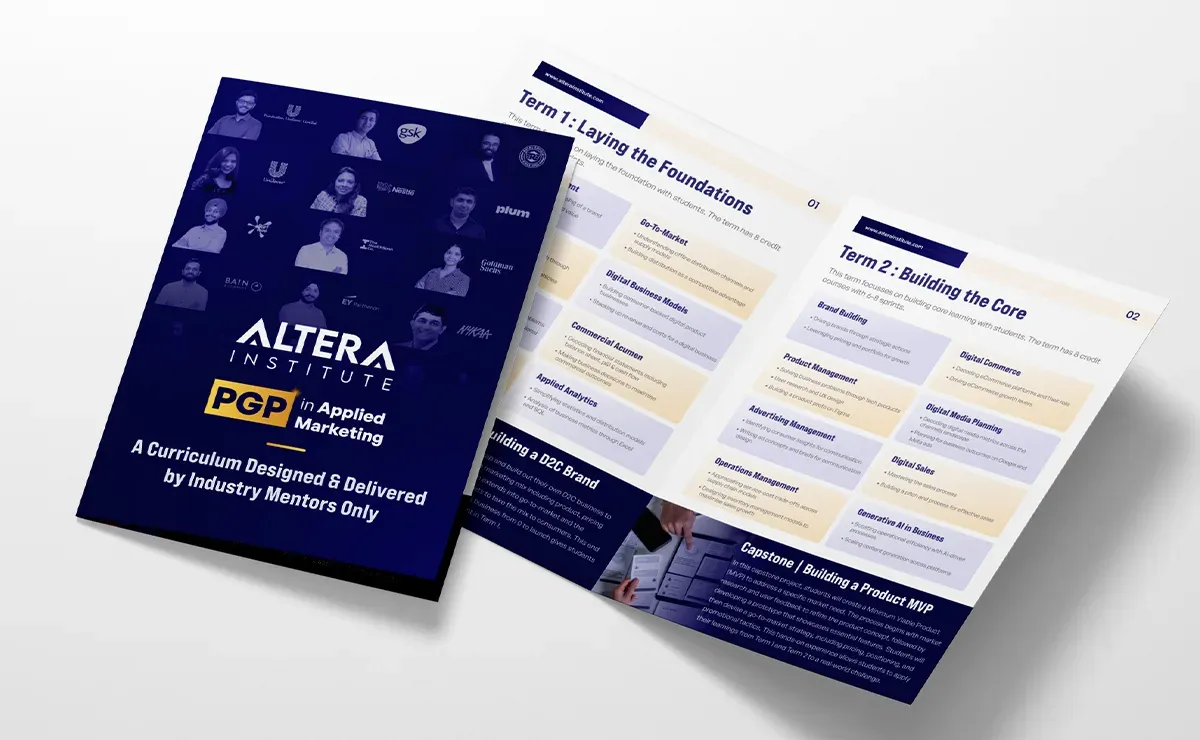
Altera’s curriculum is 100% industry-aligned, built on more than 1,200 hours of AI and digital-first coursework and over 70 live projects across the program. The four terms are built on one another in sequence, progressing from foundational marketing concepts to full ownership of a real business problem by graduation.
Each term runs for 12 weeks and pairs six core courses with sprint workshops and a real-world project, pushing students to apply what they've learned immediately rather than articulate it in an exam. Running alongside all four terms is a parallel business analytics track covering Excel, Power BI, and Tableau, a personal branding track, and a 1-1 mentor assigned to every student for the duration of the program.
Term 1: Marketing Foundations
Among the subjects covered in the first term are marketing management, advertising management, business communication, go-to-market, business finance, and media basics. This is exactly where students build the vocabulary needed for every marketing role, from how a brand plans a launch to how media budgets are actually allocated.
Alongside these courses, students attend sprint sessions with industry leaders and sit in on case discussions with founders and CXOs. Term 1 closes with students building their own D2C brand from scratch, applying go-to-market and communication concepts to a brand they've created themselves rather than a case study written by someone else.
Term 2: Building the Core
As part of Term 2, students study brand building, digital advertising, eCommerce and direct-to-consumer (D2C), product management, digital business models, and media planning. These subjects shift students from general marketing literacy into the specific disciplines eCommerce and consumer-tech companies actually hire for.
Students keep attending sprints and CXO case discussions through the term and close it by pitching a business plan alongside an early product prototype, putting the term's Product Management and Digital Business Models coursework directly to work.
Term 3: Scaling the Learning
The curriculum during Term 3 emphasizes content marketing, media planning, growth marketing, product design, category management, and business innovation, which are the skills that make specialists like growth marketers and category managers different from generalist marketing graduates.
This term also carries the heaviest load of live projects, run in partnership with more than 20 companies. Students build a content engine for a digital-first brand as their term project, working within the budget, timeline, and brand guideline constraints a real marketing team would face.
Term 4: Closing the Loop
In the final term, students learn about brand strategy, digital business operations, B2B marketing, product marketing, leadership in business, and retention marketing to round out their knowledge of the skills required to run a marketing function rather than simply operate within one.
Additionally, term 4 concludes with a capstone project, such as creating and launching a product MVP that integrates brand strategy, product marketing, and retention thinking. After this, students move into a 3-month internship in brand management, product management, growth marketing, sales, and strategy, and, depending on their performance, many convert this internship into a full-time position.
Build Real-World Skills Through Applied Learning Instead of Exams
Altera backs its learning-by-doing approach by constantly leveraging these aspects:
- Case studies with CXOs and founders
- Live projects run with more than 20 companies
- Capstone projects and business simulations across the four terms.
None of these replaces traditional exams. It uplifts them with a graded output a hiring manager can objectively assess, signalling to them that our students indeed have the real-world skills that will render them valuable to a company right from the outset.
Build Your Own D2C Brand (Term 1)
Students build and pitch their own D2C brand in Term 1, the same project covered in the curriculum breakdown above. For most, it's the first time they've owned a brand decision from start to finish.
Build a Product Prototype (Term 2)
Term 2's live exercise in prototyping and pitching a business plan turns the term's product management coursework into a working concept and a pitch deck, closer to what a first-quarter product hire or founder's office associate would actually be asked to produce.
Live Projects (Term 3)
Term 3 carries the heaviest live-project load, with students tackling real briefs such as innovation ideas for a healthy-foods brand, a content strategy for a natural-beauty brand, or a retention plan for a consumer-tech business, then presenting the work back to the leaders who set them.
Career Track
Placement support includes more than 100 hours of personalized career prep, a dedicated 1-1 mentor for the duration of the program, a 3-month internship, and a final placement process open to every eligible student.
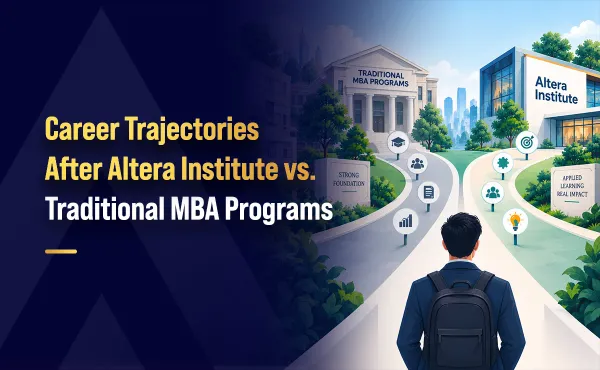
How Altera's Curriculum Compares With a Traditional MBA in Marketing
A comparison between the two doesn't mean one is better than the other. A traditional MBA prepares generalist managers who can move across functions and industries throughout their careers. On the other hand, Altera's PGP is built for a narrower outcome: specialists who can start in marketing, growth, or product roles without months of ramp-up.
Unlike traditional MBA programs that allow students to explore functions before making a choice, Altera's curriculum requires students to make that choice on day one and builds toward it each term. Both paths have real value. But the right format depends on whether a student knows they want a career in marketing, eCommerce, or product or is still unsure.
Is the Curriculum Accepted by the Industry?
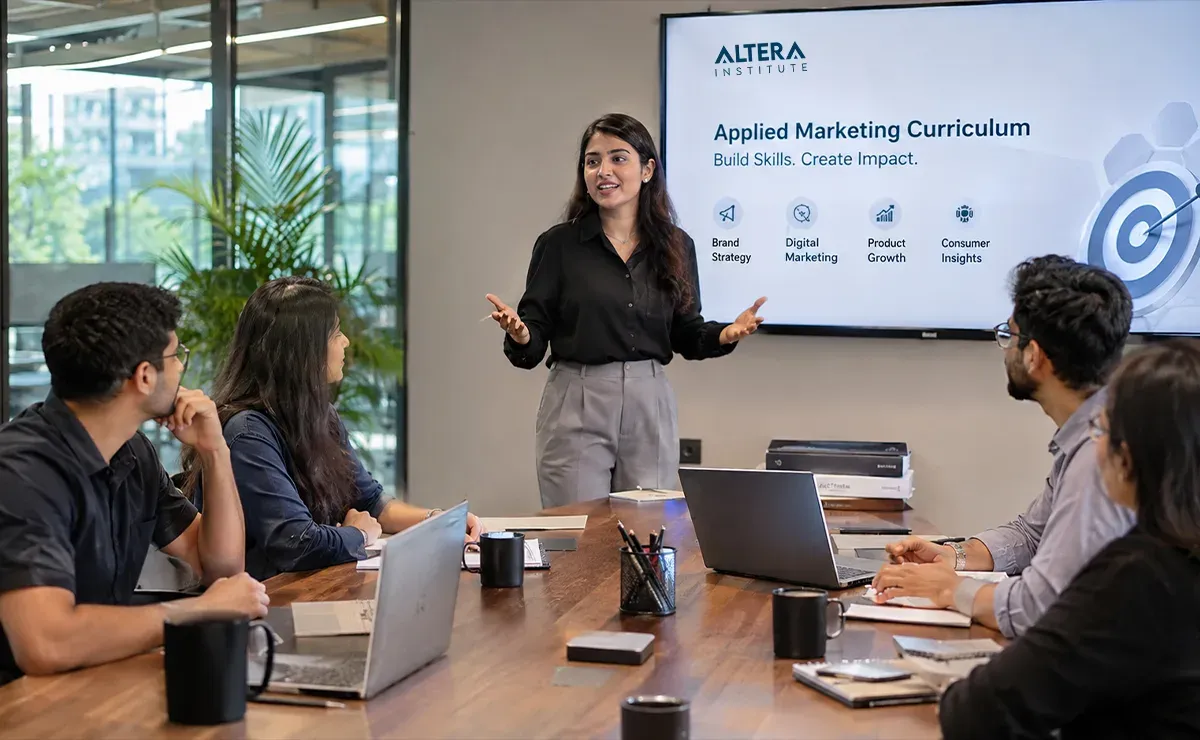
Here is where Altera's placement data proves that specialist PGPs are not only accepted in the industry but also thriving. Its curriculum is designed with industry leaders, taught by practitioners from the same companies that later hire from the program, and its placement outcomes are audited by an independent third party rather than self-reported.
Altera Institute's Interim Placement Report for the PGP Class of '26 is verified by B2K Analytics, the same firm that audits IIM Ahmedabad's placement numbers, in accordance with the Indian Placement Reporting Standard (IPRS). Fewer than 10 of India's 5,500-plus B-schools follow that standard, making Altera’s placement report highly trustworthy in the market.
Employer participation backs this up further. Altera is a knowledge partner to Hindustan Unilever and Amazon, and more than 40 organizations use its programs to upskill their own employees.
On the placement side, over 90% of students placed so far for the PGP class of ‘26 have landed digital or AI-first roles. More than 50% of them landed roles in eCommerce, and this year's recruiter list grew by more than 40 new companies, including Hindustan Unilever, Mondelez International, Dabur, Nykaa, Swiggy, Shiprocket, WPP, and Mars Petcare. One of the students also secured Altera's first-ever placement at a venture capital firm this year, a segment that rarely hires MBA freshers straight out of a program.
Employer involvement at this level, designing the curriculum, teaching it, and then hiring from it, is a stronger signal of relevance than any brand name on a brochure.
Who Benefits Most from This Curriculum?
Altera's own cohort composition suggests that this curriculum works for a wide range of students at different career stages and is open to both freshers and working professionals.
Fresh graduates make up a large share of every batch, with 37% of the incoming Class of '27 arriving with less than six months of work experience, and outcomes back this up, with students moving from BBA, engineering, and sociology degrees straight into roles like Key Account Manager, Area Manager, and Brand Management.
Career switchers and early marketing professionals show up just as consistently in placement outcomes, moving from operations, sales, or generalist roles into growth marketing, brand management, and category management positions at companies like Nykaa, Mondelez, and Honasa.
Is Altera Institute's Applied Marketing Curriculum Worth It?
For students set on a career in marketing, eCommerce, growth, or product management, the case is straightforward: an industry-designed curriculum, an audited placement record that most B-schools don't publish even after their cycle closes, and a recruiter list that keeps growing year over year.
Although it's a narrower bet for students eyeing consulting, finance, HR, or operations, it's still better served by pursuing a broader MBA program, since those functions aren't what this curriculum is built around. Which is why choosing the right program comes down to the career someone wants, not just the qualification they'll walk away with.
For anyone weighing this decision, Altera Institute's full curriculum and placement reports are worth a closer look before making the call.