1-Year MBA Programs Accepting NMAT Scores in India: Full List [2026]
![1-Year MBA Programs Accepting NMAT Scores in India: Full List [2026]](/blog/content/images/size/w1200/2026/05/1-Year-MBA-Programs-Accepting-NMAT-Scores-in-India-2.webp)
Yes, several reputed 1-year MBA and PGPM programs in India accept NMAT scores for admission, though most also accept CAT, XAT, GMAT, or their own aptitude tests alongside it.
Before diving in, it helps to know one thing: true 1-year MBAs are quite rare in India. Most programs in this space are called PGPM or PGP, which stands for Post Graduate Programme in Management. These are fully equivalent to an MBA in terms of curriculum and career outcomes, just structured differently. Recruiters from top companies treat them the same way.
Acceptance through NMAT varies from institute to institute. Some accept it as a standalone score, others need it paired with a second exam, and a few use it as one of many options in a broader test pool. The work experience requirement, fees, and specialization focus also differ quite a bit across programs.
Among newer industry-focused options, Altera Institute has emerged as a notable NMAT-accepting alternative for candidates seeking specialized business education in applied marketing. It was established in 2023 in Gurgaon's Cyber City, and it has swiftly established a reputation for having a curriculum that is taught entirely by industry professionals and having outstanding placement figures for a relatively young school.
Quick Comparison Table: 1-Year MBA Programs in India Accepting NMAT Scores
Detailed Review of Top 1-Year MBA Programs Accepting NMAT in India
Altera Institute – PGP in Applied Marketing
Altera Institute is an industry-backed business school in Cybercity, Gurugram, and its 15-month PGP in Applied Marketing is designed as an upgrade to the traditional MBA, built specifically for careers in marketing, eCommerce, and product management. It targets early-career professionals and fresh graduates who want focused, role-ready outcomes rather than a broad generalist degree.
Program Highlights
- Duration: 15 months (12 months on campus + 3 months internship)
- Exams Accepted: CAT, XAT, NMAT, and GMAT. No score? You can take Altera's own test called ALNAT, which is held periodically.
- Eligibility: Bachelor’s degree with a minimum 50% marks; freshers are eligible
- Curriculum Style: 100% designed and delivered by industry experts from FMCG, consulting and eCommerce
- Live Projects: After the first term, students work directly with companies on real business challenges, applying learning while building their professional network
- Career Focus: Brand management, growth marketing, performance marketing, product management, and eCommerce.
Fees and Placements
- Total Fee: Rs. 16.44 lakh (Rs. 1 lakh admission fee + Rs. 15.44 lakh tuition)
- Average Package (2025): Rs. 16.85 LPA, verified by IPRS audit
- Highest Package (2025): Rs. 26.08 LPA
- Top Recruiters: Purplle, Sheela Foam, NatHabit, SquadStack, Supertails, Plum Insurance, etc.
Best For: Candidates who want a specialized marketing or digital-first career and prefer depth over a general MBA.
ISB AMPBA – Advanced Management Programme in Business Analytics
ISB AMPBA is not a traditional MBA. It is a 15-month blended program for mid-career professionals looking to move into analytics, data science, or machine learning roles. NMAT is accepted as part of the admissions pathway, though with a condition worth noting.
Program Highlights
- Duration: 15 months (mix of online learning and on-campus residencies)
- Exams Accepted: You can submit GMAT, GRE, CAT, or NMAT scores to request a waiver from ISB's own admissions test. But the final call on whether to grant that waiver is made by the admissions committee. So your NMAT score helps, but it does not guarantee a test exemption.
- Who Can Apply: Graduates in engineering, technology, statistics, mathematics, or science with at least 2 years of full-time work experience.
- Placements: ISB does not run campus placements for this program since most participants are already employed and typically have employer support during the program.
Fees
- Total Fee: Rs. 965,000 plus 18% GST. This covers tuition, course materials, and boarding during on-campus residencies.
Best For: Working professionals from STEM backgrounds who want to upskill into analytics and use the ISB network to grow within their careers. Not the right fit if you are looking for campus placements.
Great Lakes Institute of Management – PGPM (Chennai)
Great Lakes PGPM is one of India’s most established one-year management programs, accredited by both AACSB and AMBA. It added NMAT to its accepted exams list starting with the 2026-27 admission cycle, which makes it now accessible to a wider pool of candidates.
Program Highlights
- Duration: 1 year, full-time and residential
- Exams Accepted: GMAT from January 2023 onwards, CAT 2024 or 2025, XAT 2025 or 2026, and NMAT 2024 onwards
- Who Can Apply: Graduates with at least 60% in 10th, 12th and college, plus a minimum of 2 years of work experience
- What You Study: General management with options in marketing, finance, analytics, operations and strategy
- Bonus: You can do a short international trip to partner schools in France and other countries as part of the program
Fees and Placements
- Total Fee: Rs. 23.50 lakh, including single AC accommodation on campus
- Average Salary After Graduation: Rs. 17.8 LPA
- Highest Salary Offered: Rs. 30.8 LPA from a multinational consulting firm
- Top Hiring Sectors: Technology consulting at 36%, business consulting at 25% and IT/ITeS at 22%
- Top Recruiters: Accenture, Deloitte, Infosys Consulting, KPMG, IBM, Swiggy and ZS Associates
Best For: Experienced professionals targeting consulting, analytics, or general management roles who want a well-ranked, globally accredited one-year program.
SOIL Institute of Management – PGPM
SOIL’s one-year PGPM is built around a leadership-first philosophy. The admissions process aims to identify students with the right attitude aligned with SOIL’s value system and the willingness to explore their leadership potential. It is backed by an industry consortium of companies that co-created the curriculum, which gives it a strong corporate connection.
Program Highlights
- Duration: 12 months
- Accepted Exams: CAT 2024, NMAT 2025, XAT 2025. No entry score? SOIL's aptitude exam is also an option.
- Eligibility: Bachelor's degree with a minimum of 50%, 60% in both the 10th and 12th, and two years of work experience.
- Curriculum Style: The year-round program includes leadership courses, design thinking, group activities, and industry professional time.
- Selection Process: Application, followed by GEPI (Group Exercise and Personal Interview)
- Scholarships: Need-based and merit-based scholarships of up to Rs. 2 lakh each are available
Fees and Placements
- Total Fee: Rs. 1,533,226 GST included. Tuition, program costs, alumni membership, and a refundable deposit of Rs. 30,000 are all included in this.
- Placement Rate (2025): 98 to 100%
- Average Package (2025): Rs. 11 to 12 LPA
- Highest Package (2025): Rs. 21.8 LPA
- Top Recruiters: Gartner, Infosys and KPMG, among others
Best For: You have a few years of work experience, want to grow as a leader, and are looking for a program that builds both your skills and your character alongside each other.
Which Other Entrance Exams Do These 1-Year MBA Colleges Accept?
Most 1-year MBA and PGPM programs in India do not rely on NMAT alone. Almost every institute on this list accepts two, three, or even four different entrance exams, which means your options are wider than you might think. Whether you have taken the CAT, GMAT, or a lesser-known institute test, there is likely a program that will consider your score.
Here is a quick look at the most common exams accepted across these programs and what each one is best suited for.
Several programs on this list also run their own entrance tests, which is useful if you have not taken any of the national exams above. SOIL conducts the SOIL Aptitude Test. Great Lakes has its own GREAT exam. ISB runs an online admissions test for candidates who do not submit an external score.
Altera Institute goes one step further by offering the most flexibility of any program on this list. It accepts NMAT along with CAT, XAT, and GMAT and also runs its own test called ALNAT for candidates who have not appeared for any national exam. This makes Altera accessible for a much wider range of applicants, including those who did not prepare for CAT but still want a rigorous, industry-focused management program.
How to Choose the Right 1-Year MBA Program if You Have an NMAT Score
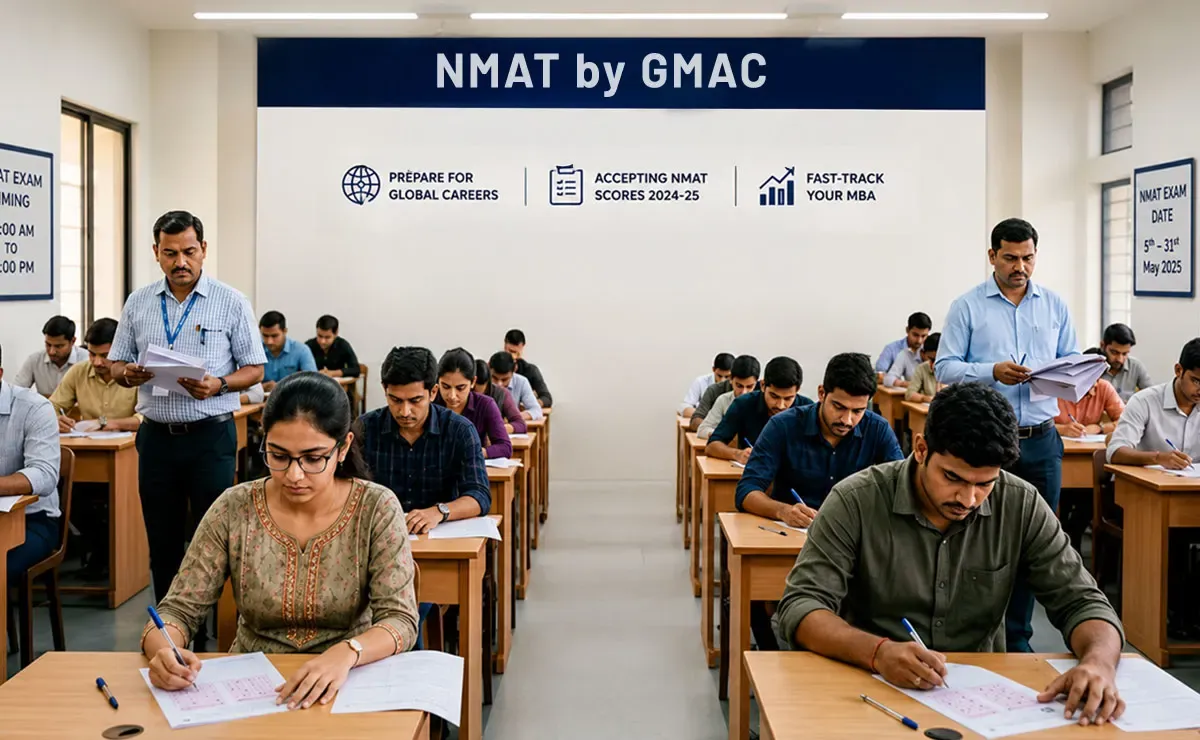
Having an NMAT score is a good starting point, but it does not tell you which program is the right fit. Before you apply anywhere, ask yourself these four questions.
Career Goal Alignment
If you want to work across different business functions or grow into leadership, a general management program like Great Lakes or SOIL makes more sense.
But if you already know you want marketing, brand management, or eCommerce, a specialized program gets you there faster. Altera Institute’s PGP in Applied Marketing is built entirely around those roles, so every class, project, and placement points in that one direction.
Work Experience Eligibility
This is the first thing to check before you get excited about any program. Most 1-year programs need at least 2 years of full-time work experience, and they are strict about it. Great Lakes, SOIL, and ISB AMPBA all have this rule and do not make exceptions.
If you are a fresh graduate or have under 2 years of experience, Altera Institute is one of the very few programs on this list that will consider your application, as long as you have a degree with 50% marks.
ROI & Placement Outcomes
Look at the numbers honestly before you commit. A program that costs Rs. 23 lakh but places students at an average of Rs. 17 to 18 LPA has a different payback timeline than one that costs Rs. 15 lakh with an average of Rs. 11 to 12 LPA. Neither is wrong, but you need to factor in your current salary, your expected jump, and how long it will take to recover the investment.
As a rough guide, a healthy ROI means you recover your full fee within 2 to 3 years of working post-program. Use the placement numbers from each institute's official reports, not estimates, to do this calculation before you decide.
Curriculum Relevance
Some programs follow a traditional classroom format with lectures, case studies, and exams. Others are built around live industry projects and sessions run by working professionals.
If you prefer learning by doing, Altera is built around exactly that. Students work on live business projects with real companies from their very first term. If you prefer a more structured academic environment with globally recognized accreditation, Great Lakes or SOIL will suit you better.
Who Should Consider a 1-Year MBA Through NMAT?
Not every candidate fits every program, so here is a simple breakdown of who benefits most from this route.
If you have 2 or more years of work experience, you have the most options. Great Lakes, SOIL, and ISB AMPBA are all within reach. You can compare them based on fees, placement outcomes, and the kind of roles their alumni land. This group typically sees the strongest salary uplift after a 1-year program because they are coming in with context and going out with credentials.
If you are switching careers, a 1-year program can work well, but only if the program's placement outcomes actually reflect the new domain you want to enter. Check the sector-wise placement breakdown, not just the average salary number. Great Lakes places emphasis on consulting and analytics. Altera places entirely in marketing and digital roles. Pick based on where you want to go, not where you are coming from.
If you are a fresher or have less than 2 years of experience, most programs on this list will not be an option for you. The exception is Altera, which accepts fresh graduates, and SPJIMR GMP, which also does not mandate work experience. If you fall into this group and your goal is a marketing or digital career, Altera's program is one of the very few structured, full-time options available to you at this stage.
Conclusion
NMAT is not just for getting into NMIMS anymore. Today, a good NMAT score can get you into several solid 1-year management programs across India, whether they are established names like Great Lakes or SOIL or newer industry-focused schools like Altera Institute.
The right choice depends on where you are in your career and where you want to go. Fees, work experience requirements, and placement outcomes vary widely, so compare carefully before you decide.
For candidates targeting marketing, growth, or digital business roles, Altera's PGP in Applied Marketing offers stronger role alignment than a generalist PGPM. Match your goal to the right program and apply early.
FAQs
Q1. Is NMAT accepted for 1-year MBA programs in India?
Ans: Yes, it is. Several strong 1-year MBA and PGPM programs accept NMAT, including Great Lakes, SOIL, and Altera Institute. Most of them also accept CAT, XAT, and GMAT alongside it, so you are not limited to just one exam score.
Q2. Which is the best 1-year MBA accepting NMAT in India?
Ans: It honestly depends on what you want to do after. Great Lakes and SOIL are strong choices for general management careers. But if you want a focused career in marketing, digital business, or eCommerce, Altera is the more direct and relevant pick.
Q3. Does ISB accept NMAT for its 1-year MBA?
Ans: ISB accepts NMAT for the AMPBA program, but only as a waiver request for their own entrance test. The admissions committee makes the final call on whether to grant it. So treat your NMAT score as a supporting document, not a guaranteed entry ticket.
Q4. Can freshers apply to NMAT-accepting 1-year MBA programs?
Ans: Most programs on this list require at least 2 years of full-time work experience and are firm about it. Altera Institute is one of the very few exceptions, welcoming fresh graduates who have a degree with at least 50% marks. SPJIMR GMP also does not have a strict work experience rule.
Q5. Is Altera better than traditional 1-year MBA programs for marketing careers?
Ans: If marketing is your end goal, then yes, Altera makes a strong case. Its entire curriculum is built around marketing, growth, and digital roles. Traditional programs tend to cover many subjects broadly, whereas Altera focuses only on the specific skills and knowledge you actually need for those careers.