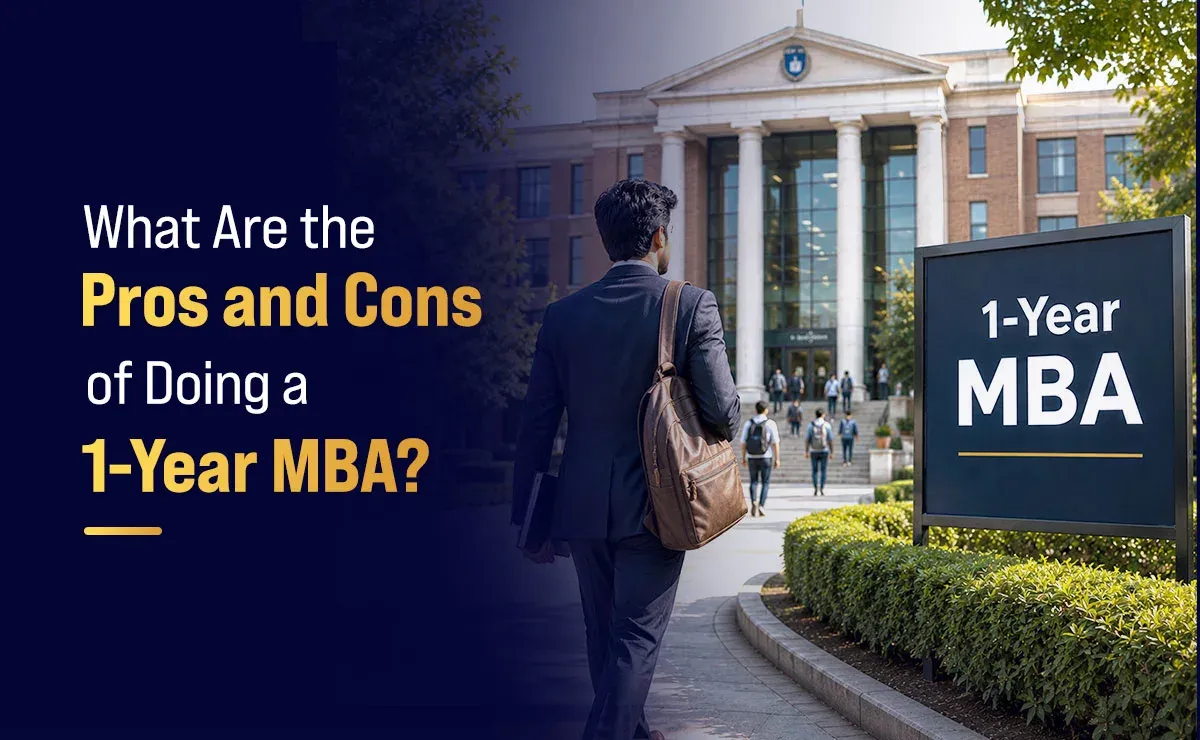
What Are the Pros and Cons of Doing a 1-Year MBA?

For many years, the two-year MBA was the only path to management careers and leadership roles in the country. The idea that top colleges like IIMs were the only path to success was a reasonable assumption, given limited options in fields of expertise. Today, however, things are very different.
Digital businesses now grow in a matter of months; consumer behavior evolves with every new product, and AI is affecting marketing, operations, and strategies across every aspect of a modern-day business. Because of these key shifts in how businesses operate today, one-year MBAs and PGP programs have become increasingly popular worldwide.
Today, in India, top colleges like the ISB, SPJIMR, XLRI, and newer industry-designed B-schools like the Altera Institute offer specialist, hands-on programs that last 12 to 18 months. The benefits of this model are clear: it provides a more curated curriculum and specialization in targeted fields, therefore leading to more desirable outcomes.
But just like every other good educational pathway in the country, 1-year MBAs also have a flip side to them, and in this article, you will explore a holistic way to understand which format to choose for a better career.
Why are One-Year MBA Programs Growing Globally?
The rise in one-year MBA enrollments isn’t just a trend. It’s a direct result of the changes in careers, hiring, and business models over the past ten years.
One-year MBAs are now more widely accepted worldwide. Top B-schools are increasingly offering one-year courses, often at the executive level. Moreover, recruiters today care more about demonstrated skills than about the length of a program. And because of this, one-year programs are now seen as equivalent, and in some cases even a specialist upgrade, to the two-year MBAs in many fields.
The Biggest Advantages of One-Year MBAs
For many people, the one-year MBA has several clear advantages over the traditional two-year program.

1. Faster Career Acceleration
One-year MBAs are less time-consuming and can be completed in 12 to 15 months, letting you get back to work much sooner than two-year MBAs. This lets you use your new skills and talents right away, grow faster, and keep your career moving without a long pause.
2. Stronger Financial Efficiency
A shorter program also directly translates into lower tuition and living costs, meaning you can also earn back your investment faster. Programs that offer great job placements help you break even much sooner after graduating. For example, Altera Institute’s PGP in Applied Marketing recorded a median salary of ₹18.14 LPA for the class of ’25. And since the program fee is ₹16.44 lakhs, most graduates recover their costs within a year.
3. Industry demand for job-ready, mid-career talent
Recruiters today are hiring candidates who can demonstrate job-ready skills without requiring extended on-the-job training. With the advent of AI, there is also a shift in the relevant skills required in many high-growth roles. Whether it is social media trends or hiring, the changes are happening faster, and companies are becoming leaner & hiring smarter. Therefore, it is important that we produce industry-centric talent more quickly through relevant digital-first education, which is exactly what 1-year MBA programs are focusing on.
4. Focused, Targeted Learning
One-year MBA programs do not include extensive foundational courses and instead focus on execution, strategy, analytics, and digital and AI-first business skills. This is particularly useful in fast-moving fields where practical and targeted learning is more valuable. Courses that focus on AI, eCommerce, and solving real business problems make these competencies an active part of the curriculum rather than just adding them as electives taught in the same generic manner.
The Trade-Offs You Need to Know
The benefits of the one-year format also come with some real downsides. It’s just as important to know about these challenges before you enroll as it is to see the positives.
1. The Pace Is Intense
One-year MBA programs pack a lot of learning and skill development into a short time period. There is little opportunity for students to take time off, build foundational business knowledge, or explore other specializations beyond the one they opted for. Since a one-year MBA moves beyond foundational courses to focus on a particular specialization, it can be harder for people without the necessary background.
2. Clarity of Expectations from Day One
A two-year MBA lets students explore a number of different electives, provides a more comprehensive understanding of business functions, and gives them time to try out different industries and specializations. In contrast, one-year programs expect students to be clear about their career path right from the outset. If you want to switch careers but haven’t yet tried your target industry, the short duration gives you little time to test your options before making a decision.
3. Certain Career Pathways May Still Prefer Two-Year MBAs
There are certain sectors and roles in the industry, such as investment banking or traditional consulting, that still require students to have a traditional two-year MBA to be considered. Hence, if you are aiming to get into specific roles that require entry only through a traditional full-time MBA degree, the two-year option might offer better outcomes.
Who Should Actually Consider a 1-Year MBA?

Choosing between the two formats is about what fits you best, not which one is better. The right choice depends on where you are in your career, what you want from the program, and your goals after you graduate. Both options have their own strengths.
A one-year MBA is best for you if:
- You have 1 to 5 years of work experience and a reasonably clear career direction.
- You are pursuing specialist roles, as many one-year programs are specifically designed to prepare students for new-age, high-growth positions.
- Lost opportunity cost is a serious consideration for you, and faster financial recovery is one of your primary goals.
- You want a practitioner-led curriculum focused on execution rather than broad academic coverage.
- You are an early-career professional looking to build specialized, digital-first skills faster.
A traditional two-year MBA is best for you if:
- You are switching industries and need to build foundational business knowledge.
- You want broad academic exposure and time to explore different electives before specializing.
- You are targeting traditional roles in investment banking, consulting, or legacy corporate leadership programs.
- You value an extended campus experience for deeper networking and long-term relationship building.
Now, it is true that most top one-year MBA programs in India are executive-level programs, meaning they are open only to early-career professionals with at least 3 years of experience. There are, however, alternatives like one-year PGPs and PGDMs that address the market gap by catering to both freshers and working professionals.
And this is where B-schools like the Altera Institute have made a mark in the industry. They have broadened this conversation by designing programs that welcome both freshers and early-career professionals. This makes the one-year format a credible entry point for candidates who want to build digital-first, industry-relevant skills at the very start of their careers, rather than waiting years to upskill.
Summing Up
One-year MBA programs are more than just a new format of management education in the market. It is a key indicator of how professionals, employers, and businesses have actually changed over the years. And when you are clear about what you want, the one-year model gives you focused skills, quicker returns, and a direct path to some of the fastest-growing industries in the country right now.
In the end, prospective students must remember that recruiters today care more about skills and real-world competencies than about the duration of a course, program format, or even brand names. It is because the world of business has changed significantly, which requires job-ready talent to pave the way for the next generation of evolution and growth across industries.
Programs built on practical execution, AI integration, and a digital-first business model will surely have the upper hand and help produce that talent, no matter the format or duration.