
Why 1-Year MBA Programs are Becoming the New Norm Globally?

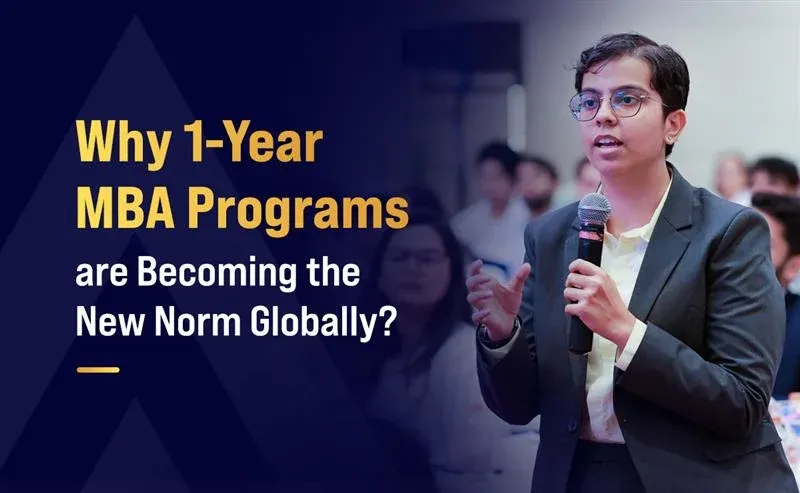
Not just in India, but most prominent B-schools across the world are now offering one-year MBA programs. It is not a sudden shift but a careful step to meet the dynamic needs of the constantly evolving economic landscape.
Professionals are now seeking faster career growth and more efficient returns on their education. They are constantly looking for upskilling opportunities that don’t require them to stay away from the workforce for too long.
This has resulted in the push for accelerated programs like a one-year MBA that can deliver the same strategic learning but in a more time-efficient format.
Let’s break this down in more detail so you know the pros and cons of a 1-year vs. 2-year MBA.
Why Are More Aspirants Choosing a One-Year MBA Program?
There are multiple reasons why an MBA aspirant may choose a 1-year MBA over the traditional 2-year course. But here are the most prominent reasons.
1) Better Return on Investment
A one-year MBA is often a more cost-effective option compared to a traditional two-year program. Since the course duration is shorter, students spend less on tuition and living expenses. This makes the financial investment more manageable while still allowing candidates to gain advanced business education.
2) Faster Career Acceleration
Pursuing a 1-year MBA program means you get to join/return to the workforce faster as compared to a 2-year program. While the traditional MBA requires a commitment of at least 2 years, a one-year MBA only needs 12-15 months of your time. This allows aspirants to apply newly acquired skills faster, transition into leadership roles, or switch industries without taking a prolonged break from their careers.
3) Lower Opportunity Cost
When you leave your job to pursue an MBA, the salary lost during this period also becomes a part of the education cost. So, for a two-year MBA, you lose working opportunities and salary for two years, whereas a one-year program reduces that opportunity cost by half.
4) Intensive but Focused Learning
Most one-year MBA programs skip the basics and focus on specialized learning through practical applications and industry-specific curriculum. They are designed for high-demand leadership roles in niches like digital marketing, business analytics, SaaS and AI development, product management, etc.
5) Networking Opportunities
Since these programs are designed for experienced professionals, they bring together a diverse cohort of individuals from different industries and backgrounds. You get access to a higher-quality and more relevant network as compared to a two-year program, where most students have no prior industry experience.
6) Flexible Model
A lot of 1-year executive MBA courses now offer online or hybrid learning models, so you don’t have to let go of your job to pursue higher education. Additionally, the wider acceptance of these programs has made them equally effective for exploring global opportunities. This flexibility allows professionals to upgrade their skills without significantly disrupting their careers.
Why Should You Consider Altera Institute for a One-Year PGP?

Not just the economy, but our lifestyle has also shifted to a digital and AI-first world, and that is why we need leaders who understand this shift. Altera Institute bridges the gap between the traditional MBA and the real-world job requirements. With its 15-month curriculum that focuses on practical business application, AI-first thinking, and industry-aligned marketing expertise, it equips you to navigate real-world challenges of this rapidly evolving economy.
1) Curriculum Style
Altera’s curriculum is heavily focused on live execution, real business problem-solving, and modern digital business careers. It prepares you for roles in growth marketing, product strategy, business analytics, brand building, etc. Their teaching focuses on how to develop execution strategies and business models, build brands, and learn current industry tools instead of just focusing on traditional consulting and finance roles.
2) Faculty
Unlike the traditional IIM faculty who employ career academics from global universities, Altera Institute brings in startup founders, growth leaders, product managers, and industry leaders to bring real-time insights into the classroom. It allows you to learn from people who are actually solving real problems in real-time through case studies, live projects, and direct interaction with companies.
3) Placement and Roles
Digital businesses and startup ecosystems have become the new business norm. They require leaders who can go beyond consulting roles and think digitally first. This is where Altera Institute steps in by preparing leaders who understand startup environments, high-growth consumer brands, digital strategy, and product thinking. If you aim for growth and performance marketing, product management, and roles similar to brand and consumer strategy, Altera can prepare you for it.
4) Eligibility
While institutes like ISB require 24 months of work experience to enter their 1-year PGP program, Altera Institute also accepts freshers and early-career professionals. Instead of just focusing on mid-career leadership roles, it aims to prepare young professionals early in their careers. It also allows you to build in-demand skills right at the beginning of your career for faster acceleration and to penetrate specialized roles much earlier in your professional journey.
5) Live-Project Learning
One of the key differentiators that sets Altera Institute apart from other one-year MBA programs is its access to live company projects. While most elite courses focus on theoretical learning, the Altera Institute exposes its students to real assignments from companies directly.
It pushes them to gain practical portfolio experience by learning how to run marketing campaigns, design growth and go-to-market strategies, conduct real-time market research, and more.
6) Peer Networking
Because Altera’s faculty includes industry leaders and founders, it gives you early access to a highly valuable professional network. Instead of building connections only with fellow students, you also interact with founders, operators, and growth leaders who are actively shaping modern digital businesses. This exposure allows students to build meaningful industry relationships early in their careers and also access opportunities across startups and high-growth brands.
Key Takeaway
With changing economic trends, MBA aspirants are seeking upskilling opportunities that prepare them for the digitally driven ecosystem with hands-on learning in a shorter duration. One-year or accelerated MBA programs are designed to equip students with relevant skills in an intensive but focused and shorter time duration than traditional MBAs.
Institutions like Altera Institute are adapting this model to prepare professionals for digital-first industries through hands-on learning and real-world exposure. If you’re exploring whether a one-year MBA aligns with your career goals, you can learn more about their program by visiting their website.