Which MBA is the Best?

An MBA is a master's degree in business administration that builds skills in strategy, finance, marketing, leadership, and operations. Students need it to accelerate careers, switch industries, gain credibility for senior roles, expand networks, and boost earning potential through structured business thinking.
In a way, asking which MBA is the best is like asking which career is the best. It depends entirely on who you are, where you are in your career, and what outcome you are trying to achieve. There are more than 5,000 management programs available in India, with a wide range of formats and specializations available.
MBA programs are not all built the same, and not all students are suited to the same program. By choosing the right format, you have a say in how you learn, who your peers will be, and which employers will take your credential seriously. Depending on the specialization you choose, you will be prepared for different roles, and your career trajectory will be set in motion.
In this article, we provide an overview of the major MBA formats available in India, an outline of traditional and emerging specialization options within those formats, as well as a practical framework for determining which combination best suits your specific needs.
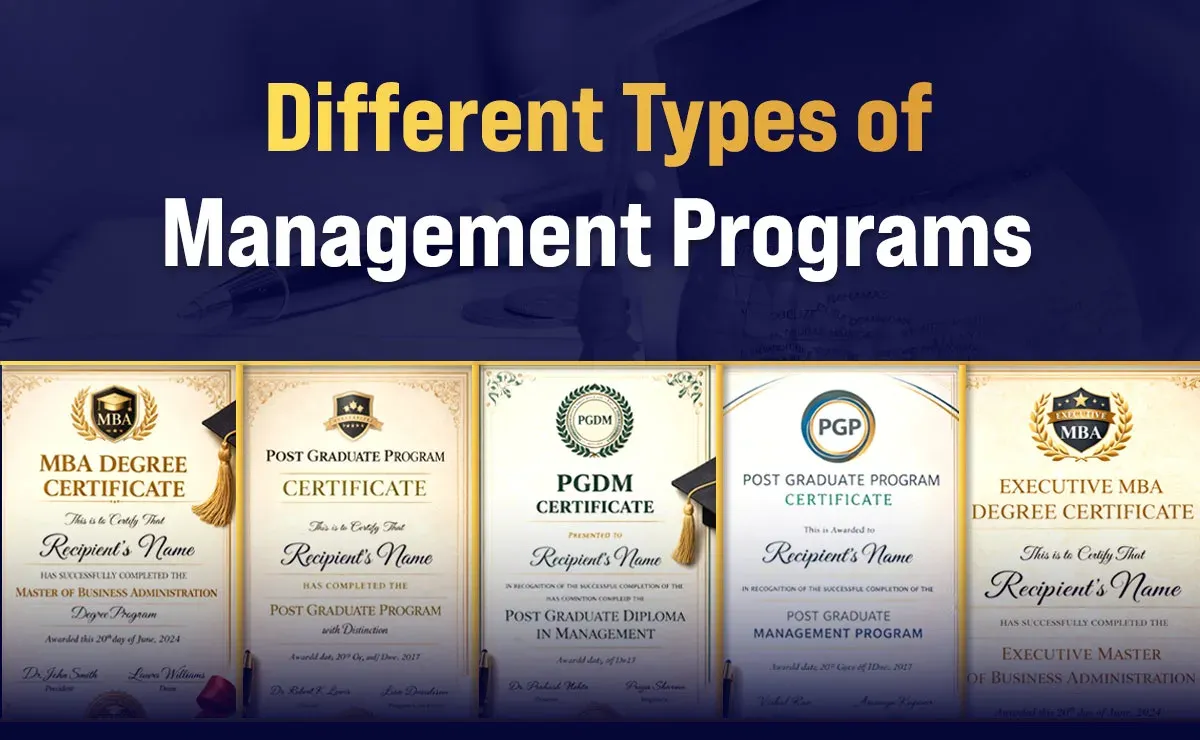
Different Types of Management Programs
The management education sector in India is not a single category. This is a structured ecosystem of formats; each is designed for a specific kind of student and career goal. To make an informed decision, it is important to understand what each format is designed for.
1) MBA
MBAs are postgraduate degrees awarded by universities and deemed universities recognized by the University Grants Commission. It is the most widely recognized management credential in India and is accepted in public, private, and government roles. In most cases, full-time residential programs last two years, but you can also complete your degree part-time or via distance learning.
An MBA is best suited to students who wish to gain a broad understanding of finance, marketing, operations, and strategy, as well as those who are seeking positions within well-established organizations. A degree from a university-affiliated program offers students the benefit of a formal credential, which is recognized across a wide range of sectors and industries.
2) PGDM
Several autonomous institutions approved by AICTE offer the Post Graduate Diploma in Management, including XLRI, SP Jain, MDI Gurgaon, and Great Lakes. Because they are not affiliated with universities, these institutes award diplomas rather than degrees; however, they are much more flexible in designing and updating their curricula than university-affiliated programs.
It is this curriculum flexibility that distinguishes the PGDM from other programs. With fewer regulatory constraints, programs can incorporate emerging business areas more quickly. PGDMs are widely considered equivalent to MBAs by private-sector employers, and graduates from reputable AICTE-approved institutions regularly receive strong placement results.
3) PGP
The Post Graduate Program in Management is a Certificate of Completion awarded by autonomous institutes outside the university system and the AICTE diploma framework. For example, PGPs are awarded by the IIMs, the ISB, and the Altera Institute. Since these institutions are governed by their own Acts of Parliament or operate independently, they have the flexibility to design their programs in line with industry demands.
PGPs attract some of India's most competitive recruiters and result in strong placements. ISB's one-year PGP, for example, is considered by many employers to be on par with, or even ahead of, legacy MBA programs from older institutions. New-age programs like Altera Institute's 15-month PGP in Applied Marketing are built entirely around digital and AI-first career outcomes and are designed and taught exclusively by active industry practitioners.
4) Executive MBA
An Executive MBA is designed for professionals with 5 to 12 years of experience who wish to advance their careers or move into a new field without leaving their current employer. A number of programs cater to this profile, such as the Executive MBA program at IIM Bangalore, the PGPEX program at IIM Calcutta, and the Executive Management Program at XLRI.
Most EMBA programs are offered on weekends or in modular formats, making them accessible to working professionals. In-person and online sessions aren't a compromise on quality; they're a deliberate design choice to accommodate people with full-time jobs who cannot study full-time.
5) Advanced Management Programs
The Advanced Management Program is a theme-specific, intensive program designed for senior managers with 15 or more years of experience in their field. The ISB Advanced Management Program and IIM Ahmedabad's AMP prepare executives for C-suite roles by offering immersive, week-long residential programs rather than month-long ones.
In contrast to generalist programs, AMPs are specialized. It assumes participants have solid business foundations and focuses on a specific domain or leadership challenge. Applicants are evaluated not on their entrance exam scores but rather on the depth and seniority of their professional experience.
It is important to note that formats such as online, one-year, and weekend MBAs do not constitute separate categories. They are delivery variants of the formats listed above. Among the most prominent one-year MBA programs in India are ISB's flagship one-year PGP program and Altera Institute's PGP in Applied Marketing. In executive MBA programs, online and weekend delivery models are routinely used to accommodate working professionals.
Now that you understand the different MBA formats, it is important to recognize that selecting the right one is only the first step. As part of each format, students must also choose a specialization, which determines what role they will prepare for and what career they will pursue.
Popular Traditional MBA Specializations
Here are some of the most popular MBA specializations in India. A specialization provides students with the skills and knowledge they need to excel in their chosen field. It includes:
- In an MBA Finance program, students learn about corporate finance, investment analysis, risk management, and market dynamics. Financial analysts, equity research analysts, and credit analysts are typical entry-level positions. Due to the digital transformation of financial services, students who possess core finance skills as well as knowledge of fintech and digital finance products have a significant advantage over their peers.
- An MBA in Marketing covers consumer behavior, brand strategy, advertising management, and digital electives. The most common entry-level roles include sales and marketing trainees, assistant brand managers, and category managers in FMCG and consumer goods. To qualify for a digital marketing career, students should ensure their program's digital curriculum is up to date.
- An MBA in supply chain management focuses on logistics, process optimization, and production planning. Graduates typically enter positions in plant operations, supply chain management, and logistics. Due to the significant changes in the flow of goods from production to consumption, programs that integrate eCommerce operations and digital fulfillment are becoming increasingly relevant.
- An MBA in consulting develops structured problem-solving, analytical communication, and cross-functional business-thinking capabilities. Graduates typically seek positions in management consulting firms, strategy functions within large organizations, and general management positions. This specialization rewards students who are comfortable with ambiguity and can build clear recommendations from incomplete information.
- MBAs in Business Analytics develop data interpretation, statistical modeling, and decision-support skills across business functions. Students enter the workforce as business or data analysts supporting marketing, operations, finance, and product teams. For students who want a quantitative foundation applicable to a variety of industries, this is a strong specialization.
- An MBA in Human Resources covers topics such as people management, performance frameworks, organizational culture, and talent acquisition. A variety of entry-level positions are available in HR, including generalist positions, recruitment, and business partner positions. Those students who build data-driven HR capabilities alongside traditional HR competencies will be able to differentiate themselves as AI transforms people's management.
It is important to note that traditional specializations continue to produce strong outcomes, particularly at well-ranked institutions with established recruiter relationships. However, they don't always give you the best path into the digital, revenue-centric roles, seeing the most growth today. To address this gap, a new category of specialization has emerged.
Emerging Digital-First Specializations
Due to the evolving needs of high-growth organizations, a new category of specializations has emerged. These tracks are characterized by rapid career growth, higher pay, and enhanced visibility through digital execution, revenue accountability, and cross-functional ownership.
- A Product Management program prepares students to own products from start to finish, combining technology, design, and business strategy. Among the entry-level roles available in technology companies, D2C brands, and eCommerce platforms are Associate Product Managers and Product Analysts. Students who enjoy systems thinking and own measurable results across functions will benefit from this specialization.
- Growth and Performance Marketing focus on owning the entire revenue funnel. In this course, students learn how to manage customer acquisition, activation, and retention by utilizing Google Analytics, Meta Ad Manager, and attribution tools. Growth Marketer, Performance Marketing Manager, and Growth Analyst are among the roles directly accountable for measurable business results.
- eCommerce and Digital Business focus on conversion rate optimization, platform management across Amazon and Flipkart, pricing strategy, demand forecasting, and category-level profit and loss calculations. The demand for these graduates continues to expand well beyond digitally native companies as legacy FMCG and consumer goods companies invest heavily in eCommerce capabilities.
- A digital brand and media management program incorporates consumer psychology, digital media planning, content strategy, and creator-led branding. Upon graduation, graduates find employment as Assistant Brand Managers, Digital Marketing Managers, or Content Strategists in digital-first companies. It is suitable for students who can handle both analytical responsibility and creative thinking simultaneously.
- Data and AI in Business teach students how to translate data into strategic decisions across functions and industries. Typical roles include Business Analyst, Data Strategy Analyst, and strategy-oriented positions within technology companies and consulting firms. As AI transforms every business function, candidates with domain knowledge and data fluency are in high demand.
How to Choose the Right MBA for You?
The most common mistake students make when choosing an MBA is optimizing prestige rather than fitness. The right MBA is the one that prepares you most directly for the roles you actually want to do. Before comparing program names or rankings, answer these questions honestly.
- What career stage are you at? A fresh graduate and a mid-career professional are not looking for the same program. MBA and PGP formats are designed for early-career candidates. EMBA formats serve working professionals. AMPs serve as senior leaders. Choosing the format that corresponds to your experience level is the first filter.
- What kind of work do you want to do? If you are drawn to revenue-centric, digital-first roles, an emerging specialization in Growth Marketing, Product Management, or eCommerce will serve you better than a traditional Finance or HR track. If you are targeting investment banking or consulting, a traditional Finance or MBA Consulting track at a well-ranked institution is the more direct path.
- What does the placement record actually show? Look beyond the average salary figure. Identify the specific companies and roles that graduates from the program enter. If those companies and roles match your target, the program is worth serious consideration. If they do not, the credential is unlikely to produce the outcome you are aiming for regardless of the institution’s reputation.
Conclusion
There is no such thing as the best MBA. Choosing the best MBA program will depend on your goals, your current profile, and the career you are pursuing. It is the format that determines how you learn and who recognizes your credentials. Your specialization determines what you learn and what roles you are genuinely prepared for.
In a business environment shaped by digital transformation and artificial intelligence, depth in a relevant specialization matters more than breadth across a generic curriculum. The professionals who build the most consequential careers over the next decade will be those who choose their program with clarity of purpose, not those who choose it solely for brand recognition.