What is an Executive MBA?


The management education system in India has evolved into a multilayered system that serves professionals at different career stages. Every program format is tailored to a specific purpose and outcome, from the early career graduate to the senior leader. Making a truly informed decision about your management education begins with understanding these distinctions.
Here is what the management education ecosystem in India is broadly divided into:
- Full-time MBAs, PGPs, and PGDMs are designed for fresh graduates and early-career professionals with up to 5 years of work experience. These are intensive, residential programs that build strong business fundamentals along with knowledge in a chosen specialization from the ground up.
- Executive MBA (EMBA) programs are built for mid-career individuals, typically with 5 to 15 years of experience, who are looking for accelerated career growth, strategic skill-building, or a significant role transition without completely stepping away from their careers.
- Advanced Management Programs (AMPs) are tailored for senior leaders and C-suite aspirants with over fifteen years of professional experience. These are highly specialized, theme-based programs aimed at preparing executives for focused organizational leadership responsibilities.
Among these formats, the Executive MBA occupies a particularly important position. It bridges the gap between foundational management education and senior leadership preparation — serving people who have built solid careers but find themselves at an inflexion point where structured, strategic learning becomes necessary to move forward.
Why Are Traditional 2-Year MBAs Losing Relevance?
The traditional two-year MBA is targeted toward early-career professionals. Assuming that participants had limited professional experience before an MBA, these programs required two full years of structured classroom instruction to develop a comprehensive foundation of management skills and competencies. However, today, the reality is that there is a growing segment of MBA candidates, particularly mid-career individuals, who seek fundamentally different outcomes after an MBA, and are overlooked due to this assumption.
For experienced people, two-year MBA programs pose a significant opportunity cost. The cost of leaving an active career for two years includes giving up salary, losing professional momentum, and risking the loss of industry relationships and institutional knowledge developed over time. This trade-off is substantial for individuals with a decade's worth of professional experience.
The financial commitment further amplifies these concerns. Tuition fees at premier Indian institutes are considerably higher when living expenses and lost income are factored in. This investment is increasingly difficult to justify when program outcomes are not demonstrably superior to those of shorter, more targeted formats.
Curriculum mismatch is also a significant issue. The first year of most two-year MBA programs focuses on building business fundamentals that experienced professionals have already acquired through practical experience. It is only in the second year that students can choose a specialization, which only translates into wasted time and resources for experienced professionals.
This is precisely the gap the Executive MBA was built to address, and it is why it has become increasingly relevant for mid-career professionals. Hence, the question is no longer “Should I do an MBA?” but “Which MBA format matches the ROI of my current career stage?”
For a professional earning 20-30 lakhs per year, a two-year break can result in an opportunity cost of 50-70 lakhs. As such, the EMBA is not just an alternative; it is often the most financially rational option for many people in this situation.
Types of Executive MBAs in India
In India, executive MBA programs are divided into three distinct formats based on work commitments, career goals, and personal circumstances. Choosing the right Executive MBA is ultimately determined by your current position, career goals, and the kind of growth you want to accelerate.
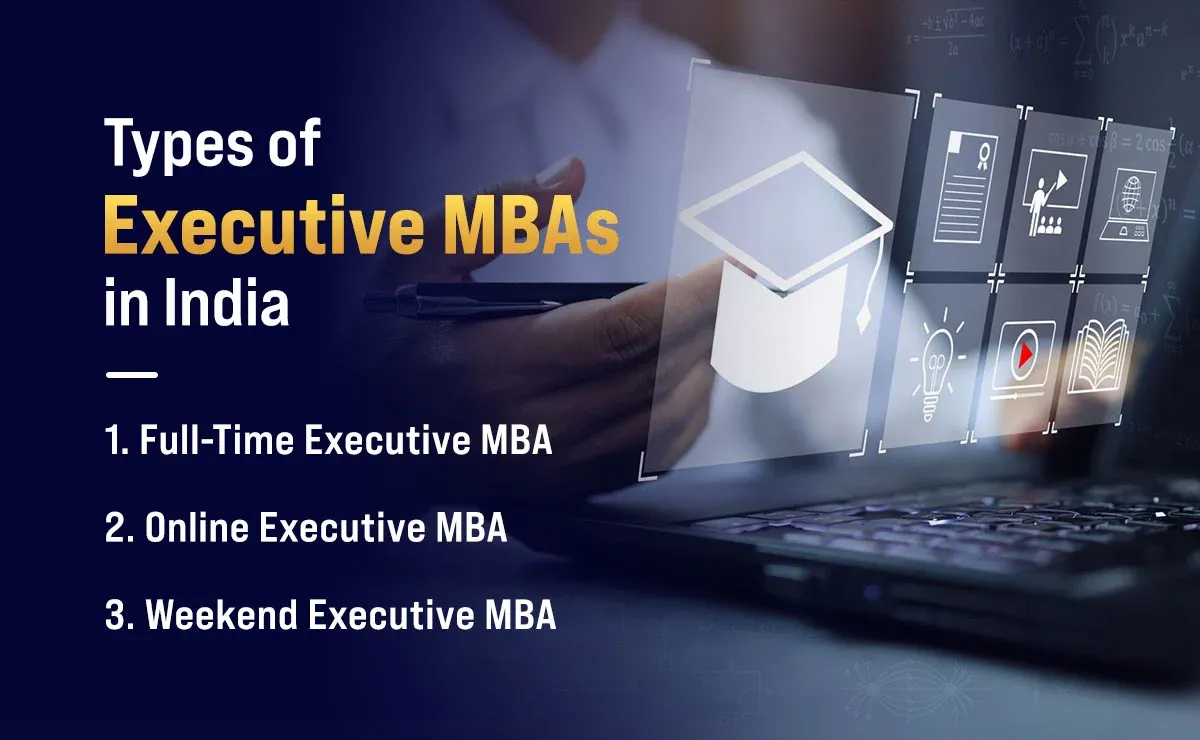
1. Full-Time Executive MBA
A full-time Executive MBA is a residential program, which takes one to two years to complete. The MBA for Executives Programme at IIM Calcutta and the SP Jain Executive MBA (EMBA) are examples of this format. It is designed for people who wish to take a structured break from their jobs and seek sustained faculty engagement, intensive peer interaction, and deep academic immersion. While it requires significant time away from employment, the depth and coherence of the experience are unlike any other format.
2. Online Executive MBA
There has been a significant increase in legitimacy and expansion of the online EMBA format in recent years. EMBA programs at NMIMS and SP Jain School of Global Management are offered online, combining virtual sessions, recorded lectures, and occasional on-campus sessions. People living outside of major cities or who travel frequently can benefit from the online format by removing traditional logistical and geographical barriers to attaining top-tier management education. It is no longer necessary to reside near a premier campus to enroll in a rigorous program.
3. Weekend Executive MBA
EMBA programs offered on weekends are most popular among mid-career professionals in India. Students are able to study while working full-time, while attending classes on Saturdays and Sundays or night classes on select weekdays. The PGPGM course at SPJIMR follows this structure. The benefit of this format is the immediate applicability of concepts; students can apply what they have learned in the workplace, creating an effective theory-to-practice cycle that is not possible in a full-time program.
B-schools like Altera Institute are rethinking the traditional MBA by making it more industry-relevant, outcome-driven, and flexible, with an industry-led curriculum tailored for modern professionals, similar to an EMBA.
Unlike traditional programs, an MBA at Altera Institute emphasizes real-world application, cross-industry exposure, and measurable career outcomes rather than just academic completion.
What Are the Benefits of Learning in an EMBA Program?
The benefits of an Executive MBA extend beyond classroom learning. As you progress in your career, you will experience these advantages in ways that you might not expect at first. Many EMBA graduates say that the most meaningful results appear not right after graduation, but in the years that follow.
- A key outcome of an EMBA program is the development of clear leadership skills and strategic thinking. To move from day-to-day management to strategic leadership, mid-career professionals need a different set of skills. It involves understanding organizational design, market positioning, managing stakeholders, and making long-term decisions.
- A major advantage of an EMBA program is the professional network you build over time. Top EMBA programs have wide-ranging alumni networks, including individuals from a variety of industries, roles, and countries. Group projects, case studies, and on-campus sessions often lead to some of your most valuable professional relationships, and these connections are difficult to make at regular networking events or via online platforms.
- In India, over 60% of EMBA graduates report role expansions, salary increases, and career changes within 12–18 months after graduation. Regardless of previous experience, many companies require a formal management qualification to move into senior leadership. This requirement is met by an Executive MBA from a respected institution that will also enable you to build the skills you need to succeed in those roles.
- An EMBA program often enables students to gain confidence to take on more challenging roles. The combination of challenging coursework, learning from industry leaders, and working alongside talented peers helps build a strong sense of professional self-confidence. Upon graduation, students have more than just a degree; they have a clear understanding of their strengths and a network of professionals to help them succeed.
Who Finds the Most Value in an EMBA Program in 2026?
Not every professional or career stage is a good fit for an Executive MBA. However, certain profiles can benefit greatly from it. Examples include a product manager transitioning to a business head position or a doctor transitioning to hospital administration. In general, the most successful program participants share a few characteristics.
- Professionals who have reached a career plateau may benefit from an Executive MBA. Although they have developed expertise, delivered consistent results, and earned organizational trust, advancement remains elusive. It is usually caused by a lack of cross-functional skills and strategic thinking required for effective leadership. An EMBA is designed to close this gap in a format that accommodates a busy professional schedule.
- Management professionals preparing for wider leadership roles can also benefit significantly from an EMBA. A professional who is transitioning from managing a team or function to leading a business unit or moving into general management must develop new perspectives and skills. An EMBA program offers learners an intensive, structured learning experience that equips them with the tools and confidence to take on broader responsibilities effectively, reducing the need for trial-and-error.
- EMBAs are also popular among professionals considering a career change. Whether moving from a corporate role to entrepreneurship, changing industry sectors, or shifting from a technical specialty to leadership, the combination of targeted coursework, live business projects, and recruiter access in a strong EMBA program reduces the challenges of a career pivot that might otherwise take years to accomplish independently.
An Executive MBA is not a shortcut to instant promotions or guaranteed salary jumps. Its value depends heavily on how clearly you define your post-program goals and how actively you leverage the network and learning.
Choosing a Program That Moves Your Career Forward

Management education should be a proactive decision for mid-career professionals. A successful Executive MBA program requires professionals to have a clear purpose, such as closing a specific gap, preparing for a specific role, or developing a needed skill. In the absence of this clarity, even the best program will have limited value. In other words, the program accelerates progress toward an existing goal rather than creating a new one.
Focus on the following factors when evaluating EMBA programs: alignment with current industry needs, diversity and quality of the cohort, the strength and accessibility of the alumni network, and the institution's track record of career outcomes for professionals with your level of experience. These are more meaningful indicators of value than brand recognition or institutional prestige.
Also, the format you choose, whether it is a full-time, online, or weekend program, is less important than its rigor and its ability to meet your professional goals. It is often more beneficial to enroll in a rigorous online EMBA program than an average in-person program. It is important that you choose a format you can engage with fully and consistently throughout the program.
In 2026, relevance, practical application, and measurable career outcomes will be more important than program duration or institution legacy in management education. Professional development programs are based on industry needs, experiential learning, and tangible growth. Choosing the right program ultimately depends on your current position, your goals, and the next step you wish to take.
Conclusion
The Executive MBA comes at a crucial point in a professional career, which is when accumulated experience begins to call for a more structured, deliberate approach to growth. This is not a program designed to introduce professionals to business; it is a program designed to develop their existing skills into strategic capabilities, leadership depth, and a professional network that is needed to operate at high levels in an organization.
In India, mid-career professionals are challenged by a business environment that is evolving faster than ever before, and the question is rarely whether management education is worthwhile. What is more important is determining which format and institution will work best for the career they are building.
In 2026, the value of an Executive MBA is measured by its ability to deliver tangible career outcomes, rather than by duration or brand. Institutions such as Altera Institute are leading this change by aligning management education with the non-linear, fast-paced, and outcome-driven nature of modern careers.