What Does an MBA Teach You?


The question "What does an MBA teach you?" deserves answers that go beyond textbook management principles and business frameworks. If you're among the lakhs of students preparing for CAT or weighing whether two years and a significant investment are worth it, you need real answers and not platitudes.
The fact is that an MBA in 2025 is completely different from what it was even 5 years ago. Companies are now seeking graduates who can combine analytical skills with leadership. MBA graduates' employment rates also paint the same picture, increasing from 47% to 78% in the last 4 years.
However, the most important part is that you know what skills you are going to graduate with, how these skills can be applied to career development, and whether the investment will be justified. This article decomposes the tangible skills, actual deliverables, and honest trade-offs that characterize MBA education in India today.
Key Statistics
The following are some important statistics on current trends in MBA outcomes in India.
- Applications to MBA programs in India surged by 26% in 2025, driven by visa uncertainties abroad and growing confidence in domestic B-schools. This represents one of the biggest shifts in recent years.
- Indian MBA graduates see salary increases of 187% three years after graduation. Financial Times data shows this significantly outpaces global averages, making an MBA in India one of the strongest value propositions worldwide.
- Employers are increasingly seeking MBA recruits, as indicated in GMAC’s 2025 survey, which found that 90% of recruiters plan to hire MBA graduates.
- Top-tier IIMs now report average salaries between ₹30-36 lakh per annum. IIM Bangalore leads at ₹35.92 lakh, followed closely by IIM Calcutta at ₹35.07 lakh, establishing strong benchmarks for quality programs.
- A striking 97% of Indian employers are prepared to offer a compensation premium to MBA holders with qualifications in AI and analytics. This reflects how deeply technology has penetrated business education and hiring priorities.
These numbers reveal that MBA success in India isn't just about getting a degree—it's about choosing the right program, building in-demand skills like analytics and digital fluency, and positioning yourself in high-growth sectors where demand consistently outstrips supply.
Why MBA Education Now Matters More Than Ever?

The Indian economy is poised to become a 5-trillion-dollar economy, and the business environment is changing faster than ever. MBA programs have transitioned from training general managers to adaptive leaders who can manage uncertainty, capitalize on technology, and generate sustainable value. The MBA education market in India itself is projected to grow from $9.87 billion in 2024 to $19.13 billion by 2033, reflecting sustained demand.
Core Learnings from an MBA
The MBA programs have diverse specializations that students can pursue, including finance, marketing, operations, human resources, and analytics. In addition, they combine theory with practice through classroom instruction and practical experience through case studies, live business projects, and internship programs. This applied base, combined with the chance to specialize through elective courses, will prepare the graduate to deal with various management issues that they will face in their work lives.
1. Strategic Thinking and Business Acumen
MBA programs are designed to help you think much like CEOs who are great at making strategic decisions. You will learn to analyze markets, spot opportunities, assess risks, and make data-driven decisions. The curriculum uses case studies and proven business frameworks to teach you how to break down complex problems and create practical solutions that work in real business settings. IBS Hyderabad's Case Research Centre, ranked second globally, requires students to analyze an average of 240 cases to build decision-making skills.
2. Financial Literacy and Management
Whether you specialize in finance or not, every MBA program teaches you to read balance sheets, understand cash flow statements, manage budgets, and evaluate investment opportunities. This financial acumen is essential for any leadership role, from startup founder to corporate executive.
3. Data Analytics and Digital Fluency
Over the years, B-schools have embedded analytics, AI, and digital tools into their core curriculum. You'll learn to work with business analytics tools like Python, understand AI applications, and leverage data for strategic decision-making. As mentioned before, 97% of Indian employers are willing to pay premium salaries for candidates with AI and analytics credentials, making this skill set a non-negotiable requirement.
4. Leadership & Soft Skills
The end goal of an MBA program is to build leaders and not just teach theories to students. This is why rigorous group assignments, presentations, and simulated business challenges are such an important part of an MBA journey for honing your strategic decision-making and people skills. Supporting this, Joy Jones, the Chief Executive Officer of GMAC, notes that "organizations consistently value business school graduates for their adaptability and capacity for strategic thought."
5. Marketing and Customer Understanding
Concepts such as digital marketing, consumer behavior analysis, brand management, and market research form the backbone of the marketing specialization in an MBA. With digital ad spending in India crossing ₹50,000 crore in 2025, professionals skilled in GEO (Generative Engine Optimization, SEM (Search Engine Marketing), social media marketing, and AI marketing analytics are being actively recruited.
6. Entrepreneurial Mindset and Innovation
India now ranks as the world's third-largest startup ecosystem with over 1,59,157 DPIIT-recognised startups. Naturally, MBA programs have also responded to this growth by integrating entrepreneurship labs, incubators, business plan competitions, and mentorship opportunities in their facilities. You learn market analysis, strategic planning, financial management, business model development, and how to turn ideas into viable ventures, making it a really worthwhile investment for future entrepreneurs.
7. Personal Transformation
Beyond skills and salaries, MBA programs also help students go through their own personal transformations, which can be anything from building confidence, clarifying purpose, learn new skills, developing resilience, expanding worldviews, and challenging assumptions. This inner transformation during an MBA focused on emotional resilience, ethical judgment, and self-awareness increasingly distinguishes successful leaders.
Emerging Trends and The Future
Finally, today’s MBA is evolving as schools are adding data and AI to the mix: for example, the GMAC recruiter survey emphasizes that “AI literacy is no longer a bonus but a must-have skill.” Many programs now also include electives in analytics, machine learning, or fintech. There’s also greater emphasis on soft skills such as sustainability, entrepreneurship, and global strategy.
From an Indian perspective, MBAs increasingly address local business needs (e.g., emerging market finance, supply chains for growing sectors) while still teaching global best practices. With India aiming to be a $5 trillion economy, the demand for “future-ready leaders” is rising, and MBA curricula are adapting beyond traditional lectures:
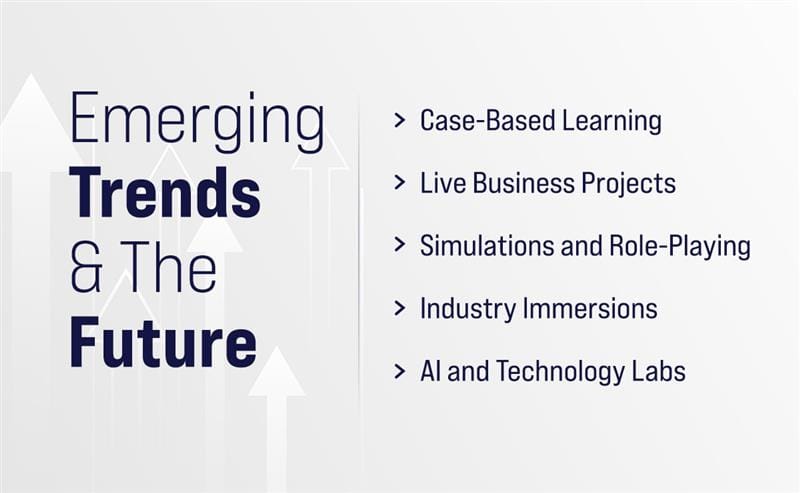
- Case-Based Learning: Analyzing 200+ real business scenarios to develop critical thinking and problem-solving abilities. Top institutions like IIM Calcutta, ISB, and IBS Hyderabad have made case-based learning central to their teaching approach.
- Live Business Projects: Working directly with companies on actual challenges, applying classroom concepts to solve real problems.
- Simulations and Role-Playing: Decision-making under risk-free conditions to manage virtual corporations and play contract negotiations.
- Industry Immersions: At the ground level, there are rural projects, sustainability programs, global exchange programs, and corporate internships.
- AI and Technology Labs: An introduction to blockchain (the BIMCOIN program at BIMTECH), fintech solutions, and AI-driven business tools.
Summing Up
To sum it up, an MBA in India is not merely a means of acquiring a title; it is a strategic, transformational journey that challenges your methods of thinking, leading, and melting down. The participants come out of the experience with better analytical minds, a more concise view of the business reality, and a strong set of tools to address both the local and global issues.
The real advantage is the blend of technical expertise, actual leadership skills, and dexterity in a fast-paced market. In classrooms, boardrooms, and beyond, MBA graduates in 2025 are shaping industries, driving innovation, and showing that the value of business education is not a one-size-fits-all concept.
For every aspiring manager and future entrepreneur, the MBA is not just a degree; it’s a launchpad for a career defined by purpose, adaptability, and meaningful impact.