
Top Non-IIM MBA Institutes in India


Each year, over two lakh students take the Common Admission Test (CAT) to secure admission to an Indian Institute of Management. However, the total annual intake across all IIMs is approximately 5,500 seats. This is insufficient to meet the substantial demand for quality management education in India.
This persistent gap between aspiration and available seats has led to the emergence of a parallel ecosystem of non-IIM institutions. These institutions have established strong reputations based on measurable outcomes rather than institutional associations.
Today, non-IIM MBA institutes are relevant beyond their availability. Many offer specialized programs, distinctive pedagogy, and placement records that compete with or even surpass several IIMs. FMS Delhi, for example, delivers one of the highest return-on-investment ratios of any MBA program in the world. ISB Hyderabad is ranked among the top 30 B-schools globally by the Financial Times. XLRI Jamshedpur has defined excellence in Human Resource Management in India for over seven decades. IIFT remains the country’s foremost institution for international business. These are not consolation choices; they are deliberate, strategic ones made by some of India’s most competitive management aspirants.
This article reviews the best non-IIM MBA institutes in India. It outlines the main factors to consider in your application strategy and compares program fees, average salaries, and highest placements. This allows you to make an informed choice that fits your professional ambitions, academic prowess, and finances.
What to Consider When Applying to Non-IIM Colleges in India
When selecting an MBA program, one must carefully evaluate several factors to find the right fit for their needs and career goals. An MBA application requires an analytical eye that compares the strengths of institutions with individual career objectives. Below are the factors you need to consider.

1) Accreditation and Institutional Recognition
The credibility of an academic program depends on accreditation. Those institutions that are accredited by NAAC (National Assessment and Accreditation Council), AICTE (All India Council for Technical Education), and UGC (University Grants Commission) ensure that academic excellence, facilities, and faculty are of the highest quality. At the global level, accreditations like AACSB and EQUIS indicate that you compete on a world stage and help you access opportunities related to cross-border academic collaborations and international employers. Also, performance in national rankings, especially the NIRF (National Institutional Ranking Framework), provides an objective, government-backed scale for comparing institutions year on year.
2) Return on investment (ROI)
One of the most financially significant factors in MBA decision-making is the ratio of program cost to post-graduation salary. For example, public universities such as FMS Delhi charge about 2.4 lakh for a two-year MBA while reporting an average package of 34.1 LPA and a high package of 1.23 crore. In addition to headline fees and average packages, several other factors need to be considered, including the median salary, the distribution of salaries across different cohorts, and the continuity of placement performance over time.
3) Specialization and Program Focus
There is a huge variation in focus and expertise across MBA programs. Several schools have developed specializations in particular fields and have become the right places for students interested in those fields. For example, XLRI’s PGDM in Human Resources is the gold standard for HR professionals in India. International Business at IIFT is designed to prepare students for careers in international trade, export management, and cross-border strategy. Altera Institute’s 15-Month PGP in Applied Marketing is designed for individuals interested in building careers across Digital Marketing, eCommerce, Brand Management and Product Management domains. The key to a successful career is to match your institution's strengths to your career goals.
4) Infrastructure and Transparency
An excellent track record of placements can only be relevant when verified. Potential students must not be carried away by the headline numbers but rather analyze the scope of the recruiter pool. They are also expected to review the variety of positions available, the industries covered, and whether placements are documented via a reputable, standardized model. Institutes that subscribe to the Indian Placement Reporting Standards (IPRS), which is the same model used by IIM Ahmedabad, provide greater transparency than those that self-report without an independent assessment. High placement rates of 100%, a large distribution of participating companies, and a healthy ratio of dream-to-mass offers are all signs of a strong placement infrastructure.
5) Faculty Quality and Industry Integration
The quality of an MBA is directly related to the way it is delivered. An experienced industry professional faculty member who has been there and done that is better positioned to teach the next generation of professionals than a pure academic faculty member. The level of institutional integration of industry-related pedagogy in the curriculum is also a must. These encompass live projects, consulting projects, executive guest lectures, corporate mentorship programs, and internship-to-placement pipelines. Colleges with advisory boards composed of top industry practitioners produce graduates better equipped to handle real-world management issues.
Top 10 Non-IIM MBA Institutes in India
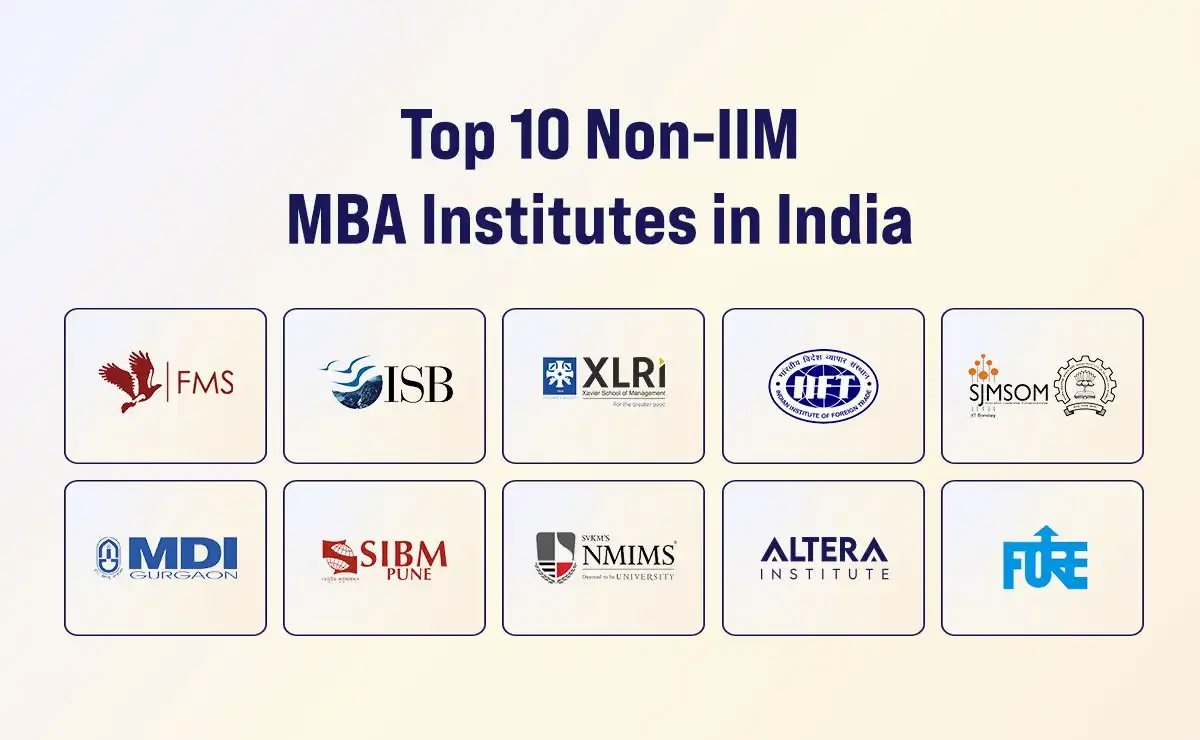
The following table lists India's top 10 non-IIM institutes where students can pursue an MBA.
Institute | Program Fee | Average Salary | Highest Salary |
₹2.43 Lakhs | ₹30.1 LPA | ₹1.1 Crore PA | |
₹38.67 Lakhs | ₹33.25 LPA | ₹66 LPA | |
₹28.60 Lakhs | ₹31.40 LPA | ₹59 LPA | |
₹21.82 Lakhs | ₹31.30 LPA | ₹72 LPA | |
₹15.15 Lakhs | ₹25.82 LPA | ₹53.8 LPA | |
₹18.50 Lakhs | ₹25.6 LPA | ₹53.6 LPA | |
₹29.36 Lakhs | ₹28.83 LPA | ₹53.58 LPA | |
₹27 Lakhs | ₹25.13 LPA | ₹67.70 LPA | |
₹16.44 Lakhs | ₹16.85 LPA | ₹26.08 LPA | |
₹23.24 Lakhs | ₹16.4 LPA | ₹29 LPA |
Note: Fee and placement data are indicative and subject to revision annually.
Altera Institute: PGP in Applied Marketing
Altera Institute's Post Graduate Program (PGP) in Applied Marketing offers a compelling alternative to the traditional two-year MBA for students seeking a career in digital marketing. This full-time, 15-month program in Gurugram focuses exclusively on an industry-backed curriculum designed by practitioners from Hindustan Unilever, Bain & Company, Goldman Sachs, etc., and is taught by working professionals rather than academics.
The curriculum is divided into four terms covering topics such as Growth Marketing, eCommerce, Brand Management, Product Management, Digital Media Planning, and Generate AI in Business. Every term concludes with a hands-on capstone project, and students work on live briefs with real companies. This applied pedagogy is reinforced by 20+ intensive skill sprints led by industry experts.
Altera Institute stands out for its deliberate focus on recruiting talent for digital and AI-first roles, where talent shortages are common. According to the Class of '25 placement report, which was audited by B2K Analytics under the IPRS standard, the median salary for the Class of '25 was 18.14 LPA, and the placement rate was 100%, with 89% of the students placed in digital or AI-first roles at companies including Amazon, Flipkart, and Mamaearth.
For aspirants targeting new-age marketing careers rather than conventional MBA pathways, Altera Institute is worth considering.
Conclusion
The institutions profiled in this article are not merely alternatives; they are, in their own right, powerhouses of management education in India. They have built careers, created industries, and trained generations of leaders across sectors of the Indian economy.
What sets the best non-IIMs apart from the rest is not their placements, but the congruence between what they teach, who teaches it, and what the industry demands of them. The decision to apply to any of these institutions should be grounded in a clear assessment of personal career goals, academic readiness, financial capacity, and the specific value proposition each institution offers, not peer pressure or default rankings.
Ultimately, the value of an MBA is not determined solely by the brand name. It is determined by the quality of learning, the strength of the network, the relevance of the curriculum, and the conviction with which a graduate applies their education to the challenges of the real world. When approached with that mindset, a well-chosen MBA program can be as transformative and, in many cases, more precisely targeted than its IIM counterpart.