The Skills Gap in Indian Education & How Graduates Can Get Ahead

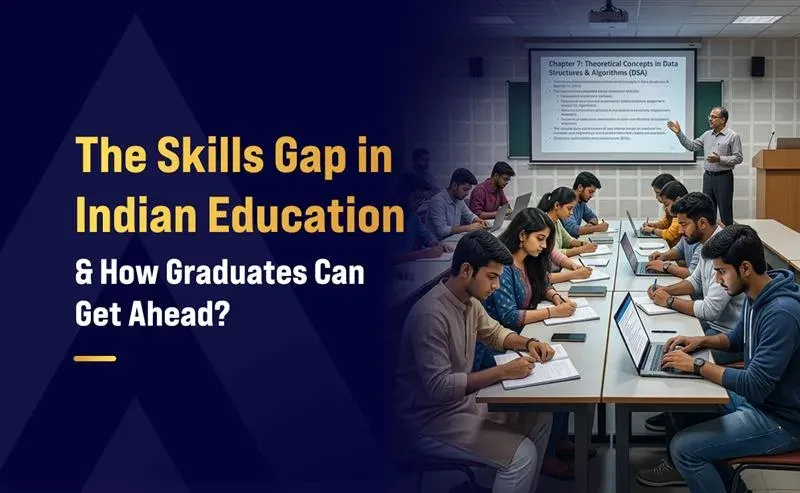
A "skills gap" is the difference between the competencies developed by an education system and those required by employers. This gap in India has reached a level that can't be considered temporary. According to the India Graduate Skill Index 2025 by Mercer-Mettl, only 42.6% of Indian graduates were considered employable in 2024. Graduating students continue to fall short of employers' expectations even as record numbers of degrees are being awarded today.
The Indian education system produces thousands of graduates each year, and while they hold degrees from recognized institutions, employers consistently report that they are underprepared to contribute effectively to the job. This issue is not related to incompetence. In reality, it is the result of a systemic problem that is rooted in the design, priorities, and shortcomings that affect higher education in India.
As graduates apply for jobs or consider MBA programs, they discover that recruiters aren't particularly concerned with academic grades or the prestige of the institution. The interviewer instead looks for evidence that candidates can work effectively in real business environments, solve real problems, and achieve measurable results. It is clear that these expectations differ significantly from the standards most classrooms are designed to test.
What Is the Skills Gap in Indian Education?
The skills gap measures the difference between being educated and employable. Education involves students completing a structured course of study, passing exams, and earning a credential. Meanwhile, employability refers to your ability to step into a job, understand expectations, and create value without extensive training. The first outcome is academic, and the second is professional. While India produces a great deal of the first, it consistently falls short of the second.
A 2023 survey of hiring managers in technology, eCommerce, and digital services found that 80% prioritize job-ready skills over formal education. However, this does not imply that degrees are irrelevant. While credentials continue to serve as a filtering mechanism, signaling dedication and focus, they no longer verify readiness for a job.
How AI and Digitization Changed the Rules of the Game?
In the past decade, automation, artificial intelligence, and digitization have taken over many tasks that were once carried out by entry-level employees. The use of machines has made data entry, basic analysis, report generation, customer communication, and routine documentation quicker and more efficient. Although these jobs have not been eliminated, their contribution has changed fundamentally.
Several new roles have emerged in their place, including product management, brand building, eCommerce operations, growth marketing, and positions in founders' offices. These roles require active decision-making, cross-functional collaboration, comfort with data and AI tools, and the confidence to own outcomes rather than just follow instructions. These are not roles that can be filled by knowing the right frameworks. They require the ability to apply judgment in uncertain, fast-moving, and consequential conditions.
Where does Indian Education Fall Short?
In India, most colleges and MBA programs operate on a pre-digital economy model. As a result, graduates know the vocabulary of modern business but lack the ability to operate within it. They can define a marketing funnel but cannot diagnose what is underperforming. They know the 6Ps of marketing but can't build a go-to-market plan for a live product. This gap is largely due to a lack of practical exposure and hands-on learning opportunities in the Indian education system.
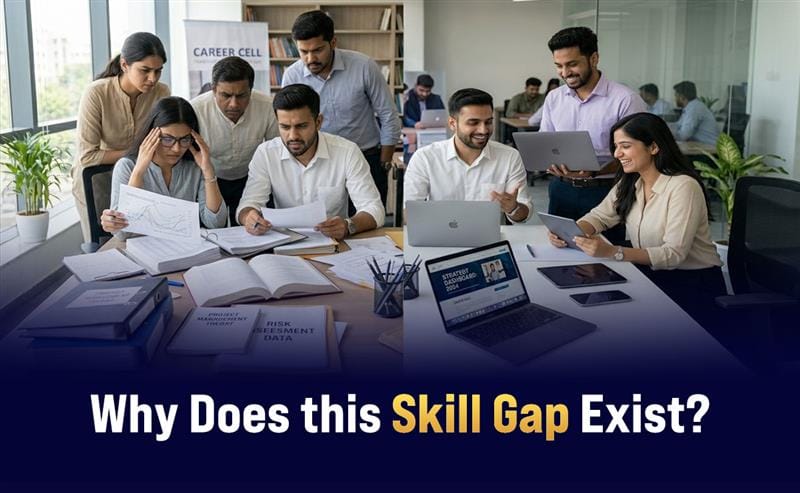
Why Does this Skill Gap Exist?
There are a number of reasons why there is a skill gap in the workforce, including:
1) Outdated, Siloed Curricula
Historically, Indian MBA and degree programs have focused more on academic subjects than on the roles that graduates will fill. Although students leave with theoretical knowledge of marketing, finance, and operations, actual jobs require simultaneous decision-making across all three areas.
Many programs still treat eCommerce and digital performance as electives, even though a brand manager must understand eCommerce economics, performance marketing metrics, and product data. As a result, graduates are unprepared for the integrated business demands of today.
2) Insufficient Skill-Building:
Traditionally, education and MBA programs are dominated by theoretical frameworks, case discussions, and exams that reward recall rather than execution. Despite examining dozens of cases on paper, few graduates have owned a campaign, run experiments, or been accountable for real outcomes.
Hence, when interviewers ask for a campaign walkthrough or funnel improvement plan, such candidates default back to textbook answers. Only repeated practice in real-world or simulated business conditions can build the skills that employers require in students.
3) Slow Adaptation to AI and Modern Tools:
The majority of institutions view AI as a one-off elective, whereas in businesses, it's an integral part of everyday tasks, such as marketing, product development, eCommerce, and strategy. Students rarely gain hands-on experience with AI, but professionals use it to generate content, analyze behavior, model pricing, and forecast performance. Considering how quickly tools evolve, by the time a new AI module is designed and delivered, industry practice has already changed.
Recruiter Expectations from Graduates Today
Recruiters at leading consumer, technology, and eCommerce companies now prioritize digital fluency, knowledge of AI tools, and the ability to collaborate across functions. The following are the five core capabilities that companies are increasingly looking for:
- Ownership: It means acting like a business owner, proactively taking responsibility for tasks, outcomes, and mistakes rather than just doing assigned duties. It involves accountability for results, initiating solutions without being asked, following through from start to finish, and aligning actions with company goals.
- AI Fluency: Skills in creating content, segmenting audiences, analyzing campaign data, and modeling performance scenarios using AI tools. In addition, it is also equally important to recognize when to trust an AI output and when to use independent judgment. Modern roles require a combination of tool proficiency and critical thinking.
- Data-Driven Thinking: Being able to analyze live dashboards and funnels, design and evaluate A/B tests, and make decisions based on ongoing data, rather than waiting for quarterly reviews. Companies that operate digitally move quickly. Students who thrive in those environments are comfortable with and can act on continuous feedback.
- Cross-Functional Ability: Jobs of the modern age don't fit into departments. A growth marketer, for example, collaborates with engineers to set up tracking, product teams to influence features, and finance to defend budgets. As a result, collaboration across these functions and driving shared commercial outcomes are now baseline expectations rather than distinguishing factors for students.
- Experimentation Mindset: The ability to design a controlled experiment, define success metrics, run the experiment, interpret the results honestly, and iterate on the results. As companies run more experiments faster, they can make better strategic decisions. Hence, it is crucial for them to hire people who are familiar with that process and can control it without being instructed.
How Can Students Start Closing the Skills Gap?
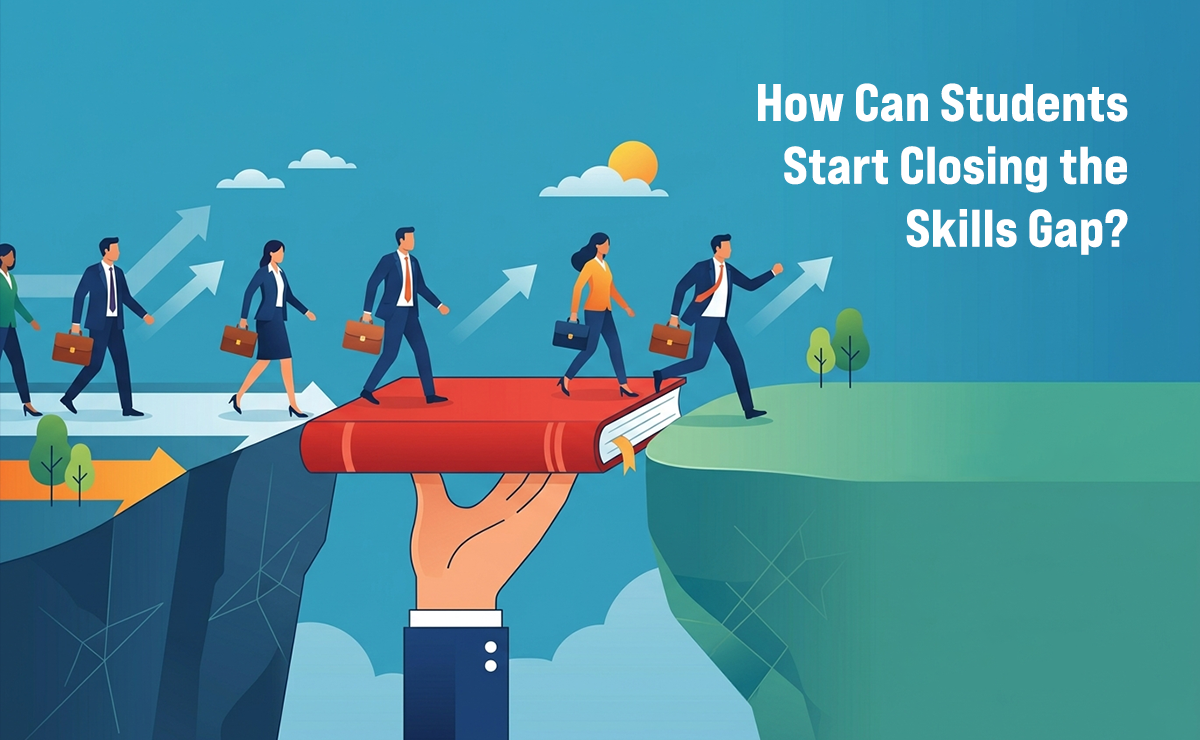
There is a structural problem within the educational system that leads to the skills gap. It is up to the individual to make informed choices about how to spend their time, what experiences they seek, and how to develop skills as they progress through their program. Here is a practical framework to help you accomplish this.
Step 1. Map Your Target Role Before Your Degree
You should choose your role before you choose your qualifications. Instead of chasing broad credentials, research specific job profiles and understand their daily realities. Identify what you already have and what you need to build using self-assessment tools such as SWOT or a strengths matrix. To prepare for a specific career path, you must first determine where you are headed and which will matter most.
Step 2. Develop AI and Digital Fluency Every Day
Think of AI as a skill that needs to be mastered rather than a shortcut. Summarize reports, analyze campaigns, or evaluate performance with tools, then verify your findings manually. This will improve your judgment skills and data interpretation skills, as well as your productivity. Instead of enhancing convenience over capability, technology should improve analytical thinking and contextual understanding.
Step 3. Gain Real Experience Through Projects and Internships
The importance of practical execution is greater than that of theoretical knowledge. As a freelancer or campus worker, you may work on live projects, manage campaigns, or hold responsibility for metrics. Build a portfolio based on results, record outcomes, and gather evidence. Rather than grades or transcripts, employers today value the ability to make decisions and solve problems.
Step 4. Build Cross-Functional Collaborative Skills
To simulate a real business team, work with peers from different disciplines. Explain your ideas clearly in each context by communicating across marketing, finance, and technical domains. Leadership is about integrating insights into actionable understanding. This is the quality that separates those who manage collaboration from those who operate in their own spheres.
Choosing the Right Programs and Institutes to Get Ahead
Although individual effort is important, the environment in which you develop your skills plays a significant role in your success. Since credentials alone no longer guarantee job readiness, professionals gain the most from programs designed for today's AI-driven, digital-first careers rather than following popular belief or prestige.
Rather than focusing on short-term placement results, management education today should be assessed by how well it prepares young professionals for careers that will evolve in the next 15 to 20 years. Most programs have yet to meet this standard.
There has been a significant shift in hiring patterns since COVID-19. Digitally savvy companies are now looking for managers with deep expertise, not just relationship management or process expertise. Companies require professionals who can use data and AI tools daily and operate at a high level across all functions. And this depth comes from a combination of a relevant curriculum, real business exposure, and mentorship from experienced practitioners, not coursework alone.
This reality distinguishes modern business education from traditional models, and this is exactly why new-age B-schools like Altera Institute were founded on this principle by leaders from companies like Bain & Company, Hindustan Unilever, Goldman Sachs, Haleon, and EY Parthenon.
Altera Institute offers a 15-month Post Graduate Program (PGP) in Applied Marketing. It includes industry mentorship from former marketing directors, eCommerce heads, and VP-level sales leaders. With AI tools integrated throughout the curriculum, it addresses the actual requirements of key roles students want to break into.
The program also emphasizes real-world business applications. Students engage in live projects with founders and senior leaders, participate in simulations, and interact with over 200 professionals, many of whom recruit from the program during placements. As a result, graduates are well-prepared to bridge the gap between academic learning and workplace demands, equipping them to excel in competitive business environments.
Conclusion
The skills gap in Indian education is a structural issue, not a temporary disruption that will resolve as the economy stabilizes. There is a clear disconnect between classroom learning and the practical skills businesses require from new professionals. Possessing a skill is no longer sufficient. What sets candidates apart today is the depth of their expertise: the ability to apply skills in real situations, link them to business outcomes, and adapt as circumstances evolve.
Among the skills shaping future professional relevance, AI fluency is the most significant. Professionals who achieve practical proficiency with AI tools, along with the judgment to use them effectively, will have a lasting advantage over those who view AI as merely theoretical or a shortcut. This proficiency comes from daily, hands-on experience with real-world problems, not from reading about AI.
Modern institutions such as Altera Institute are developing curricula and mentorship programs that address this need directly. Rather than adding AI to outdated business education models, they begin with current role requirements and design programs accordingly. For graduates facing a rapidly changing job market, the key decision is not just which program to choose, but whether it prepares you for the future rather than the past.