MBA in Marketing: Evolution, Scope, and Future in the AI Era

An MBA in management has undergone a significant transformation from a traditional industry-centric model to a data-driven, revenue-focused, and AI-enabled specialization. This is why today, marketing professionals are expected to combine creativity with analytics, growth, and technological fluency.
Marketing, at its core, is about understanding the needs of customers, creating value, and facilitating profitable growth. For a long time, Marketing education was dominated by the 4Ps (Product, Price, Place, Promotion) and the guidelines of Philip Kotler. These were the frameworks that defined marketing thinking from the 1970s onward and formed the backbone of MBA marketing curricula across the world.
However, these models were built for a very different business environment where:
- Mass media dominated communication channels. Broadcast advertising was the main vehicle for brand building.
- Distribution networks were a competitive advantage, as physical shelf space determined market access.
- Consumer feedback loops were slow, often taking months to gather through traditional market research.
- Marketing impact was difficult to measure, as attribution remained largely theoretical.
Hence, marketing was primarily brand-led and campaign-driven, where planning cycles were annual. Performance was inferred rather than tracked in real time, relying on proxy metrics like brand awareness and recall studies.
Over the last two decades, however, marketing has undergone a more radical transformation than most MBA programs have acknowledged. This shift is evident in the rapid distinction of advertising, which has grown exponentially to $690 billion, outpacing traditional media at 15%–20% annual growth over the past decade.
Currently, eCommerce accounts for approximately 20% of global retail sales, fundamentally altering how brands engage with consumers. And by 2029, more than 80.4% of total advertising revenue will be in digital formats, indicating a tremendous shift in audience behavior and buying habits.
How MBA in Marketing has Evolved in the Digital and AI Era
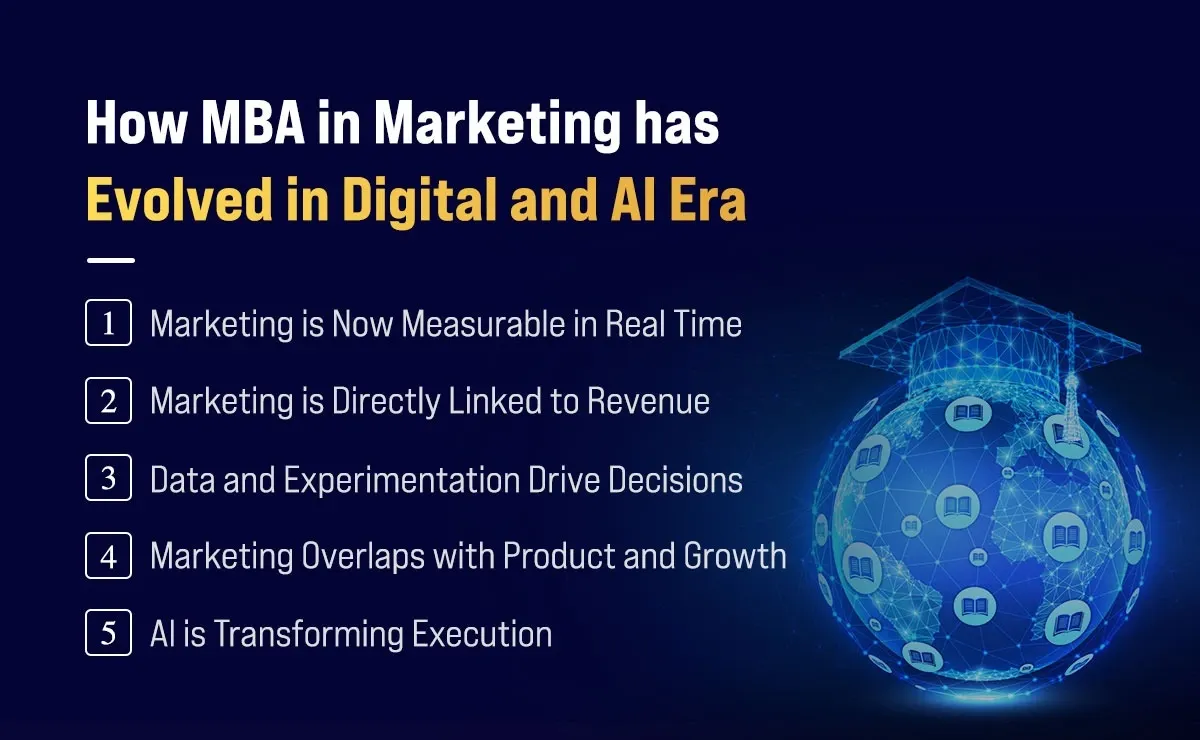
The transformation of marketing from an art to a science is marked by five fundamental shifts that redefined what marketing means in modern business contexts.
1) Marketing is Now Measurable in Real Time
Among the many benefits of digital marketing, perhaps the most significant is its ability to provide extensive, real-time, and detailed data. Digital marketing can track every touchpoint of the consumer, from the first click through to the final conversion, and everything in between, thus removing the need to rely on marketing intuition and instead allowing marketers to make decisions based on data.
2) Marketing is Directly Linked to Revenue
Modern marketers are revenue generators, not just brand builders. With recent eCommerce and D2C growth, the marketing department focuses on unit economics and revenue goals. Customer Acquisition Cost, Lifetime Value, and payback periods are all metrics that are fundamental to the marketing organization. These accountabilities have heightened the importance of such roles, which help an organization reach its strategic goals.
3) Data and Experimentation Drive Decisions
A/B testing, cohort analysis, funnel optimization, and other experimental methodologies have defined the operations of modern marketing teams. Campaigns are not created on a whim – marketers have data to support their hypotheses that include continuous iteration and measurement. Performance marketing expenditures are a prime example of this shift toward data and testing fundamentals, as they have outpaced all other marketing methodologies by over 25% annually.
4) Marketing Overlaps with Product and Growth
The integration of marketing with product management and customer experience has created a marketing ecosystem that aligns with product strategy, customer onboarding, retention, and customer experience improvement. This convergence of functions indicates that the product itself is the most effective marketing system available to a digital marketing business
5) AI is Transforming Execution
Perhaps the most important of the new marketing technologies is AI, which has transformed marketing by automating many routine tasks. AI is now capable of campaign optimization, bidding strategy setting, content creation, audience targeting, personalization at scale, and predictive analytics. The paradox is that, despite AI's capabilities, the shift from operational to strategic roles has become more significant. Reports indicate that over 88% of marketers rely on AI in their current roles, with 93% using it to generate content faster and 90% to make quicker decisions.
Where Many MBA Marketing Specializations Fall Short?
Although industry practices have undergone significant transformation, many MBA marketing programs continue to prioritize theories and frameworks developed before the digital era. Consequently, the gap between academic instruction and industry requirements has grown substantially.
MBA marketing curricula frequently emphasize traditional brand management case studies from consumer goods companies, advertising theory based on mass media assumptions, legacy consumer behavior models that predate digital channels, and extended campaign planning processes. While these topics retain conceptual value, they provide an incomplete representation of contemporary marketing practice.
Furthermore, many programs provide limited exposure to the skills and mindsets essential for modern marketing roles. For example:
- Performance and growth marketing, which represent the fastest-growing segment of marketing roles, receive minimal curricular attention.
- Funnel thinking and experimentation frameworks, which drive decision-making in digital-native companies, are rarely taught systematically.
- Marketing technology stacks, which are integral to daily marketing operations, remain unfamiliar to many graduates.
- Essential marketing analytics platforms, such as Google Analytics and attribution modeling software, are rarely incorporated into practical coursework.
Additionally, the rapid evolution of digital channels further adds to these gaps. Search engine optimization (SEO) is transitioning toward Generative Engine Optimization (GEO) as AI-powered search tools change how consumers discover brands. eCommerce platforms such as Amazon and Shopify, along with marketplace-specific advertising, demand specialized expertise. Key business concepts, including customer acquisition cost (CAC) payback, contribution margins, and growth accounting, often remain theoretical rather than practical competencies.
As a result, MBA marketing graduates often understand brand theory but struggle with CAC modeling, can discuss positioning frameworks but cannot run performance campaigns, and know consumer behavior principles but lack familiarity with attribution analysis.
Skill shortages in the practical aspects of digital marketing, data analytics, and growth strategy are reported in all employer surveys. While marketing has always required digital competency, this is particularly true for the current generation, where 80% of marketing roles today require digital skills, creating a large skills gap.
This gap between what is taught and what employers need continues to widen, creating an urgent need for educational innovation that bridges theory and practice.
The Rise of Industry-Aligned Marketing Education

The evolution of practical, business-focused, results-oriented marketing education is essential to meet the demands of a performance-driven, technology-based marketing environment. To achieve this change, a reorientation of teaching methods, a redesign of the curriculum, and a shift in desired outcomes are critical.
Marketing education must shift from theoretical analyses of past case studies to an emphasis on practical activities. Students need opportunities to:
- Handle live campaigns with real budgets, where decisions have consequences and results provide immediate feedback.
- Use analytics tools like Google Analytics, Facebook Ads Manager, SQL, and data visualization platforms, so that they can gain hands-on experience with them.
- Apply unit economics in practice, like calculating and optimizing CAC, LTV, retention curves, and funnel metrics on actual products or campaigns, not just on paper.
- Solve end-to-end eCommerce and digital growth problems right from strategy and execution to measurement, iteration, and analysis.
This is where new-age B-schools like Altera Institute have come up, which is designed around how marketing functions today—not how it did three decades ago. Its pedagogy reflects the realities of modern marketing practice through several key design principles:
- Digital-First Frameworks: Recognizing that digital channels are not supplementary but central to modern marketing strategy, the curriculum is built around digital and AI-first marketing principles, platforms, and methodologies that drive business growth in today's environment.
- Real Business Problem-Solving: Students engage with real-business problems involving budget constraints, competitive pressures, and measurable business outcomes, moving beyond theoretical exercises to tackle actual challenges that marketing teams face daily.
- Industry-Led Teaching: The faculty members at Altera Institute are not just academicians but professionals who understand current market dynamics and emerging trends. Bringing industry practitioners with real-world experience into the classroom ensures students learn from those actively working in the field.
- Live Projects: Students are exposed to live projects with real companies so that they experience the messy reality of marketing execution, where data is incomplete, timelines are tight, and stakeholders have competing priorities.
- Revenue-Linked Thinking: Students learn to think like business owners, connecting marketing activities to financial outcomes and understanding the full P&L impact of their decisions. Integrating business economics throughout the learning experience reinforces the idea that marketing is the key lever that supports business growth.
- Exposure to Marketing Technology and Analytics Tools: Students learn not only marketing theory but also the technical and analytical skills needed to support data-driven decision-making. This includes familiarity with advertising platforms, analytics software, customer data platforms, marketing automation tools, and the broader marketing technology ecosystem, ensuring graduates are job-ready from day one.
Recruiters are looking for candidates who can start contributing to business growth teams immediately. Candidates who know how to work with funnel metrics, construct and analyze dashboards, run experiments, and contribute to the revenue side of a business.
Hence, programs aligned with modern marketing practices are better positioned to produce such skilled graduates. Industry demand for digital marketing talent continues to grow rapidly, with specialized roles in growth marketing, performance marketing, eCommerce, and marketing technology commanding premium salaries.
Marketing as a career has evolved from communication-led roles to growth and business-ownership-focused roles. This is why a modern marketer is expected to understand unit economics, run experiments, interpret dashboards, collaborate with product teams, and drive measurable revenue outcomes. This is not a peripheral shift, but a fundamental redefinition of what marketing professionals do and how they create value.
This shift demands a parallel transformation in MBA marketing specializations. Theory remains important; foundational frameworks still provide essential structure for thinking about customer needs, competitive positioning, and value creation. But without digital fluency, analytical depth, an experimentation mindset, and exposure to real business decision-making, marketing education risks becoming disconnected from industry reality.
The future marketer must be as comfortable with data, technology, and business economics as they are with creativity and brand storytelling. This hybrid profile, combining strategic thinking with analytical rigor, creative insight with technical competence, represents the new standard for marketing excellence.
Institutions such as Altera Institute represent this new direction by integrating live projects, industry-led instruction, digital-first frameworks, and practical learning models that reflect how marketing functions today. These programs recognize that the gap between traditional education and modern practice cannot be bridged through incremental updates but requires a structural redesign of pedagogy, curriculum, and learning outcomes.