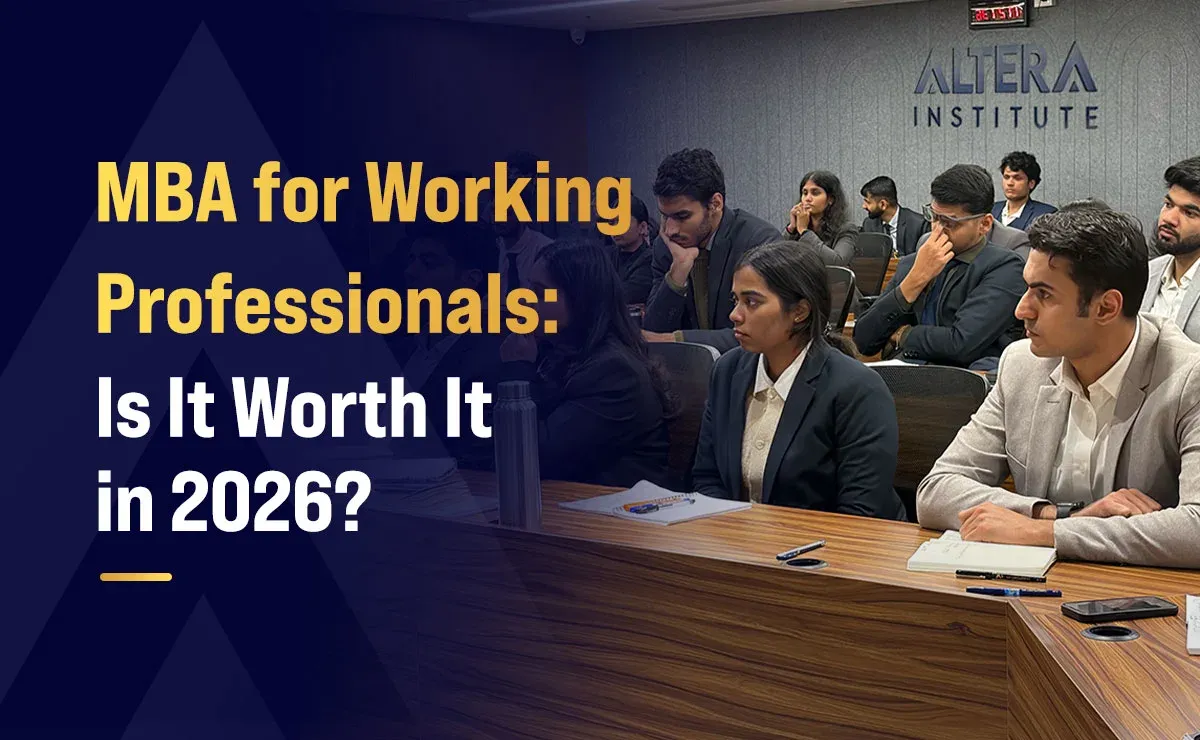
MBA for Working Professionals: Is It Worth It in 2026?
An MBA degree for working professionals provides a structured academic pathway to those wanting access to high-growth leadership positions in the job market. Yet they face a unique predicament where the skills they have are becoming outdated faster than ever. Additionally, taking a career break to pursue a traditional 2-year MBA feels risky due to the unpredictable nature of the current job market.
This raises the critical question: Is an MBA still worth the time, effort, and investment for working professionals today? The answer to this question is more nuanced than you may think. While an MBA is surely a transformative experience, not all MBAs deliver equal value, and quitting your job for 2 years seems impractical for many working professionals.
This is why modern B-schools like Altera Institute are rethinking MBA formats to cater to working professionals. It recognizes that management education, rather than being a career interrupter, can complement and accelerate your professional journey when delivered in the right format. This article explores whether an MBA is worth it for working professionals in 2026, and more importantly, under what conditions it creates genuine value.
Types of Management Programs for Working Professionals
Management education in India is structured around three distinct formats, each catering to professionals at distinct career stages:
- Full-time residential programs such as an MBA, PGP, or PGDM are designed for early-career professionals with up to 5 years of experience. These programs require students to quit their jobs for an intensive on-campus learning experience.
- Online MBA programs are delivered entirely or largely through digital platforms, allowing students to learn remotely without attending on-campus classes. These programs are specifically designed for individuals looking to balance education with career, personal, or family commitments.
- Executive MBA programs are designed for mid-level professionals with 5 to 12 years of experience seeking career advancement or a strategic career shift. These programs are designed specifically to fit the schedule of working professionals and tend to be offered via weekend courses, modular programs, or blended formats.
- Advanced Management Programs (AMPs) target senior leaders and executives with over 15 years of experience, preparing them for C-suite positions. AMPs are theme-specific courses, which means that they offer specialized knowledge in a single domain. These short, intensive programs allow senior professionals to upskill in their chosen field without long career breaks.
Ultimately, the best MBA option for a working professional depends on individual objectives and current career stage.
The Career Reality of Working Professionals in 2026
If you’re thinking about getting an MBA in 2026, here are some important career realities that you must know about:
- The evolution of new-age roles and growing skill requirements in digital and AI-focused careers is defining today's professional landscape.
- Positions that existed five years ago have undergone fundamental changes, while new roles have also emerged to address ongoing transformations.
- Companies across sectors, from legacy corporations like HUL, ITC, and Nestle to digitally native firms like Blinkit and Zepto, are investing heavily in digital and AI capabilities and are demanding professionals who can navigate this landscape.
Beyond these factors, early-career professionals must also know that experience alone no longer ensures career advancement. Even with strong performance and several years of experience, you may find your progress limited if you lack relevant skills. Hence, experience without continuous learning will only act as a barrier rather than a ladder of growth.
Why the Traditional MBA Question Has Changed
Traditional MBAs were designed to deliver foundational business knowledge and general management training, out of which graduates could build skills and competencies over time. However, employer expectations have shifted radically in the direction of specialized skills, readiness to perform well immediately on the job, and the ability to work in a digital and AI-driven business environment.
This is exactly the reason why traditional MBA programs for working professionals fail, because they continue to depend on old curricula while imposing high costs and significant time commitments within rigid schedules. Adding to this is the fact that taking two years off work leads to lost salary and career growth, weakened industry connections, and loss of professional momentum.
Furthermore, professionals who have completed a traditional MBA pathway may discover that their career goals do not align with the opportunities they are offered, making this trade-off impractical for many working professionals.
Today, the value of an MBA depends more on the relevance of the program, rather than on the reputation of the B-school. Although degrees from prestigious institutions are highly beneficial, employers today are increasingly prioritizing the practical skills and abilities a candidate brings to the table. This is why a practical, hands-on program like the one offered by Altera Institute yields better career outcomes than many theory-heavy programs.
What 'Worth It' Means for Working Professionals
MBA programs are worth it for working professionals only if they deliver the right career momentum, real-world skills, and access to opportunities that would otherwise take years to unlock.
- Career Acceleration Versus Career Interruption: For working professionals, an MBA program makes sense only if it provides access to industry-relevant specializations, professional mentoring from experts, and opportunities in new-age careers that can define their long-term growth.
- Skill Application Versus Academic Learning: Modern MBA programs are more oriented toward practical applications than theoretical academic learning. This is because short, specialist courses prove more beneficial to an experienced participant than a long process of starting with foundational business knowledge. Moreover, programs focused on case competitions, live projects with industry partners, and experiential problem-solving provide much greater value than those centered on textbook-based learning and exams.
- ROI Measured Through Quality of Roles, Responsibilities, and Confidence: The true ROI of an MBA goes beyond salaries and placements. It includes access to positions with higher responsibility, broader impact, and greater long-term growth potential. Moving from executive roles to strategic leadership and gaining confidence to pursue previously unattainable opportunities are key indicators of a valuable MBA program.
Who Benefits Most from an MBA While Working
Early and mid-career professionals aiming for leadership roles are the best fit for an MBA while working. If you have 3–7 years of experience and have proven yourself in your current role, a specialist MBA can help you move from execution roles to strategic leadership. Since such professionals already have basic business fundamentals, they now need frameworks for strategic thinking, exposure to new business areas, and credentials that will help them reach their desired career goals.
Specialists who want to move into management also gain significant value from an MBA. If you are an engineer, analyst, or technical expert wanting to manage teams or work cross-functionally, an MBA helps you build the business skills you need. You do not have to give up your technical strengths; instead, you add strategic and managerial skills that qualify you for roles where deep expertise and leadership go hand in hand.
Professionals looking to make a strategic career shift benefit most when the MBA program offers real access to new fields. If you are in a traditional industry and want to move into digital or AI-focused roles, or you are in operations aiming for product or growth positions, the right MBA program and specialization give you the credibility and skills that are hard to gain through organic career progression.
Making the Right Call: Is an MBA Worth It for You?

Before pursuing an MBA, it is important to ask yourself a few key self-assessment questions.
- What specific skills am I missing that an MBA would provide? If you cannot identify clear gaps in your current skills, you may not be ready for an MBA.
- Where do I want to see myself three years down the line, and does that role specifically require an MBA? Research your target roles, talk to professionals who are already working in those roles, and find out whether having an MBA is strictly required or just useful.
- Am I in a position to afford the time and financial investment an MBA would need, and will I achieve my expected return? Calculate all costs, total tuition fees plus opportunity cost and time away from your Job.
- Is the program's structure, content, curriculum, and outcomes aligned with my goals? Do not select programs based on their brand reputation or proximity and convenience in delivery. Select a program that aligns with your objectives.
Choosing the right format and curriculum is critical for working professionals. Whether you select a traditional MBA, an executive MBA for working professionals, or the Advanced Management Program, ensure it meets your specific career objectives. In today’s content, management programs should focus on skills employers value, such as digital marketing, AI applications, data analytics, and growth strategies, rather than outdated business fundamentals.
Your MBA should also be a strategic investment, not a default choice. Many pursue an MBA because they feel it is expected of them or because they are unhappy with their current job, which is a completely wrong approach. Make the right decisions with clear objectives, good research, and focus on expected results. If you cannot articulate how getting an MBA will help you in your career, then most probably it is not the right option.
Why Altera Institute Could Be Your Best Choice
The one-year Post Graduate Program (PGP) in Applied Marketing at Altera Institute is tailored to the specific needs of working professionals, offering education that supports career advancement. Within only three years of its inception, the institute has achieved placement outcomes comparable to those of established business schools while providing distinct advantages for professionals.
Placement Snapshot for Working Professionals in the Class of ‘25
Working professionals representing 65% of Altera Institute's student body in the Class of '25 achieved a 3.2X average increase in salary compared to their pre-PGP earnings. They also reported a median post-program salary of ₹20.01 LPA, an average of ₹17.39 LPA, and a mid-80% average of ₹17.58 LPA. This significant salary growth highlights the program's value for experienced professionals aiming to transition into high-growth digital and AI-first roles.
Here is a sector-wise breakdown of roles:
- 35% of the students landed eCommerce roles
- 24% in Founder’s Office or EIR positions,
- 12% moved into Growth and Revenue roles,
- 9% entered Product Management,
- 9% in Brand Management,
- And lastly, 11% joined FMCG Sales and Marketing functions.
These outcomes demonstrate that the program's industry-focused curriculum and practical approach deliver measurable career advancement, allowing professionals to access roles typically reserved for Tier 1 graduates.
In fact, Altera Institutes has also been able to attract prominent recruiters from companies such as Flipkart, Amazon, Himalaya, Honasa Consumer, Supertails, and Mamaearth, along with many D2C and innovative consumer tech companies.
These placement outcomes are not only comparable to, but in many cases surpass, those of many traditional B-schools in the country. Here are the reasons why Altera Institute’s PGP in Applied Marketing can be the right choice for you:
- First, the curriculum is developed by industry experts and delivered by well-established leaders, with CXOs, founders, and marketing leaders of companies like Amazon, Hindustan Unilever Limited, Nestle, Bain and Company, and Goldman Sachs, teaching the curriculum. This aligns the curriculum in tune with the present market needs rather than just teaching theory.
- Second, the teaching method is practical. Students are engaged in live projects with real businesses, weekly bootcamps, final projects, and real problems with business executives. They are also given more than 300 hours of career preparation and individual mentorship.
- Third, the institute is committed to helping its students land digital and AI-first jobs–positions that are mostly unavailable to traditional B-school graduates. The interview-based selection process, accompanied by case studies, has been designed to filter out applicants who would thrive successfully in such a demanding yet innovative environment.
FAQs Regarding MBA for Working Professionals
Q1. Which MBA is best for working professionals?
Ans: The answer depends on your career goals, skill gaps, target industry, and several other factors. Shortlist programs with an application-oriented curriculum and a strong placement record in your domain. Executive MBAs or specialized one-year PGPs for working professionals usually deliver outcomes equal to, or even better than, those of many full-time MBAs. Hence, prioritize programs with transparent placement reporting, industry-led faculty, and formats that help you balance work, study, and personal commitments.
Q2. Can a working professional do an MBA?
Ans: Yes, many MBA courses for working professionals, such as Executive MBAs, 1-year MBAs, part-time MBAs, and weekend programs, are specifically designed for working professionals and let you pursue management education while maintaining your career. The key is to choose an MBA format that meets your unique needs and goals.
Q3. Is 30 years too old for a full-time MBA?
Ans: No, a 30-year-old individual is not too old for an MBA, though it may be too late for a traditional full-time program. At 30, professionals can benefit the most from an Advanced Management Program (AMP) designed for professionals with 13+ years of experience.
Q4. Can I pursue an MBA without leaving my job?
Ans: Absolutely. Formats like executive MBA programs, part-time MBAs, weekend programs, online MBAs, and blended formats combining online learning with occasional intensive modules. The challenge is to select a program with structure, rigor, and placement outcomes. Structure and rigor justify the time and financial investment that it incurs.
Q5. Is an MBA for working professionals recognized by employers?
Ans: Yes, MBAs for working professionals are recognized by employers. However, recognition has more to do with the reputation of the institution, the quality of the program, and your demonstrated competencies. Hence, executive MBAs from reputable institutions carry the same recognition as a full-time MBA.