What are the Top Marketing Careers Post MBA?


Marketing is one of the most mischaracterized concepts in business and is often confused with activities like sales, promotions, or advertising. Although these are all elements of marketing, the field works at a much more strategic level throughout the value chain, encompassing product development, price setting, distribution, customer knowledge, and brand building in the long term.
To understand what marketing is, consider this scenario: you are opening a coffee shop in your locality and want to develop a comprehensive marketing strategy to attract and retain customers. Here is an analogy where:
- Advertising refers to paid messaging via controlled channels. It is an investment in advertising avenues such as billboards, social media advertising, or television commercials to help convey your core message, such as "The best cold coffee in town." Advertising provides you with direct control over what is posted, where it is posted, and who views it.
- Promotion can be used as short-term incentives, such as coupons, flash sales, buy-one-get-one deals, etc., to motivate immediate action. Offering “Buy one, get one free on cold brews every Tuesday” or giving samples at the entrance are all examples of a promotional strategy aimed at creating urgency and encouraging trial among potential customers.
- Publicity is a type of earned media, which takes place when your target audience mentions your brand without being paid. When a food blogger comes to your store, enjoys your cold brew and leaves a good review that goes viral on social media; that is publicity. Unlike paid media, such as advertising, earned media offers audience validation organically and is seen as more credible.
- Sales are the conversion process. It occurs when your barista engages with a customer, recommends pairing cold brew with oat milk, and successfully upsells a sandwich. Sales are about closing transactions and building direct customer relationships at the point of purchase.
So, where does marketing fit into this framework?
Marketing is a comprehensive strategy that enables all of the above activities to function cohesively and deliver measurable outcomes. It can be anything from setting clear objectives for businesses to identifying target segments, developing a clear value proposition, selecting the most effective channels for reach and engagement, allocating budgets across advertising activities, and using data analytics to continuously refine the approach.
In the absence of a clear plan, execution becomes fragmented, budgets are deployed inefficiently, and outcomes become difficult to predict or scale. This is where marketing functions as a strategic framework that ensures every tactical decision contributes toward defined business goals.
Why Marketing is an Attractive Career Choice in India?
Marketing is currently among the most vibrant and rapidly expanding careers in India because of its strategic significance. A booming consumer economy, quick digital innovation, and the development of new business models demanding advanced-level marketing skills are all driving this industry.
As the Indian consumer market is projected to become the second largest in the world by 2030, demand for skilled marketing professionals who can work in complex, multi-channel settings and deliver measurable outcomes is growing at an unprecedented pace. The scope of marketing in India spans many industries, including FMCG, retail, eCommerce, fintech, healthcare, education technology, and D2C brands, each with its own opportunities and demanding different combinations of strategic, analytical, creative, and digital capabilities.
Compensation trends also highlight the rising value of marketing talent. Jobs in high-growth companies at the entry level can offer a package of ₹8-12 LPA, and specialized roles in growth, product and performance marketing can fetch ₹15 to 25 LPA and more. Additionally, the Chief Marketing Officer and Vice President of Marketing are among the top-paying positions in both startups and established companies.
Lastly, marketing career pathways have become more diversified than ever before. Professionals can choose to pursue the mainstream paths in brand or general management, work in a specialize area like digital marketing or analytics, pursue a related career move like product management or business strategy, or leverage their skills to become an entrepreneur. This adaptability, coupled with a high demand and competitive pay, makes marketing one of the best post-MBA careers in India.
Traditional and New-Age Marketing Careers in India
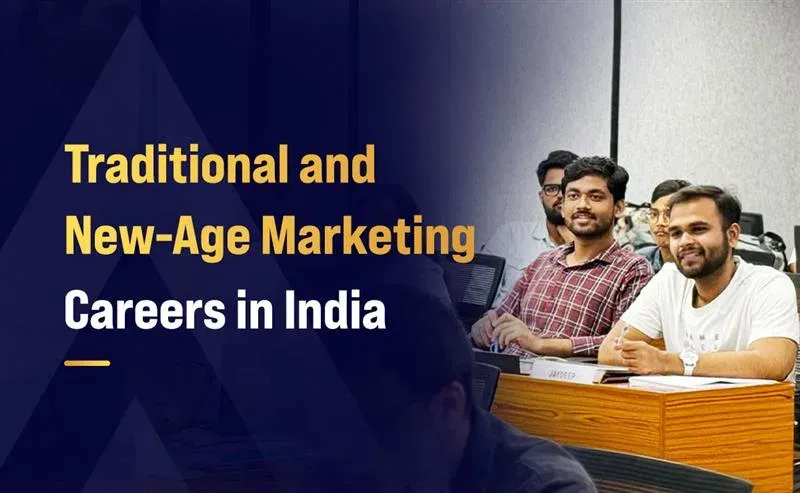
Having established what marketing as a discipline entails, it is essential to understand the career landscape that has emerged in India and the range of roles available to graduates of specialized marketing programs. This section provides an overview of both traditional and new-age career paths, setting up the context for the skills and preparation required to succeed in these roles.
Traditional Marketing Careers
Even though marketing as a career is changing rapidly, traditional marketing roles are still important to how organizations build and sustain brands. These positions play a structural role in marketing activities in all industries and remain popular with the best MBA talent seeking a structured career path with exposure to the fundamental principles of marketing.
Sales
Sales jobs, especially in the FMCG industry, have long served as the entry point for many marketing careers in India. They involve managing distributor relationships, analyzing regional market dynamics, and driving revenue through effective territory management and customer engagement.
This role directly impacts revenue generation, market penetration, and the effectiveness of distribution networks. Companies like HUL, ITC, and Nestle hire marketing graduates for roles such as Area Sales Manager, where they usually spend two to three years attaining commercial acumen and understanding the markets before they move into core brand management or strategic marketing roles.
Trade Marketing
Trade marketing is concerned with the development and maximization of strategies to promote the demand of products at the wholesaler, retailer, or distributor level and not directly to the consumer. They also identify in-store promotional tactics, negotiate shelf placements and shelf visibility with retailers, craft trade incentive programs, and set promotional budgets in order to maximize conversion at the point of purchase.
This role influences sales velocity, distributor and retailer relationships, product availability in priority markets, and the effectiveness of promotional investments. Strong trade marketing execution is critical in ensuring that brand strategies translate into actual purchases at retail.
Media Planning
Media planning is a data-driven role focused on determining the optimal mix of media channels to reach target audiences efficiently. Media planners evaluate and select the right channels, like television, print, radio, digital, and billboards and determine budget allocations, timing, and frequency to maximize campaign effectiveness.
Media planning directly influences campaign ROI, audience reach, brand visibility, and cost efficiency. In agencies and client-side marketing teams, media planners work with creative teams and account managers to bridge marketing goals into actionable media strategies that deliver measurable results.
New-Age Marketing Careers
Besides traditional marketing jobs, a whole new generation of marketing jobs has emerged due to digitization, easier access to customer information, and the shift toward performance-based accountability. It is the fastest-growing segment of marketing careers in India and also offers some of the highest compensation packages for MBA graduates.
Growth Marketing
Growth marketing has become one of the most sought-after roles in India, particularly among eCommerce, fintech, and D2C companies. It focuses on driving quantifiable business outcomes that include user acquisition, activation, retention, and revenue growth through fast experimentation and data-driven decision-making.
Growth marketers identify and optimize key levers across the customer journey. They develop and implement A/B tests on web page elements, landing pages and messages; set budgets on paid advertising on channels (Google, Meta, programmatic platforms); build retention and re-engagement strategies; and strategize growth experiments that can have more effect and become viable in the long term.
Growth marketers directly affect user growth rates, lifetime customer value, conversion funnel performance, and the overall scalability of the business. The role demands a combination of analytical rigor, creative problem-solving, and an iterative mindset, where campaigns are continuously tested, measured, and refined based on performance data.
Performance Marketing
Performance Marketing is the most quantifiable form of digital marketing, where every rupee spent is tied to measurable outcomes such as clicks, conversions, and revenue generation. Performance marketers execute paid advertisements, landing page optimization, email marketing automation, and ensure marketing spend produces the intended level of ROI.
Performance marketers decide on bid strategy; create conversion-focused landing pages, enforce and direct marketing automation processes, and constantly review campaign data to make reasonable ROI adjustments.
This role directly impacts customer acquisition costs, conversion rates, campaign ROI, and marketing efficiency. While growth marketers think holistically about the entire customer journey and long-term value maximization, performance marketers typically focus on specific campaigns or channels with clear, short-term ROI targets. The position requires technical expertise with tools and analytical skills to interpret data and make real-time optimizations.
Category Management
Category Management blends traditional FMCG expertise with data analytics and commercial strategy. Category managers are responsible for driving profitability and market share within their assigned product categories by analyzing performance trends, managing pricing and promotional strategies, and working closely with retail partners to optimize assortment and shelf placement.
Category managers decide product portfolio strategy for their category, set pricing and promotional programs, negotiate with retailers on shelf space and positioning, interpret market and sales data to identify growth opportunities, and decide when to launch or phase out product variants.
This position has an impact on category profitability, market share, relationship with retailers, and inventory efficiency. Category management is especially useful in the context of omnichannel retailing, where specialists have to reconcile online and offline forces. The position provides deep expertise in commercial acumen, profit-and-loss control, and market research, equipping professionals to take on broader cross-functional leadership roles.
The Persisting Talent Gap in Marketing and How It Can Be Addressed
Over the last ten years, the marketing environment in India has transformed considerably, and these changes have brought about new types of marketing positions that require entirely different sets of competencies from what traditional marketing jobs demand.
According to the India Skill Report 2026, hiring intent for digital marketing professionals has risen to 40% for the fiscal year 2026–2027, while the supply of job-ready candidates has grown by only 12%. Companies continue to face challenges in finding candidates with both strategic marketing knowledge and the technical, analytical, and execution skills needed in digital-first environments.
Additionally, according to job portals such as LinkedIn and Naukri, over 20 lakh new digital marketing professionals will be needed in India in the future, which cannot be met only through conventional MBA programs. And this disconnect is not only technical; it includes the lack of practical, on-the-job skills offered by the traditional MBA degree, which are essential to prepare students for digital-first marketing roles.
Most traditional MBA programs in marketing have been slow to catch up to these changes, as their curricula largely remain theoretical and place very little focus on execution, analytics, and the technical know-how of tools. As a result, even though graduates have conceptual knowledge of various marketing practices, they lack the applied skills and operational fluency that are needed to contribute effectively to their roles.
To fill this gap, it is necessary to reconsider how marketing education is designed and delivered. Programs need to stop concentrating on theory-based programs and shift to models focusing on industry relevance and practical application. The faculty structure, curriculum, learning methodologies, and career-preparation infrastructure, among others, must reflect the realities of marketing jobs in the field, especially in digital and AI-first contexts.
How Altera Institute Facilitates Digital-First Marketing Careers
The evolution of marketing and the growing skills gap in the market have created an opening for new-age B-schools like Altera Institute to create purpose-built education models that address these challenges. Founded by industry leaders from Hindustan Unilever, the Altera Institute offers a Post Graduate Program (PGP) in Applied Marketing, designed as a specialist upgrade to the traditional MBA.
The program is structured around three core principles intended to produce marketing professionals who are immediately effective in digital-first, data-driven roles:
- Firstly, the program is designed and delivered by industry practitioners with direct experience in building and scaling marketing functions across high-growth businesses. Faculty includes CXOs, founders, and senior marketing leaders from companies such as Amazon, HUL, Nestlé, Bain & Company, and Goldman Sachs. This format is designed to ensure that the content of the curriculum is tightly linked to the way marketing positions work in real life.
- Secondly, the learning model emphasizes the practical application of skills. Students complete live industry projects, attend structured bootcamp, capstone projects, and real business challenges sourced from actual operating environments. Concurrently, the program includes extensive career preparation and personal mentorship to help students transition from learning to role readiness.
- Lastly, the program outcomes listed below reflect the growing demand for digital and AI-first marketing talent. This is why the admission process at Altera Institute uses a profile-based evaluation to gain a holistic understanding of candidates’ skills and competencies. It prioritizes analytical thinking, execution discipline, and continuous learning to assess a candidate's ability to operate in modern marketing careers.
Placement Outcomes Snapshot
The class of 2025 at Altera Institute achieved a 100% placement rate. The highest offered salary was ₹26.08 LPA, the median salary was ₹18.14 LPA, and the average salary was ₹16.85 LPA. Notably, 70% of students received offers above ₹15 LPA, and these are roles in high-growth marketing positions.
If we look at the sector-wise placement breakdown, it is aligned with the program’s focus, which is to help students get into digital-first roles:
- 35% students placed in eCommerce roles
- 24% took up Founder’s Office or Entrepreneur-in-Residence (EIR) roles
- 12% moved into Growth and Revenue roles
- 9% entered Product Management
- 9% took up Brand Management roles
- 11% joined FMCG Sales and Marketing functions
Some of the top recruiters at Altera Institute included Flipkart, Amazon, Himalaya, Honasa Consumer, Supertails, and Mamaearth, as well as many direct-to-consumer brands and consumer tech companies.
The current PGP batch of 2026 is made up of 135 students, 65% of whom bring over two years of professional work experience from organizations such as Marico, Asian Paints, Deloitte, Nestlé, Goldman Sachs, KPMG, Citibank, and Titan. These students have chosen Altera Institute specifically for its applied learning approach and direct pathways into high-growth marketing careers.
Summing Up
Marketing today is a strategic, data-driven discipline that is a part of the entire value chain in businesses, from customer insights and product positioning to channel strategy, performance optimization, and brand building. It goes far beyond just advertising, promotions, or sales pitches and determines how businesses can create, communicate, and capture value.
So, it does not matter if your post-MBA marketing careers lead you to traditional roles or more rapidly expanding digital-first positions. What matters is if you have the distinct mindsets, skills, and the right preparation to succeed in both career paths.
The structural change in the way marketing is practiced today has left a glaring talent gap, one that practical, industry-aligned programs like the one offered by Altera Institute are uniquely positioned to address. For those building careers in marketing, the priority should be going for an educational program that combines traditional marketing fundamentals with digital fluency and analytical capabilities, consistently reinforced through exposure to actual business problems. Professionals who can integrate both skill sets will be best positioned to lead the next wave of marketing innovation in India and beyond.