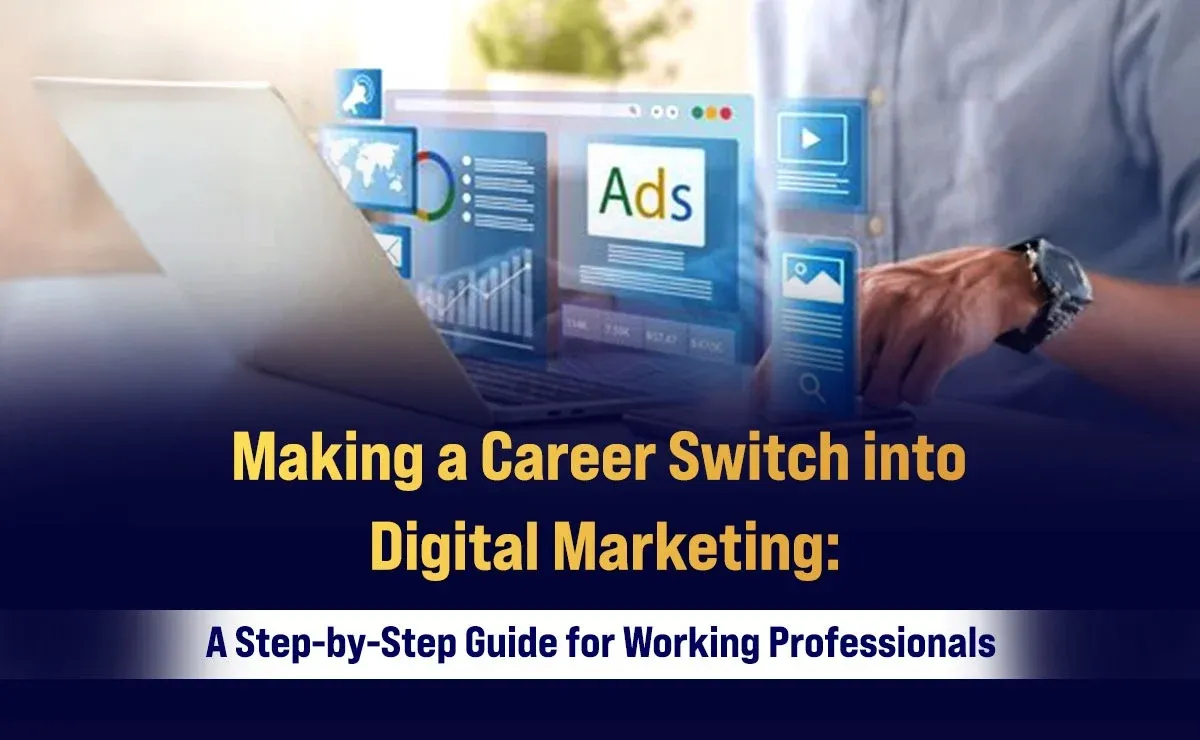
Making a Career Switch into Digital Marketing: A Step-by-Step Guide for Working Professionals

At some point in your career, you might have wondered if it’s too late to switch career paths. Maybe a recent performance review felt out of touch with your work, or you’ve seen colleagues move into higher-profile, better-paid roles in digital-first careers.
If you have 2 to 6 years of experience in IT, sales, operations, BPO, or finance, a switch to digital marketing is not only possible but may be better timed now than at the beginning of your career.
In 2026, digital marketing brings together skills like data, technology, revenue, and strategy, meaning the experiences you have built in your previous roles will serve you well in a career switch into digital marketing. The most sought-after roles in digital marketing are filled with people who combine experience from other fields with new digital skills.
But first, let’s understand the reasons behind the switch towards digital marketing.
Why So Many Professionals Are Switching to Digital Marketing
People are transitioning toward digital marketing roles because there is a fundamental shift in how companies generate revenue and the roles they prioritize and reward.
In any organization, roles are often divided into cost-centric functions, which are essential for seamless operations of a company but do not directly drive the top line, and revenue-centric roles, which are directly accountable for business growth and revenue.
Roles like Growth marketing, eCommerce, performance marketing, and product marketing are revenue-centric, and as a company grows, these functions receive the most recognition, advancement, and compensation.
Digital transformation has spread far beyond tech-native companies like Zomato and Blinkit. Established organizations such as HUL, ITC, Nestlé, and the Tata Group invest heavily in their digital capabilities. Such roles are now professionalized at scale, with clear metrics, real-time decision-making, and measurable attribution, meaning they are more rigorous but also more rewarding than traditional marketing roles.
For mid-career professionals, the advantage is clear: cross-functional thinking and domain depth are valued in ways that entry-level hiring cannot match. A growth marketer who understands sales, or an eCommerce manager who can read P&L, delivers strong results. This is exactly the profile experienced professionals with cutting-edge digital skills bring.
How to Switch Careers into Digital Marketing
To break into digital marketing careers, one can always take guidance from the following steps:
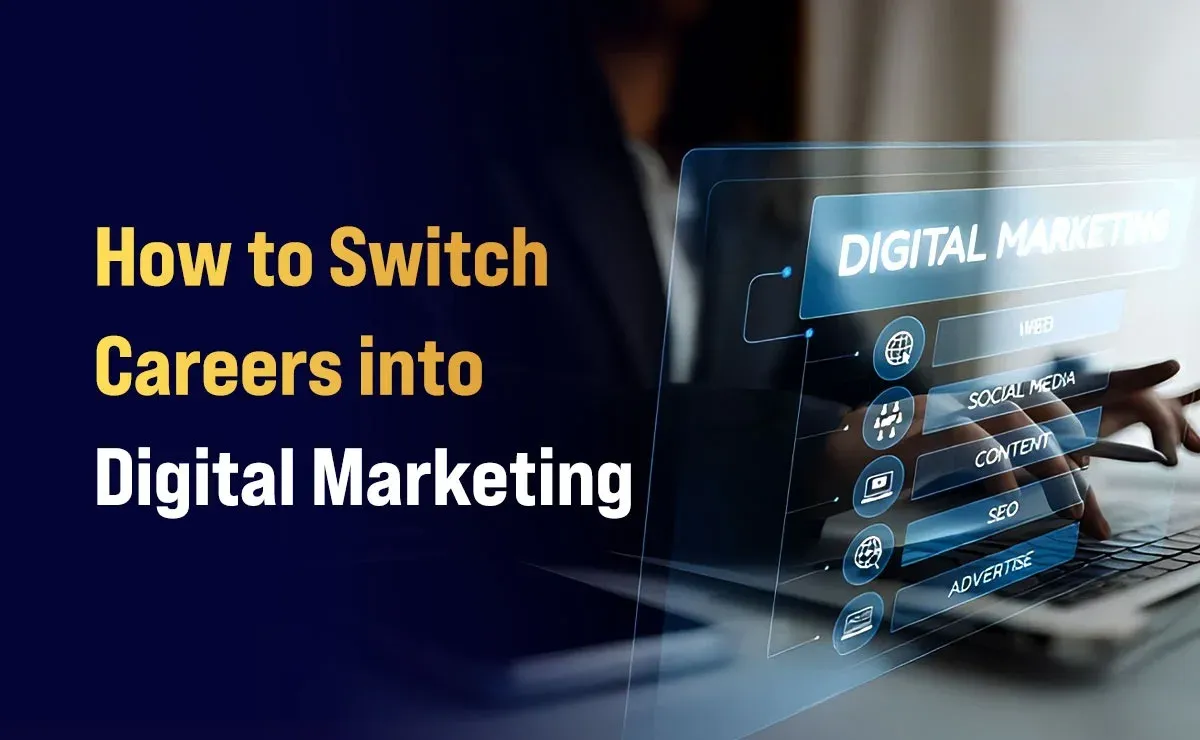
Step 1: Understand What Digital Marketing Really Means in 2026
The first thing most Career switchers need is a clear understanding of digital marketing. There is a common misconception that digital marketing is just about managing social media and posting content, but that is incorrect. Digital marketing is a cluster of analytically rigorous, revenue-accountable disciplines, like:
- Performance Marketing, which involves carefully managing paid ads on Google and Meta platforms, measuring cost-per-click, conversion rate, and return on investment.
- Growth marketing is about managing the entire customer journey from acquisition to retention and referral.
- Marketing analytics involves an understanding of dashboards, attribution models, and cohort data.
- Funnel optimization is about improving conversions at each stage of the customer journey.
- Revenue management is about producing measurable business results, and the field is analytical, experimental, cross-functional, and AI-driven.
Step 2: Identify Your Transferable Skills
People switch careers, thinking that their past experience doesn’t matter. In reality, your professional background is often a real advantage if you know how to use it.
Sales professionals already have two key skills that set exemplary growth marketers apart: persuasion and comfort with metrics. IT professionals bring strong analytical skills and know how to use tools, work with data, and think in systems. These abilities are central to performance marketing and analytics roles.
Operations professionals understand how to design processes and improve efficiency. This is the same mindset needed for funnel optimization, where the goal is to find friction points and improve results at scale. Finance professionals know unit economics, such as CAC, LTV, margin, and contribution analyses. These are exactly the concepts used by growth marketers every day.
These are not just minor advantages but clear benefits that set senior, revenue-focused marketing professionals apart from junior ones and position them as highly valuable contributors in any organization.
Step 3: Build the Core Digital Skills
After you have determined which skills are transferable, the next step is to build more targeted skills. For example, in growth, performance, and product marketing, employers often seek candidates who have:
- A strong understanding of paid advertising, including how to set up and measure campaigns on Google and Meta.
- Strong analytical skills, particularly when it comes to using dashboards and making data-driven decisions.
- The ability to calculate customer acquisition costs and lifetime values in order to justify marketing expenditures.
- Knowledge of the customer journey and how to improve conversion rates.
- An experimental mindset for testing ideas and the ability to use AI tools for campaign optimization, content creation, and customer insight.
Skills such as these can be acquired with time. What’s difficult to teach is the judgment and business focus that experienced professionals already have—which is why your background, plus these acquired skills, makes you stand out to employers.
Step 4: Gain Real-World Experience Before You Apply
In digital marketing, credentials are important; however, demonstrating what you are capable of is even more important. Certificates are not the only thing employers look for in high-growth positions. They want proof that you can take a brief, build a plan, execute it, and measure results.
The most effective way to demonstrate this is through live industry projects, where you work on real business challenges for actual companies. This increases the quality of your portfolio and professional references.
Case simulations of real marketing decisions help you develop the problem-solving skills employers want in job applicants. Revenue-based exercises, where you get a target and work backwards through funnel math to build an acquisition strategy, train the thinking needed for growth and performance roles from day one.
Small freelance projects, such as setting up analytics for a small business, managing a paid campaign, or auditing a conversion funnel, provide real proof of your skills and make your career switch more believable. This is also where structured educational programs show their value—not just in what they teach, but in the amount and quality of hands-on work they help you do.
How Structured Programs Accelerate the Career Switch
In order to become interview-ready for revenue-centric positions, self-directed upskilling is not simply about acquiring a wide range of skills. It’s about building structured applications, getting professional feedback, and learning from experienced practitioners. These outcomes require an environment designed for real-world learning, not just online courses or independent study.
This is where B-schools like Altera Institute come in. Its 15-month PGP in Applied Marketing spans Brand Management, Growth Marketing, Product Management, and eCommerce—the four domains with the highest sustained hiring demand in India's digital economy.
Every session is taught by industry practitioners: CXOs and leaders from HUL, Amazon, Bain & Company, Goldman Sachs, Nestlé, and EY Parthenon. They set learning objectives and actively mentor students through live projects and structured simulations.
The program's structure follows a career path for marketers.
- Term 1 lays out the analytical and marketing foundations, culminating in a capstone in which students build a D2C brand from scratch.
- Term 2 develops brand strategy, digital commerce, and media planning skills, with students building and testing their own minimum viable product.
- Term 3 introduces live projects with founders and CXOs on active real-business challenges.
- By Term 4, students had moved through the full cycle of ideation, execution, and optimization.
This demonstrates the program's strong industry alignment, equipping students with practical skills and real-world experience to excel in India's rapidly expanding and competitive digital economy.
Conclusion
Changing careers is not about losing your past experience. It is about repositioning for a new digital, AI-based economy and finding value in the skills you already have.
People who succeed in this transition are disciplined: they recognize the skills gap, close it strategically, position themselves deliberately, and invest in structured pathways that provide real experience before applying. Taking these steps doesn't mean starting over. To get there, you need to move forward from where you are with intention and a clear understanding of how the landscape is changing.
There is strong demand for growth, performance, eCommerce, and product marketing talent in India. For career switchers with domain experience and digital skills, this is the right time to capitalize on the opportunity. Whether you can make the switch isn't as critical as whether you approach it with the same discipline and commitment you've brought to your career.