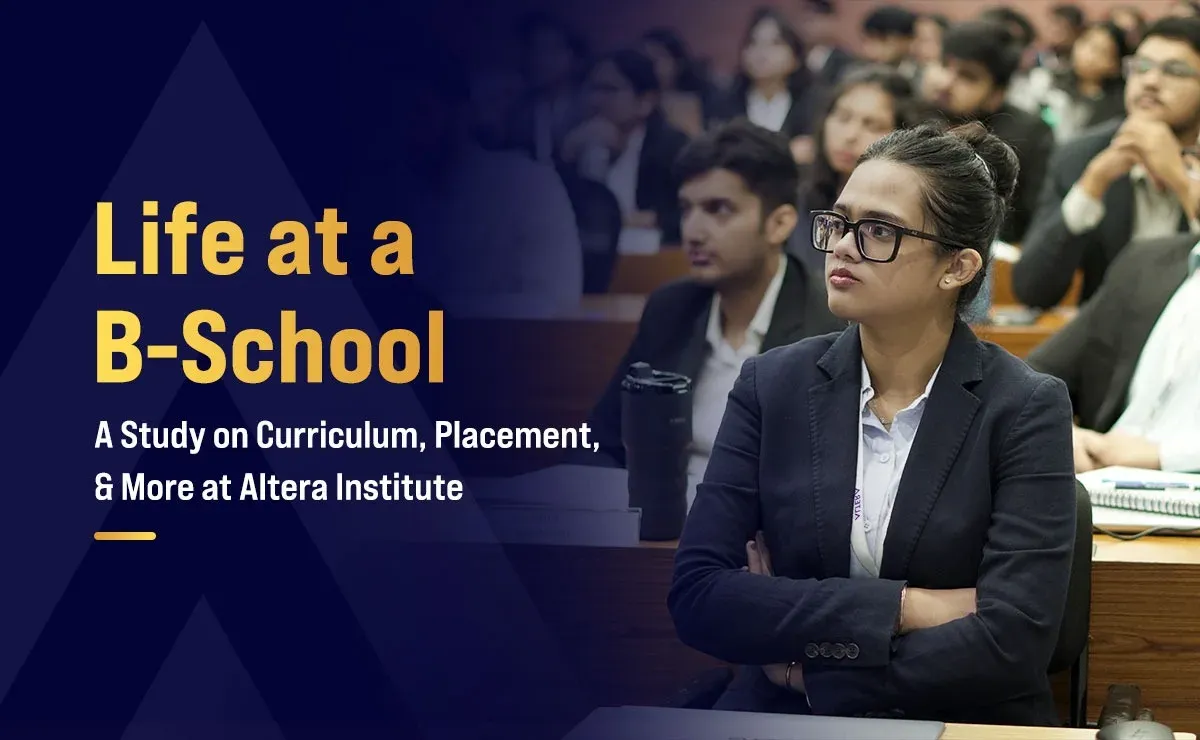
Life at a B-school: A Study on Curriculum, Placement, & More at Altera Institute

The Master of Business Administration (MBA) began as a generalist program in 1908 at Harvard University. It was designed to meet the new requirement for a cadre of managers who could translate business objectives into tangible outcomes and operate between executives and operational staff.
It was built during an industrial economy characterized by predictable cycles, defined hierarchies, and stable competition. Decisions took time; strategies were set once a year, and marketing relied on broad campaigns evaluated by reach and frequency. Education was predominantly theoretical, delivered in classroom settings, and separated into distinct specializations such as marketing, finance, operations, and strategy, each functioning largely in isolation.
Today, however, business works in a completely different way. Decisions that once took months now happen in days. Marketing is no longer about impressions, but acquisition costs, lifetime value and retention. Data informs all aspects of the business, and the digital space has eliminated industry boundaries. The skills needed now, particularly in a digital and AI-first economy, are not what traditional MBA education models were originally designed to teach.
This disconnects between traditional business education and current industry needs has created a lasting problem, especially in marketing, growth, product management, and eCommerce. Traditional programs, held back by regulations, can't adapt quickly enough or address the skills needed for today's roles.
How Careers in Marketing, Growth, and Product Have Evolved
In the last 20 years, growth, product, and marketing roles have undergone major changes; in fact, some of the fastest evolutions in modern business. What was once considered functional specializations operating within defined lanes has now become integrated revenue-owning roles at the intersection of technology, analytics, and business strategy.
Digital transformation has also changed the nature of work across industries, not only for digitally native companies such as Zomato and Blinkit but also for legacy corporations such as Hindustan Unilever, ITC, the Tata Group, and Nestlé. These organizations are investing heavily to enhance their digital capabilities, creating sustained demand for digital-first roles like Product Management, eCommerce, Growth Marketing, and Digital Brand Management.
- Marketing is now more than just running awareness campaigns and counting impressions. Today’s marketing teams track customer acquisition cost (CAC), lifetime value (LTV), and retention. They use experiments to improve conversion funnels in real time, leveraging attribution models and cohort analysis. Success is measured by real business results, not surface numbers.
- Product management has evolved from delivering features to owning strategy. Product managers now set priorities based on business impact, leading cross-functional teams. They rely on user data, A/B tests, behavior analytics, and balance technical requirements with customer needs. In software, they act as mini-CEOs, accountable for user and business outcomes.
- E-commerce management professionals play key roles in conversion rate optimization, pricing strategy, demand prediction, and platform management, including Amazon and Flipkart. They have expertise in SEO and GEO for product listings, experience with recommendation engines, familiarity with abandoned cart analysis, and logistics. Such positions require high proficiency in digital selling and revenue analysis.
- Growth marketing brings these trends together. Growth marketers handle the entire customer journey, from first contact to customer loyalty. They measure funnel metrics, find what drives growth, and expand what works. Unlike traditional marketers, they are responsible for real revenue.
These jobs require a mix of different skills and need people who can analyze data, think in systems, work with different teams, and make decisions even when things are unclear.
The Gap Between Education and Industry Reality
The biggest issue with business education today is not poor design, but the fact that MBA programs do not address the challenges relevant in today's Digital and AI-first industries.
- Regulatory Hurdles Slow Innovation: Regulatory bodies add credibility to the program but slow down the process of curriculum update. It takes years for approvals to come through, and by the time a course is updated, relevant tools and practices may already be outdated.
- Theory Over Practice: Traditional programs rely on a theory-based learning model, where students learn frameworks such as Porter’s Five Forces, Marketing Mix, and SWOT analysis. Though case-based learning adds value, nothing comes close to experiencing the messy, incomplete, and conflicting priorities of solving real business problems.
- Lack of Cross-functional Specialization: Traditional MBA programs are divided into specializations, but modern job roles require cross-functional skills. For example, a product manager should be aware of user psychology, financial trade-offs, technical constraints, and logistics. This is why isolated specialization should be replaced with integrative thinking across functions.
- Less Focus on Experimentation and Revenue: Traditional MBA programs rarely expose students to revenue and rapid iteration cycles of digital businesses. Students may learn marketing strategies, but they rarely run A/B tests or optimize pricing based on real customer behavior. Academic feedback loops move slowly, unlike the real-time decision-making that high-growth companies require.
- Faculty of Academicians over Practitioners: Traditional B-school faculty are often made up of academicians with limited industry experience. While they provide strong theoretical knowledge, they often omit practical execution skills. This gap leaves students with only framework knowledge who are unprepared to handle real business challenges.
How the Market Is Responding: The Rise of Industry-First Education
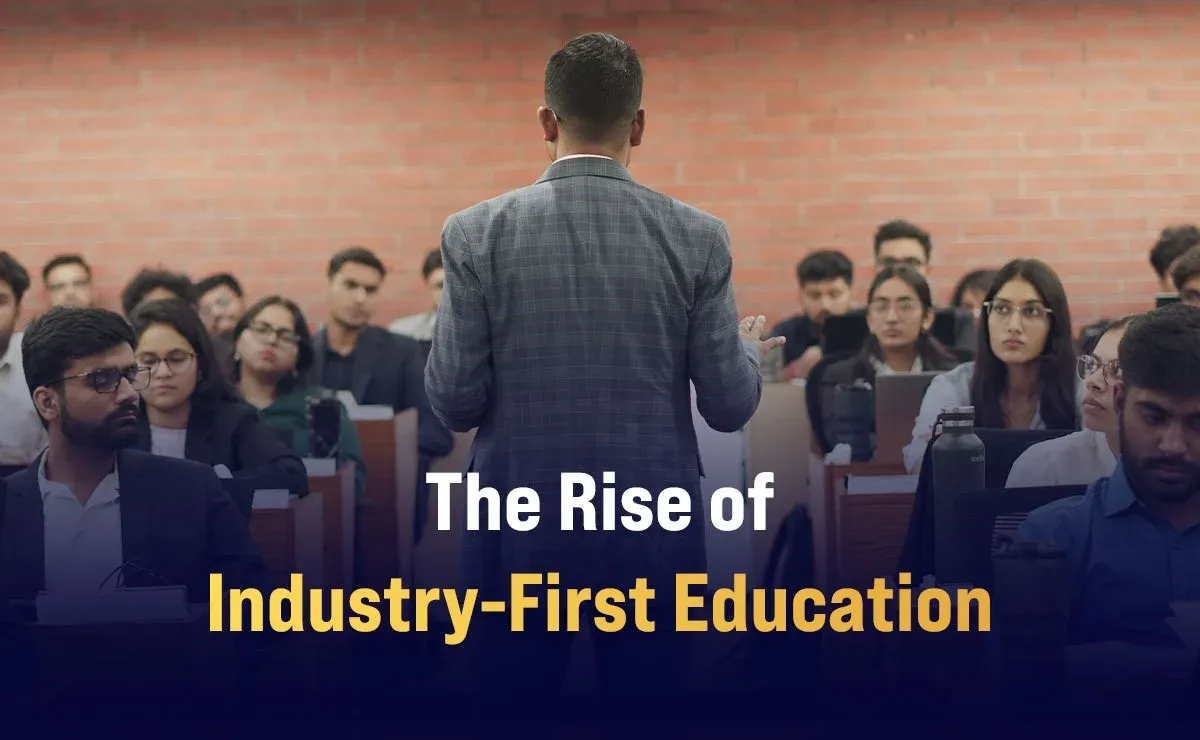
Traditional business education no longer matches what companies need today. This gap has led to a new kind of management program, built by industry leaders for real-world impact. These programs focus on hands-on skills, measurable business results, and cross-functional problem solving, rather than just theory or case studies.
Marketing education is changing fast, and instead of just teaching frameworks like the 4Ps, industry-ready programs are now building digital analytics, growth experiments, AI-driven marketing, and eCommerce directly into the curriculum. Students learn by doing: they launch real campaigns, track attribution, and optimize funnels using tools such as Google Analytics and Meta Ads Manager.
This change is happening because companies cannot spend a year training new hires on basic skills, as business moves too quickly for that. Employers want people who can add value from day one, people who know how to read dashboards, design experiments, interpret user data, and make decisions with incomplete information.
Many institutes in India are now building programs with this approach. Altera Institute is at the forefront of this shift.
What Life at Altera Institute Actually Means
Altera Institute is designed to provide students with practical skills relevant to modern business functions through a practitioner-led curriculum, where industry experts set learning objectives based on industry needs. This approach breaks from traditional MBA models, providing education that is relevant, experience-driven, and uniquely structured to prepare graduates for actual business challenges.
This is why the PGP curriculum at Altera Institute puts industry needs at the forefront. Leaders from companies like Hindustan Unilever (HUL), Amazon, Bain & Company, Goldman Sachs, EY Parthenon, Mondelez, and GSK helped create the program. And these leaders are more than just advisory members; they also actively teach and mentor our students throughout the course.
Altera’s 15-month PGP in Applied Marketing comprises four terms, each with defined learning objectives:
- In Term 1, students cover foundations such as marketing management, business finance, applied analytics, and problem-solving. They immediately apply these concepts through a capstone project where they build their own D2C brand, handling product positioning, pricing, go-to-market planning, and communication assets.
- In Term 2, the student learns and understands brand building, digital commerce, digital media planning, business communication, and the modern sales process. This is followed by capstone projects, where students develop a minimum viable product (MVP) and conduct market research. They develop prototypes, test ideas based on user feedback, and develop go-to-market strategies.
- Term 3 introduces practitioner mentorship and live projects. Students work directly with founders, CXOs, and business leaders on real business challenges in brand building, go-to-market, and product development. The placement process also starts in this term, requiring students to balance interviews, live projects, and coursework.
- In Term 4, students focus on behavioral learning, leadership, business strategy, entrepreneurship, and retention marketing. They complete a final capstone—a research project with practical business applications. By this stage, students have gone through the entire business cycle, from ideation to execution to optimization.
Students participate in multiple sprints during the course of this program. Each sprint is an intensive four to eight-hour bootcamp led by specialists from leading companies, and every sprint builds specific, immediately applicable skills.
The pedagogy prioritizes application-first learning. Students spend more time solving problems than memorizing theories, with each module building on the last. The program also includes over 300 hours of career preparation, such as interview coaching, resume building, and one-on-one mentorship.
The program is deliberately rigorous, and students manage competing deadlines and often ambiguous project briefs. Such rigor prepares students for the intensity of high-growth environments of brand managers, growth marketers, and product managers.
Life at the Altera Institute demands living like a professional right from day one: being accountable for results, making decisions in an intense environment, receiving direct feedback on performance, and building resilience through challenging problem-solving.
The Nuances of Altera Institute: Quality Over Optics
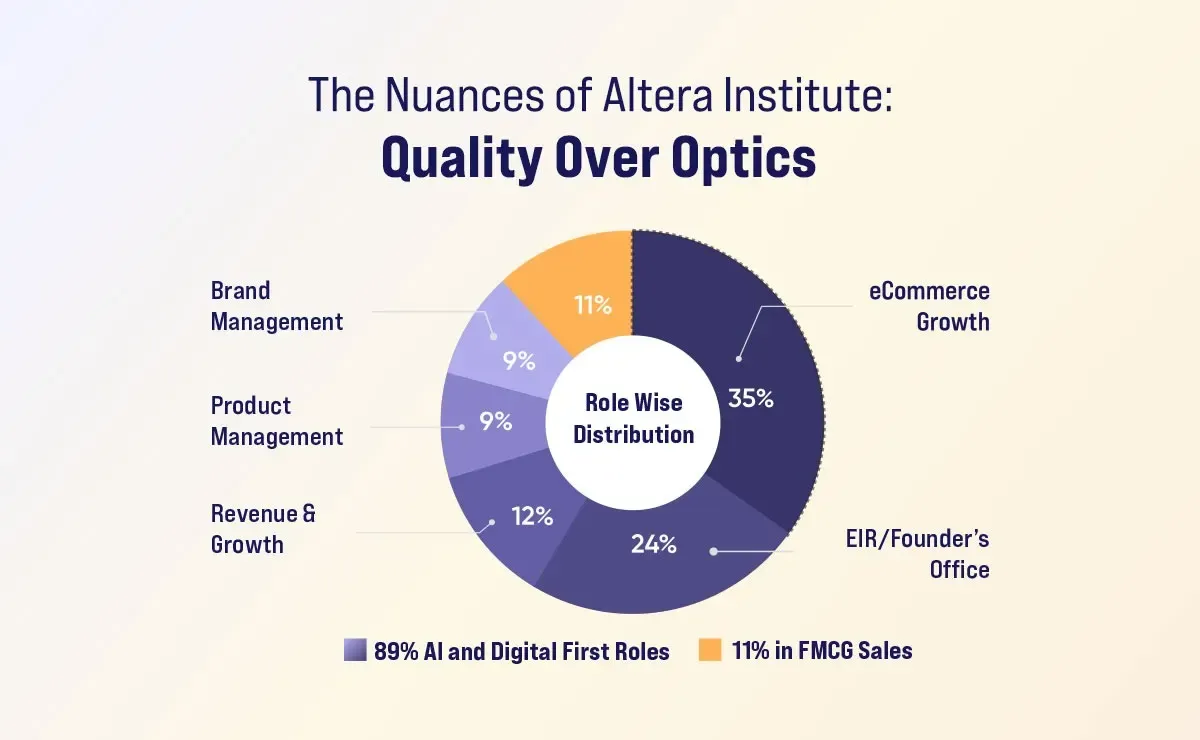
Altera’s placement approach reflects its unique philosophy, which believes that the quality of roles secured by students is more important than placement statistics.
The Class of 2025 achieved 100% placement, positioning Altera Institute among India’s top 30 B-schools, which is a notable achievement for a young institution. The median package was ₹18.14 LPA, the average was ₹16.85 LPA, and the highest offer was ₹26.08 LPA. Notably, 70% of students secured roles above ₹15 LPA, which are high-growth positions typically reserved for experienced professionals or graduates from tier-1 B-schools.
One of the best features of the institute is its placements. Unlike traditional B-schools, where graduates usually join field sales or operations, 89% of students at Altera Institute received digital and AI-first positions. The breakdown also includes:
- 35% in eCommerce,
- 24% in Founder’s Office and Entrepreneur-in-Residence positions,
- 12% in Revenue and Growth,
- 9% in Product Management,
- 9% in Brand Management,
- And 11% in FMCG Sales and Marketing.
Some of the companies that have recruited from the Altera institute include Amazon, Flipkart, Godrej, Honasa Consumer (Mamaearth), Publicis Groupe, Himalaya, Wella Company, WPP, Jubilant FoodWorks, Plum, Blinkit, GroupM, Supertails, and MullenLowe Lintas Group.
Altera Institute follows IPRS (Indian Placement Reporting Standards) Version 2.2, the same reporting model developed and implemented by IIM Ahmedabad. This standard reduces ambiguity by standardizing placement reporting. Variable pay, ESOP, vesting plans, and guaranteed cash elements are distinctly differentiated, information that most B-schools do not disclose as systematically.
The 15-month program structure also offers a higher return on investment as students spend less time away from the workforce than traditional two-year MBAs, resulting in higher lifetime earnings when opportunity costs are considered.
Conclusion: Choosing the Right Kind of Education
Life at Altera is about becoming a professional who can add value from day one. It is about building judgment, resilience, and execution skills through real business problems. High-growth careers need continuous learning, cross-functional teamwork, and the ability to handle uncertainty.
Hence, the decision between a traditional MBA and Altera Institute’s PGP is, in fact, a decision about the learning environment and career path you most favor. While traditional programs offer broad knowledge, an established reputation, and access to multiple industries, Altera offers direct pathways to high-growth digital roles, access to industry experts, and an education built around the careers reshaping India today. The key is to choose the one that matches your goals and how you want to reach them.