Is Specialization the Future of Business Education?

In 1908, Harvard University introduced the Master of Business Administration (MBA) as a generalist program designed to meet the demands of the growing industrial era. In this period, businesses needed a new set of managers who could connect senior leaders with operational teams. To translate business goals into real results, these generalist managers needed a thorough understanding of all aspects of the company’s operations.
As industries grew more complex, expectations also changed, and in response to this change, MBA specializations like Finance, Marketing, Human Resources, Operations, and Information Technology emerged, and this approach served the industry well for many years.
However, does the traditional MBA model still hold up today? To answer this question, we must first understand the organizational structures of modern business and the roles of generalist or specialist careers within them.
Generalist Vs Specialist Roles
Organizations generally have hierarchies. Founders, chief executives, and general managers are at the top, and they set the organization's strategy. They are generalist positions requiring a wide range of skills, the ability to think across functions, and the ability to make trade-offs between goals and objectives. The generalist MBA teaches these skills well and prepares graduates for jobs in management consulting, general management, and leadership roles focused on bridging gaps across business functions.
It is the senior leaders minus one level roles that directly impact organizational outcomes. Growth marketers optimize the entire customer journey, product managers guide product development, eCommerce leads manage sales and revenue, and data strategists convert analytics into action plans. These are specialist jobs that require in-depth knowledge in these key areas. Graduating from an MBA program that focuses on a specific field leads to a solid start in these specialized careers.
Therefore, today's professional landscape is increasingly dominated by specialists. However, this shift does not render generalist roles irrelevant; it just increases the proportion of specialist roles in high-growth organizations. In the past 15 years, digital transformation has created new categories of employment. Today, AI automates many coordination and process-management tasks previously carried out by generalist managers. As a result, specialized expertise and domain knowledge are in greater demand.
The fastest-growing fields in 2026 will be those that combine digital technology, data analytics, and AI in business. These trends can be seen in roles such as Product Management, Growth Marketing, eCommerce, Digital Business, and Brand Management. Because each of these roles requires its own set of skills and ways of working, choosing a focused specialization rather than a generalist program has become much more important than before, as this decision can have a significant impact on your future career.
How to Choose a Specialization in a Specialist-Centric World?
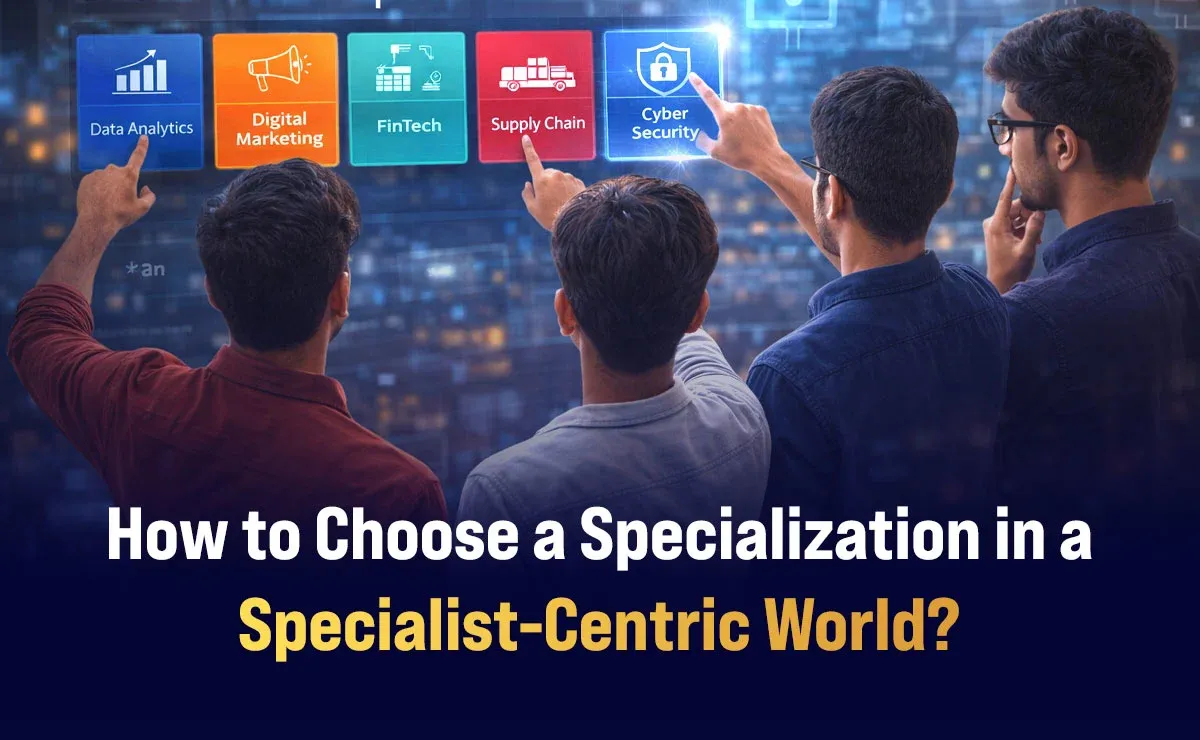
Choosing the right MBA specialization is one of the most important decisions a student must make. Take time to reflect and research yourself, rather than following trends or looking for what sounds impressive. The following is a practical approach to get started:
1) Begin by Identifying Your Natural Strengths
What you want to be good at and what comes naturally to you are two very different things. If you enjoy thinking in systems, working with technology, and solving complex problems, Product Management may be the right field for you. If you enjoy working with numbers, understanding why marketing campaigns succeed or fail, and being responsible for results, consider a career in Growth Marketing. An effective way to identify your natural strengths is to develop a 2x2 matrix, a SWOT analysis, or other frameworks that help you do so.
2) Connect Your Strengths to High-Growth Roles
It's important to be aware of one's own abilities, but understanding the job market is equally essential. Among the most in-demand and highest-paying jobs by 2026 will be digital commerce, AI-driven marketing, product and growth roles at technology firms, and data-driven brand strategy. Having expertise in these areas will enable you to gain relevant skills and position yourself in a growing industry.
3) Be Specific About the Roles You Want Before Choosing a Specialization
Whether a specialization aligns with your target roles is best indicated by its curriculum, faculty, and placement results. You should not choose a specialization and then determine what jobs it will lead to. You should instead identify your desired roles, determine what skills you need, and then choose specialization that focuses on developing those skills the most directly.
This is exactly where new-age MBA programs have come up as a clear advantage. From the very start, industry-aligned programs are designed to meet the needs of specific roles. Rather than academic teaching frameworks from a decade ago, their curricula are designed and taught by professionals today. Those aspiring to a particular career path are better served by this type of program, as it offers a more direct route.
Why is the Generic MBA Model Losing Relevance?
The decline of the generalist MBA is driven by several concurrent structural shifts. They Include:
- Outdated Curriculum Design: The traditional MBA program still teaches Finance, Marketing, Human Resources, and Operations in silos, with hardly any real-world integration. It was ideal for the pre-digital era, but today, businesses rely on metrics such as customer acquisition costs and retention rates; product teams manage both customer outcomes and business results, and growth functions run real-time experiments. Most MBA curricula have not kept up with these changes in industry.
- High Opportunity Cost with Diminishing Returns: Besides tuition costs, two-year MBAs entail lost salaries, diminished professional momentum, and a period during which peers who remain in the workforce gain industry knowledge. Since markets now prioritize demonstrable specialist skills over broad credentials, a generic degree is increasingly difficult to guarantee such returns.
- Employer Expectations have Structurally Changed: Most companies today no longer hire based solely on academic credentials, especially in digital-first and high-growth industries. They seek to hire individuals who are immediately capable of contributing practical, job-ready skills in a specific field, rather than those with theoretical knowledge of multiple business functions. The adoption of artificial intelligence has further accelerated this trend over the last few years.
- Stronger Alternatives Exist Now: In key areas, such as placement rates, curriculum relevance, industry exposure, and return on investment, shorter, specialized MBA programs are now outperforming generic MBA programs. The shortcomings of traditional MBAs are directly addressed by one-year postgraduate programs and two-year PGDM programs with real-world projects, industry-designed curricula, and strong placement outcomes.
What Employers Actually Look For in 2026?
In 2026, hiring managers at high-growth companies recognize that ideal candidate profiles will differ greatly from those produced by traditional B-schools. Understanding this gap gives those making educational decisions a competitive advantage. The following are the qualities recruiters will look for in candidates in 2026:
- Practical, domain-specific skills: Digital transformation has rendered many skills obsolete. Nowadays, employers want candidates with real-world skills, not only theoretical knowledge. People who can contribute meaningfully from day one are consistently differentiated from those who cannot.
- Adaptability and Willingness to Learn: AI and digital disruption have shaped a business landscape that requires adaptability. There is now a distinction between candidates who claim to be able to adapt to change and those who demonstrate this ability through their actions and responsiveness.
- Structured Thinking: There are often ambiguous challenges associated with roles that are expected to grow rapidly. It is advantageous for companies to hire candidates who can independently move from an undefined problem to a structured analysis and a clear recommendation. This skill is developed through practice, so programs with real business problems and live projects are especially beneficial.
- A Clear Career Narrative: Post-MBA recruiters are particularly interested in candidates who can explain their rationale for selecting a particular role. A candidate who answers questions about his or her specialization, program, and career goals with specificity and conviction stands out from generic candidates.
- Strong Communication and Enthusiasm for the Role: It is essential to communicate clearly and persuasively. In addition to writing and verbal skills, genuine engagement with the company and role is essential during the hiring process. To hiring managers, these qualities do not replace domain expertise; rather, they enhance its visibility and credibility.
Industry-Aligned Specialization Matters More Than Program Labels

There is a crucial difference between the label of an MBA degree and its quality of education that many MBA candidates overlook. The job market is shifting toward competency over credentials, making it important not to confuse the two.
A specialization aligned with industry needs is more valuable than a program label, since it bridges the employability gap between educational programs and what employers are looking for from students. An MBA with a generalist focus typically yields surface-level knowledge across functions rather than deep expertise. Despite institutional prestige, such profiles no longer meet the hiring requirements of high-growth companies.
Digital-first industries do not shortlist candidates based on their university rankings. The selection criteria include domain expertise, including AI integration, data strategy, eCommerce execution, and growth marketing, as well as the ability to apply these skills to real-world business challenges. Professionals must contribute from day one and not require months of on-the-job training in order to advance quickly.
As a result, the questions you ask when evaluating a program are more important than brand names or reputations. Here are some questions you should ask:
- Does this curriculum reflect hiring trends in my target industry?
- Who teaches it? Are they working professionals with current industry knowledge or academics with outdated experience?
- Has the program's placement record shown consistency in the specific roles and companies I am pursuing?
A good career decision is the result of asking the right questions, which complement your overall career goals in the long run.
Invest in Depth, Not Just Credentials
Students should choose specializations that develop relevant skills for an AI-driven economy rather than those that appear prestigious. Traditional MBAs continue to provide a solid foundation for career advancement. And while this is true, the fastest-growing and most rewarding roles in 2026 will require a combination of specialized expertise, accountability for measurable business outcomes, and proficiency with AI and data tools that are revolutionizing every aspect of business today.
This is why new age institutes like Altera Institute focus on digital and AI-first specializations because they understand the need for such skills in the industry. Its flagship PGP in Applied Marketing course focuses on digital-first and AI-aligned specializations in Growth Marketing, Product Management, eCommerce, and Brand, designed and taught by active industry practitioners and designed to translate directly into high-growth career outcomes.
Use the framework in this article as a guide if you are currently making this decision. Define your target roles clearly based on your strengths. Give priority to practical learning and skills over credentials that only seem impressive. In a rapidly transforming digital economy, your capabilities are more important than your degree title.