Does MBA Campus Life and Infrastructure Impact Placements?


When potential MBA students analyze prospective business schools, the rankings and credentials of the faculty members, and naturally, MBA campus placement, dominate discussions. Increasingly, however, campus life and infrastructure are entering conversations due to the impact they have on the overall experience of a student.
It may not seem like much, but in reality, the environment in which students learn, network, and grow plays a quiet yet prominent role in modeling their professionalism. State-of-the-art facilities are often indicative of a university’s credibility for recruiters, and a lively campus culture constructs essential soft skills (such as leadership, collaboration, and communication) that are highly sought after by hiring managers.
So, instead of simply being aesthetic amenities, campus resources and community experiences frequently underline desirable placement records.
What Accounts for Campus Life & Infrastructure?
In addition to the learning within classrooms and through books, campus life and infrastructure ensure holistic development in both personal and professional spheres for students.
- Student culture and peer learning are the backbone of any strong program. Whether it is clubs, competitions, or industry fests, a robust peer network builds leadership, communication, and collaborative thinking, which are all prioritized by recruiters.
- Academic infrastructure sets the intellectual tone. Smart classrooms designed for case-based learning, digital libraries stocked with market data and research journals, and simulation-based environments all collectively help students experience real-world business challenges before they enter the workforce.
- Technology and labs, right from analytics suites and trading to decision-making simulators, help students understand how they can apply their theoretical learnings to actual business scenarios. Getting the right exposure with these learning tools makes it that much easier in a professional setting.
- Living and collaboration spaces, such as well-equipped hostels or open common areas with green spaces, are important in supporting the mental well-being of students, which consequently helps them improve their performance. Additionally, spontaneous networking and informal relationship-building may seem irrelevant to an onlooker, but in reality, they can become career-defining moments.
Why Is Infrastructure Central to MBA Placements?
While being an excellent learning support infrastructure, it plays an active role in shaping the placement readiness of a student by the time recruiters arrive to interview them.

- The quality of learning is directly associated with the availability of resources. With well-equipped classrooms, access to reliable and extensive research, and faculty-supported environments, concepts are understood more deeply. Subsequently, such an environment gives students an analytical edge that distinguishes them from the crowd.
- Simulating corporate environments is equally important. By emulating real professional settings via instruments such as boardroom-style discussion spaces, live project labs, and industry-relevant tools, students find the transition to becoming working professionals easier and approach it with better confidence and competence.
Altera Institute, an industry-backed B-school in Gurgaon, is precisely curated around this philosophy. Recognizing how fast the digital world changes, its 15-month PGP in Applied Marketing uses a Digital AI-First curriculum taught by experienced industry experts, many of whom have been CXOs and CEOs, providing in-depth knowledge in FMCG, D2C, and Consumer Tech.
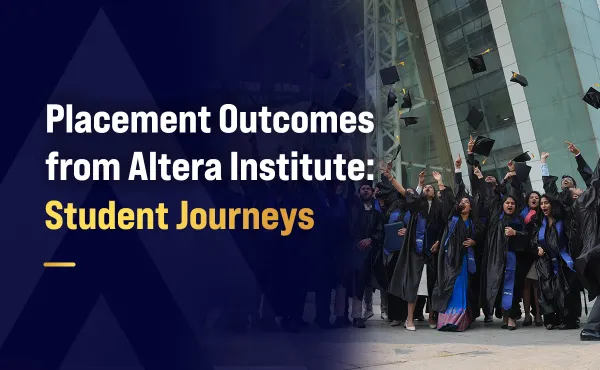
With options for specializations in brand management, product management, and growth marketing, the next batch of working professionals is trained for skills that are highly sought after. The outcomes themselves are reflective of this. Altera’s MBA campus placement of 2025 witnessed the cohort achieve a 100% placement rate, with 70% of students receiving offers above ₹15 LPA.
- Networking and presentation skills are also sharpened on campus via brainstorming sessions, peer pitches, and regular industry interactions that train students for upcoming placements long before they begin.
Key Infrastructure Elements That Matter in MBA Placements

It is consistently observed that recruiters look for something more than just academic performance. According to GMAC's 2025 Corporate Recruiters Survey, nearly two-thirds of global employers claim that the skills acquired through a graduate business degree are more significant than ever. In this light, the infrastructure that an institute invests in makes things possible. Here are some elements that influence placement outcomes:
Smart Classrooms & Case-Based Learning
The modern MBA classroom has witnessed an evolution from being a passive lecture hall. By employing various tools and methods such as interactive technology, case-based discussions, and scenario-driven problem-solving, students are encouraged to think on their feet, preparing them for the decision-making pressure of real business roles. It is just as important to analyze how the curriculum aligns with industry needs. There is no use of a smart classroom if students are exposed to dated knowledge.
Altera Institute tackles this problem head-on with its Digital AI-First curriculum designed around specializations in brand management, product management, and growth marketing. It makes sure that what students learn on Day 1 is still relevant on their final day.
Industry Labs & Analytics Centres
Dedicated labs for data analysis, consumer research, and digital marketing simulation offer students hands-on familiarity with the tools that dominate today's roles. With each passing day, employers are expecting the new workforce to be operational from week one. This is made possible through well-equipped labs.
Libraries & Digital Knowledge Access
To improve and mold a student’s quality of thinking, they must have access to the right resources, such as live market data, academic journals, industry reports, and digital case repositories. A robust research infrastructure builds the habit of evidence-based decision-making that stands out during interviews and on the job.
Incubation & Innovation Spaces
Dedicated incubation centers and innovation labs foster business thinking and independent problem-solving. Students aspiring to work in growth, product, or strategy are expected to possess the ability to ideate, test, and iterate in addition to their technical skill base.
Career Services, Placement Cells & Digital Platforms
In addition to scheduling interviews, a well-researched placement cell performs various roles. They track industry trends, prepare students through mock assessments, maintain recruiter relationships, and ensure every student has a credible shot at the right role. This process is further fine-tuned with the aid of digital platforms that centralize job postings, application tracking, and recruiter communication.
Corporate Exposure
Perhaps the most underrated infrastructure element is structured access to the real world. When it comes to MBA campus placement, Altera Institute sets a strong precedent by unlocking real-world exposure through live projects where students get to work on actual business problems.
It offers market visit opportunities that walk them through the entire journey of a product, from manufacturing and distribution to shelf placement and consumer behavior. Not only does this ground-level exposure embellish resumes, but it also fundamentally changes how students understand business.
Conclusion
It is now common knowledge that recruiters’ confidence in business school graduates does not exclusively rely on academic performance but on practical readiness, something that only a well-resourced, industry-integrated campus environment can provide. Infrastructure, campus culture, and corporate exposure all combine to reveal how quickly a student will evolve from a learner to a professional.
Hence, Altera Institute is specially curated to bring this vision to life with intent. Every student closely works with a dedicated industry mentor, while bootcamps led by senior leaders from top companies focus on sharpening their personal and business acumen. Combined with a high placement rate and a thoughtfully curated curriculum designed for the digital-first world, Altera prepares its students for soaring careers.