
Can I Do an MBA Twice?


The recent trend of increasing professionals seeking a second MBA or pursuing dual-degree and specialization options is indicative of the demand to acquire more high-level skills, international exposure, and career changes in the present competitive job landscape. Whether it’s for new domains, international opportunities, or simply to outpace peers, Indian students and working professionals are increasingly asking, “Can I do an MBA twice?”
Well, the short answer is yes, you can do an MBA twice, but most people who seem to do so are actually pursuing a different, complementary credential, like an integrated or dual degree, or a top-tier MBA after an earlier one, and not just repeating the same two-year program.
In India, this is unusual and should be based on a clear career goal, not just collecting more credentials. Hence, understanding the nuances, benefits, and challenges of dual-degree pathways is crucial for making an informed academic decision.
This article cuts through the confusion to answer whether you can do an MBA twice, explaining what a dual-degree MBA is and how it differs from dual specialization.
If you are looking for new opportunity check out our PGP program helps you build the skills companies are looking for today. Our graduates have achieved an average package of ₹16.85 lakhs, with the highest package reaching ₹26.08 lakhs. Learn from industry experts and gain practical experience through real projects. Explore the PGP program and take the next step in your career.
Key Data and Facts
- Due to the visa uncertainties, MBA applications in India increased by 26% in 2025, forcing a large number of students to explore within the country. In fact, 53% of Indian GMAT takers in 2023-24 decided to attend Indian B-schools (compared to 41% in the past), indicating high demand in the area.
- MBA grads are India’s most employable talent, as evidenced by the surge in MBA employability from 47% in 2021 to 78% in 2025, driven by curricula that adapt to AI, analytics, and soft skills.
- Industry leaders are now increasingly emphasizing skills over credentials. Notably, 97% of Indian employers say they are willing to pay more for candidates with micro-credentials (especially in AI/analytics).
- Many B-schools currently offer integrated or dual-degree MBAs. For example, the five-year IPM program at IIM Indore offers a B.A. (Foundations of Management) as well as a PGP. NMIMS Mumbai collaborates with Arizona State Thunderbird to offer a 2-year dual MBA + Master of Global Management. These courses enable students to complete two degrees on one academic path, which is quicker than completing them separately.
Why Do People Pursue a Second MBA?
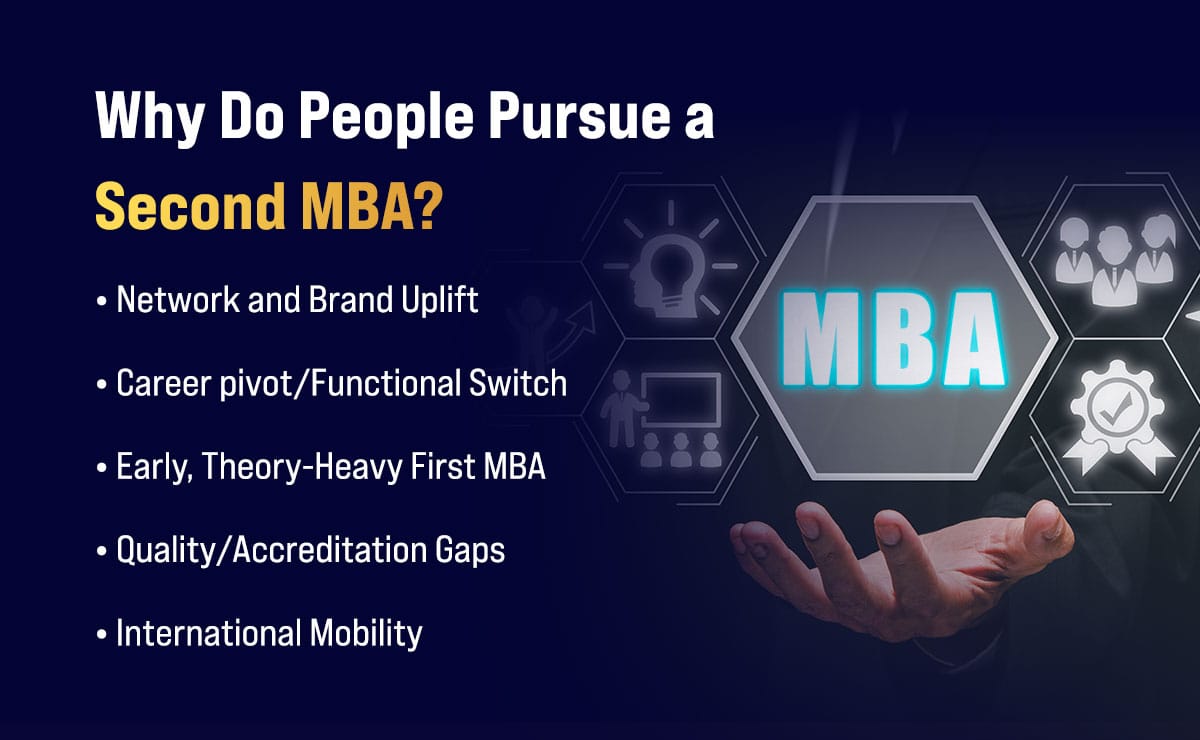
Repeating a traditional MBA degree twice is uncommon in India, as B‑schools already offer dual degree/integrated MBAs or joint international MBAs that effectively combine two qualifications for students. However, there are certain scenarios where students may choose to pursue a second MBA:
- Network and Brand Uplift: Graduates from lesser-known or for-profit programs sometimes find their career mobility limited. Hence, a second MBA from a highly ranked school (especially a global brand) helps them build international networks and on-campus recruiting channels.
- Career pivot/Functional Switch: If your first MBA didn’t provide the technical, sectoral, or global exposure needed to move into consulting, global finance, or a different function, a second MBA can be a vehicle for that pivot.
- Early, Theory-Heavy First MBA: In India, many students go for an MBA straight out of undergrad and later realize they lack practical skills and work experience to compete. This is when a stronger second MBA also makes sense and can help fill the gaps.
- Quality/Accreditation Gaps: Candidates from unaccredited or marginal programs may pursue another degree to overcome perceived ceilings in hiring markets.
- International Mobility: For professionals considering relocation, a degree from a globally respected school can sometimes be the most efficient way to access overseas roles and visas.
Therefore, it may be reasonable as long as you have a definite, constructive motive for needing a second MBA. Nevertheless, students must strive to prevent this situation by undertaking their first MBA in a proper manner. To do so, students must:
- Choose an accredited, well-ranked program after checking placement rates and recruiter lists.
- Gain 2–3 years of work experience before you apply for an MBA, which will enhance clarity and credibility.
- Prioritize institutes that offer internships, live projects, industry labs, and global exchanges.
- Verifying alumni network strength and recruitment partners.
- Pick programs with practical curricula and integrated upskilling options, like certifications or micro-credentials.
- Contact the alumni networks and the admissions department to ensure that the program suits you.
What is a Dual Degree MBA?
A dual degree MBA allows students to complete two separate graduate degrees at the same time, usually an MBA and a second postgraduate or professional degree, such as MSc, PGDM, Law (JD) or management specialties. Unlike pursuing two degrees sequentially, dual degree programs feature integrated curricula that allow coursework from one degree to count toward the other, creating significant time and cost efficiencies.
In India, dual degree MBA programs come in several formats. Some institutions partner with international universities, enabling students to earn both an Indian and an international MBA, often within 24 months rather than the 4 years it would take to complete them separately. For example, Symbiosis School of Banking and Finance offers a dual degree program in which students earn an MBA in Banking and Finance from India alongside an MSc in Finance from Aston University, UK, within 2 years.
The fundamental value proposition of a dual degree MBA is depth across disciplines. Students graduate with two complete master's degrees, each carrying their own credential weight in the job market.
Dual MBA Degree vs. Dual Specialization
Understanding the distinction between dual degree and dual specialization in MBA programs is important, as these terms are often confusing. Understanding their unique distinctions will also help you make an informed academic decision.
Aspect | Dual MBA Degree | Dual Specialization MBA |
Degree Credentials Awarded | Students receive two separate and distinct master's degree certificates upon graduation, such as an MBA and an MSc or MBA, each carrying independent academic and professional weight in the job market. | Students earn a single Master of Business Administration (MBA) degree certificate that recognizes expertise in two complementary business domains, such as Finance and Marketing or HR and Operations, within one unified credential. |
Program Duration | The program typically spans 2.5 to 5 years depending on the combination and structure, though some accelerated international partnership programs compress dual MBAs into 24 months through integrated curricula and intensive schedules. | The standard duration is 2 years (four semesters), which remains consistent with traditional single-specialization MBA programs, allowing students to complete both specializations within the conventional timeframe. |
Curriculum Structure and Academic Load | Students must fulfill the crediting requirements for two separate degree programs, though some coursework overlaps strategically to create efficiency. This involves managing different academic calendars, grading systems, and potentially attending classes at multiple campuses. | The curriculum begins with common core business fundamentals in the first year, followed by specialized elective courses spanning both chosen specializations in the second year, all integrated within a single unified academic structure. |
Career Positioning and Market Value | Graduates position themselves as specialized professionals in two distinct disciplines, particularly attractive for roles requiring interdisciplinary expertise such as healthcare technology, legal finance, or technical business management, commanding premium salaries due to unique dual credentials. | Graduates emerge as versatile business professionals with cross-functional understanding within the management domain, appealing to employers seeking adaptable talent who can bridge multiple departments and handle diverse business responsibilities. |
Career Flexibility and Industry Mobility | The dual credential structure provides career insurance through fallback options across two distinct professional domains, enabling professionals to pivot between industries or geographies based on market conditions, particularly valuable for mid-career transitions and international mobility. | Enhanced career mobility with opportunities across multiple functional areas within business organizations, allowing professionals to switch between related roles such as moving from marketing analytics to business development or from HR operations to talent management. |
Ideal Candidate Profile | Best suited for ambitious professionals with clear interdisciplinary career goals, strong financial resources, exceptional time management capabilities, desire for international opportunities, and willingness to invest 3-5 years in intensive academic pursuits. | Ideal for students seeking management careers with functional versatility, those uncertain about committing to a single business domain, working professionals balancing studies with employment, and candidates preferring faster graduation to begin applying their education. |
To Summarize: Dual specialization means two majors within one MBA, while dual degree means two separate graduate degrees earned together. The first typically doesn't lengthen the program (you finish your 2-year MBA as usual), while the second does (you must complete requirements for both degrees).
Benefits of a Dual Degree MBA
There are several potential advantages to doing a dual-degree MBA program:
- Broader Skillset and Credentials: You graduate with expertise in multiple domains. For example, in an MBA+MS program, you gain great technical and functional skills, as well as general management training. Employers recognize this breadth as well, as adding business education to a strong technical or policy background makes candidates versatile.
- Time and Cost Efficiency: Although longer than a single MBA, a dual-degree program usually takes less total time than doing the two degrees back-to-back. For example, an MBA and a Master of Computer Science can be completed in 3 years instead of 4 years separately. This saves time to graduation and may prove less costly than having two separate full-time programs.
- Integrated Curriculum: The dual-degree MBAs have a combination of subjects to enhance learning. For example, the MBA + Master of Global Management at NMIMS combine international business subjects with the fundamental management courses. Equally, there are those that incorporate industry-related electives (finance, information technology, healthcare) not offered in mainstream MBAs. It can provide you with a multidisciplinary outlook, which employers very much appreciate.
- Specialization and Future Readiness: Dual-degree students usually get to specialize in highly relevant programs (e.g. MBA+Analytics, MBA+Public Policy). This aligns with industry demand, with recent reports indicating that companies are seeking MBA candidates with skills in AI, analytics, and sustainable business. By structuring their studies with a dual degree, students can tailor their profile to emerging sectors (fintech, health tech, green biz, etc.) and command higher starting roles and salaries.
Therefore, a dual degree may be an indication of depth and leadership capability in the changing corporate world.
Should You do a Second MBA?

Ask yourself these hard questions:
- So, what will the second MBA do that the first one did not? (Specific courses, network, brand, access to recruiters or location.)
- Would there not be a quicker, cheaper way to fill that gap? To consider, one can think about executive education, specific master's, professional certifications, targeted internships, or one to two years of work experience in the appropriate field.
- Do I have the work experience and narrative to justify another MBA? B-schools expect a convincing story about outcomes and readiness.
- Is the ROI clear? Calculate the transaction in terms of tuition, missed income and opportunity costs against probable pay increase and future employment outcomes.
- Will recruiters recognize and value the second degree? If your goal is consulting/IB, a top-tier school matters more.
If you have definite, elaborate, and affirmative answers, a second MBA or a chosen dual program might be the right choice. But when your reasons are ambiguous, like having more credentials or better jobs, then it is not the best step.
Summing Up
Although sometimes having a second MBA is the right decision to take, it is best to find programs that would really suit you immediately after finishing your first degree. You can strategically choose a dual degree, a dual specialization, or a high-ranked, accredited MBA to amplify both depth and versatility. You can also choose to gather work experience in the initial years after graduation so that you can become clearer about your career goals.
Hence, rather than collecting more credentials, a thoughtful, well-timed management degree, especially one chosen with market needs and personal growth in mind, will deliver significantly higher returns than simply repeating the same academic journey.