
Are MBA Graduates Skilled for an AI-Driven Job Market?

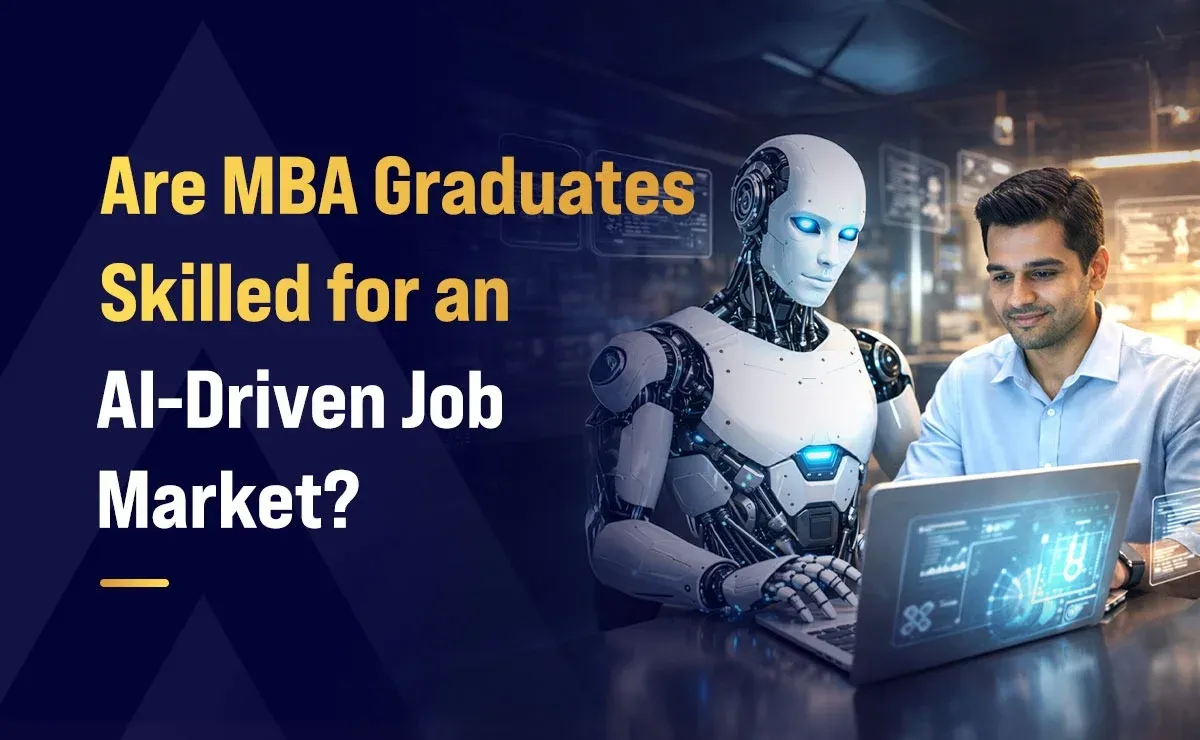
We are moving into a business world where AI handles execution, digital platforms enable real-time performance measurement, and the decision-making cycle is shorter than ever. Today, automation tools can produce content, optimize campaigns, analyze data, and streamline operations. At the same time, digital platforms from eCommerce marketplaces to SaaS ecosystems make every business decision trackable and measurable.
According to global reports such as the World Economic Forum’s Future of Jobs Report, analytical thinking, technology literacy, and problem-solving consistently rank among the fastest-growing skill requirements. AI and automation are expected to alter 23% of global jobs by 2027.
LinkedIn’s Skills Reports and NASSCOM insights in India similarly highlight digital fluency and cross-functional capability as core employability drivers. In fact, LinkedIn Skills on the Rise 2025 data shows that AI literacy is among the fastest-growing skills, with year-over-year growth exceeding 40%.
Career readiness is no longer about just knowing frameworks. It is about operating in digital, measurable, AI-assisted environments. This shift is structural, and it demands a corresponding shift in business education.
Why Career Readiness Is Being Redefined
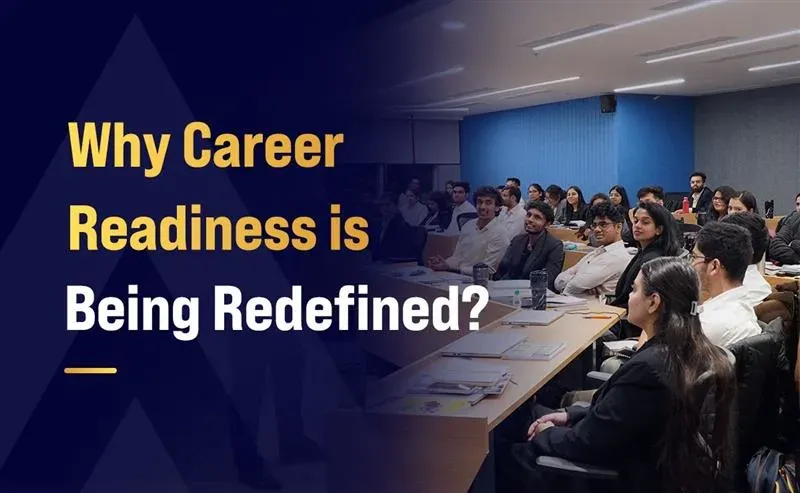
The traditional paradigms of business education are being challenged by four fundamental shifts in how companies operate, compete, and create value in today's economy.
1) AI Handles Execution; Humans Handle Judgment
Repetitive tasks across marketing, operations, analytics, and even content creation are increasingly automated. This shifts the value from execution to interpretation, strategy, and decision-making.
McKinsey reports that 88% of businesses now use AI regularly in at least one business function, though most are still in the early stages of scaling AI and capturing enterprise-level value. They also estimate that generative AI alone could automate up to 30% of current work activities by 2030.
What this means is that professionals who once spent hours creating campaign reports, analyzing customer data, or optimizing ad spending can now rely on AI tools to handle these tasks in minutes. The competitive advantage lies not in performing these tasks but in interpreting the results, making strategic choices, and understanding business implications.
2) Business Is Now Measurable in Real Time
The rise of digital platforms has created unprecedented transparency in business outcomes. Marketing dashboards, eCommerce metrics, and SaaS analytics performance are visible instantly today, meaning professionals must interpret numbers, not just execute tasks. Every click, conversion, customer journey, and revenue stream is tracked and analyzed in real time.
Digital transformation spending globally is projected to exceed $3.4 trillion by 2026. Additionally, Zoho’s Workplace Digital Transformation Survey 2025 found India’s digital workplace maturity at 64.6%, surpassing both developed nations and the global average of 62.3%.
This measurability is fundamentally changing job requirements. Where business decisions were once evaluated quarterly or annually, they are now assessed daily or even hourly. Hence, professionals are expected to understand metrics, identify patterns, and make data-informed decisions with speed and confidence.
3) Decision Cycles Are Shorter
Experimentation, A/B testing, and rapid product iterations now enable businesses to operate in weeks rather than annual cycles. Agile methodologies and rapid experimentations have replaced conventional planning, approvals, and slow implementation. Companies introduce products in beta, take user feedback, iterate, and pivot within days or weeks.
This acceleration demands individuals who are comfortable with uncertainty, skilled in hypothesis-driven decision-making, and able to learn from failure quickly. The ability to design experiments, interpret results, and iterate strategies has become as important as strategic planning itself.
4) Functions Are Interconnected
As traditional business silos dissolve, the boundaries between marketing, product, growth, and eCommerce are becoming less distinct. Addressing modern business challenges requires cross-functional expertise. For example, product managers must be familiar with marketing metrics, brand managers with eCommerce economics, and growth marketers with good product intuition.
This convergence is evident in how companies organize teams, define roles, and assess performance. The most rapidly expanding job titles today integrate multiple disciplines, such as growth product managers, brand growth leads, performance marketers with product ownership.
Four Skill Areas Defining Modern Business Careers
Four interconnected skill areas are now essential for career success across industries and functions.
1) Brand Skills in the Digital Age
The success of modern brand management depends on consumer behavior knowledge in the algorithm-driven world, differentiation in the attention-scarce markets, creators and community partnerships, and quantifying brand influence through data.
Brand building has now become quantifiable, interactive, and performance oriented. Organic content, influencer partnerships, community and performance marketing are the ways by which brands grow. Success is measured by engagement, sentiment, conversion attribution, and customer lifetime value.
AI supports these efforts by automating content distribution, analyzing sentiment at scale, and optimizing media spending. However, strategic differentiation, which is understanding what makes a brand unique, relevant, and valuable, remains a human responsibility as creative judgment in building authentic connections and cultural resonance cannot be automated.
2) eCommerce Skills
Today, it’s essential for professionals in all business roles to understand marketplaces and D2C ecosystems, connect marketing choices to revenue, manage pricing and conversion rates, and build strong platform and data skills.
Revenue accountability now shapes modern careers. Professionals need to understand Customer Acquisition Cost (CAC), Lifetime Value (LTV), margins, and conversion metrics. While traditional business education separates marketing from revenue outcomes, in today’s digital economy, every marketing decision directly impacts revenue.
AI helps with forecasting, personalization, and pricing. However, making decisions about business trade-offs, like choosing between customer acquisition and retention, balancing margin with market share, or deciding when to invest in brand or performance, still requires human judgment and strategic thinking.
3) Product Skills
Modern product thinking is defined by customer-first problem solving, cross-functional collaboration, data-driven prioritization, and an experimental mindset. It now shapes decision-making across all business functions, not just technology roles.
Whether you are launching a new service, improving customer interactions, or entering a new market, you need a product-focused approach. This means finding customer problems, setting priorities based on what matters most and what is possible, testing solutions, measuring results, and making improvements.
AI accelerates prototyping, enables rapid testing, and offers advanced analytics. However, defining the right problem, like understanding customer needs, business objectives, and acceptable trade-offs, remains critical and inherently a human responsibility.
4) Growth Skills
Skills like funnel thinking, acquisition and retention strategies, lifecycle management, and clear business ownership now shape what it means to be a modern leader.
Growth roles bring together marketing instincts, strong analysis, product sense, and financial skills. People in these roles need to know how to manage conversion funnels, optimize acquisition channels, develop retention plans, analyze user groups, and improve key business metrics such as revenue, active users, and market share.
AI can improve channel performance, automate tests, and offer predictions. Still, human capabilities are needed to design experiments, make tough choices, and build growth systems using their clear judgment, creativity, and business sense. According to LinkedIn's Emerging Jobs Report, roles such as growth marketing, revenue operations, and customer success are among the fastest-growing worldwide.
The Skills Gap in Traditional Education
Although business has evolved considerably, most of the traditional MBA programs are still rooted in old frameworks, siloed specializations, long-cycle case studies, and provide very little exposure to real-time data to students.
Such programs often do not have sufficient focus on digital consumer behavior, marketing technology and analytics, experimental methodology, funnel-based reasoning, eCommerce ecosystems, and real-world revenue management. As a result, graduates often possess strong theoretical knowledge but have limited experience with the tools, platforms, metrics, and decision-making contexts needed in digital-first organizations.
This gap is not due to a lack of effort, but rather because curriculum updates have not kept pace with the industry's rapid change. Schools face real challenges, such as limited faculty expertise, strict accreditation rules, and slow-moving institutional processes, which make it hard to update courses quickly.
Industry feedback often points out this gap. In a 2023 survey, hiring managers in technology, eCommerce, and digital services said that 68% of recent MBA graduates lack sufficient digital fluency. While 80% of recruiters consider practical, job-ready skills over formal degrees, only 48% of India’s youth are considered employable. This shows how urgent it is to close the skill gap.
This persistent gap suggests the need to adopt educational paradigms that are fundamentally designed with reference to contemporary business realities, rather than merely adding digital components to existing curricula.
How Altera Institute Prepares Students for a Digital & AI-First World
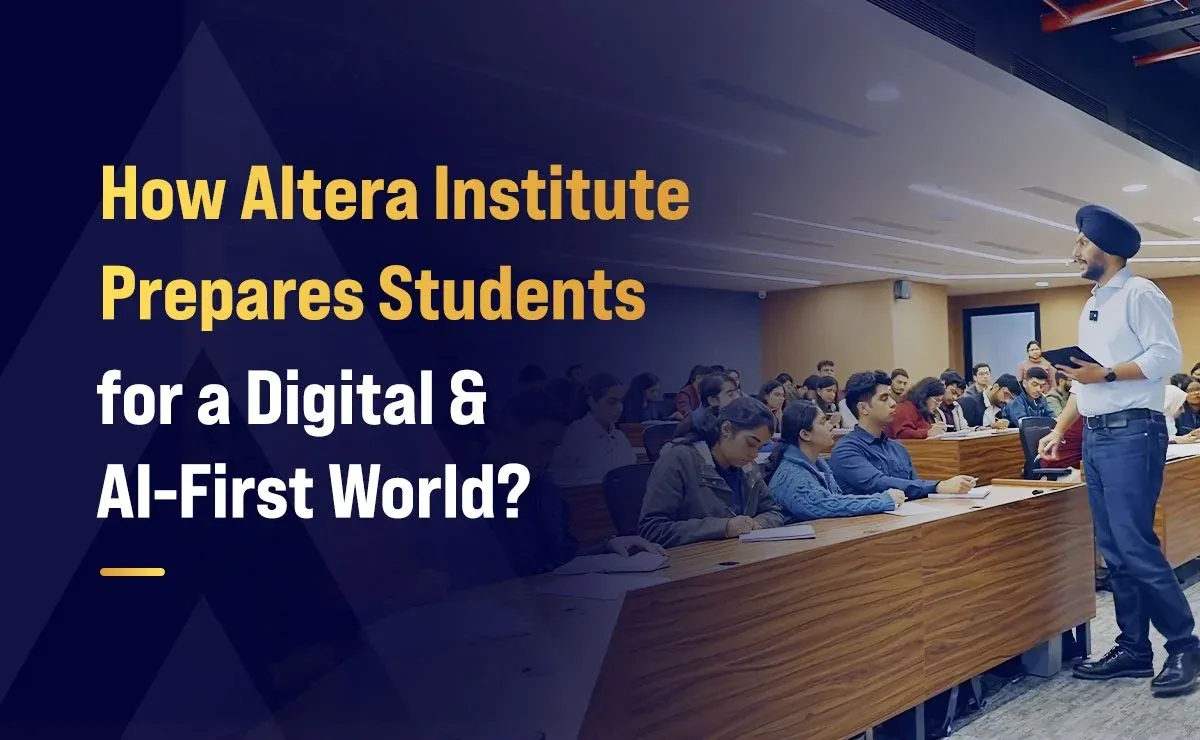
The curriculum at Altera Institute is built upon four main career paths: Brand, Product, eCommerce, and Growth. The program focuses on practical, real-world learning, which is in line with the manner in which modern businesses operate today, rather than relying on isolated theories from an outdated curriculum.
The program aims to close the gap between traditional business education and the skills prioritized by recruiters and digital-first organizations. Students engage in live projects, business simulations, real-time performance dashboards, revenue-driven problem solving, and cross-functional collaboration. The curriculum emphasizes not only conceptual understanding but also the development of judgment, analytical thinking, and a sense of business ownership.
Artificial intelligence (AI) tools are embedded throughout the learning environment to ensure students understand both automation capabilities and strategic oversight. AI is integrated across all curriculum areas, including brand strategy, eCommerce analytics, product experimentation, and growth optimization. Students utilize AI-powered tools for content creation, data analysis, customer segmentation, and performance forecasting, while simultaneously cultivating strategic and creative thinking skills that are distinctively human.
The pedagogical approach prioritizes real-world applications. Students participate in live industry projects that require making business decisions with measurable outcomes. They develop skills in interpreting dashboards, designing experiments, analyzing funnels, and optimizing performance within simulated or actual business contexts. This experiential learning model ensures that graduates are not only theoretically prepared but also equipped to contribute effectively from the outset of their careers.
By emphasizing the four interconnected skill areas of Brand, Product, eCommerce, and Growth, the program ensures that graduates acquire versatile, future-oriented capabilities. This approach avoids narrow specializations that may become obsolete as technology and business models evolve.
Summing Up
The digital and AI-first economy represents a structural change in how businesses operate today and how careers are advancing. AI will continue to automate performance, as digital platforms continue to improve performance measurement. Additionally, decision cycles are anticipated to become increasingly shorter.
Professionals who excel will possess creativity, analytical skills, technological expertise, knowledge of business economics, and growth ownership. Being career-ready now means being able to work in non-isolated, technology-enabled, and measurable environments, and not just having knowledge of theoretical models.
It is estimated that, by 2026, the digital economy of India will represent 20% of the GDP, as compared to around 10% in 2023. The adoption rate of AI in Indian businesses is expected to touch 85% in 2027. According to the World Economic Forum, 60% of workers worldwide will require retraining by 2027 due to technological advancements. These developments represent fundamental transformations in work and value creation, rather than incremental changes.
Consequently, business education must keep pace with these changes. Altera Institute represents this development by combining brand, product, eCommerce, and growth strategies into a unified, industry-focused curriculum grounded in real-world business decision-making.
Hence, it’s no longer a question of whether AI will change business and careers—it already has. The real question is whether business education can keep up and prepare graduates for this new world. B-schools like Altera Institute, which build their programs around digital and AI-focused businesses, aren’t just meeting today’s needs. They’re preparing students for the next decade of rapid technological and business model change.