
AI Impact on Careers in India: High Growth Roles for the Next 15 Years

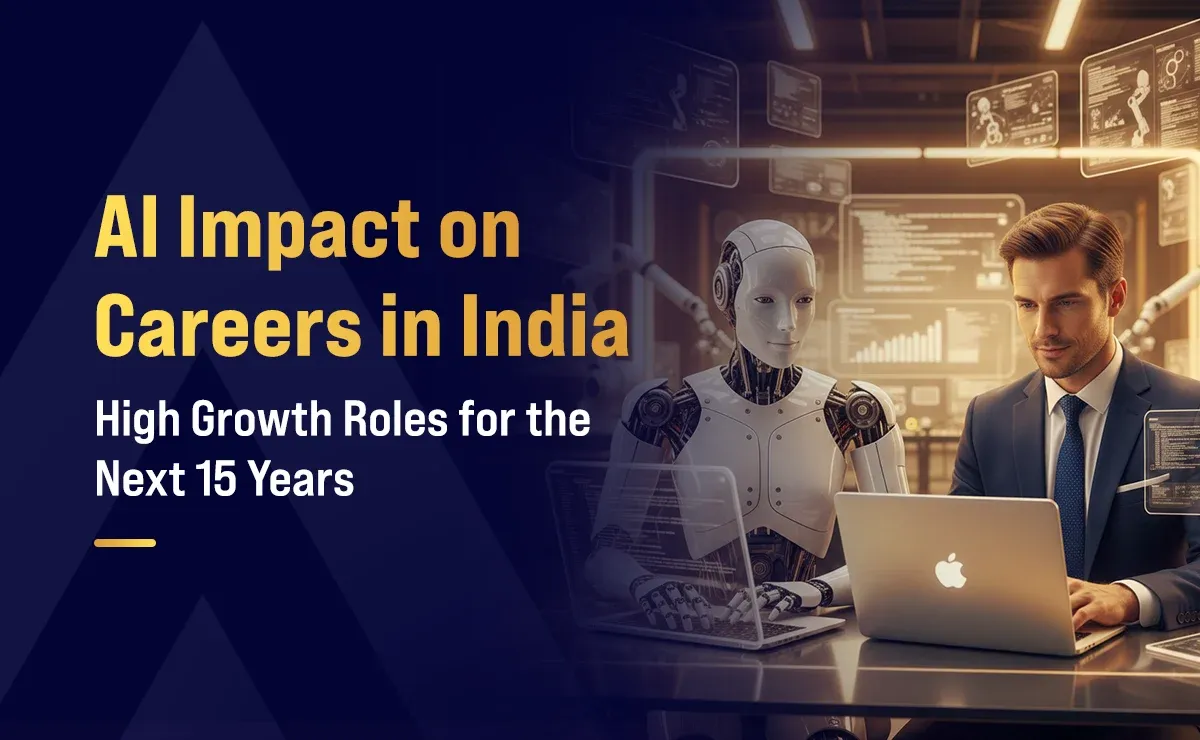
The Indian workforce is embarking on a defining period in which AI is increasingly gaining traction, eCommerce is growing, online payments are becoming the norm, and new startups are transforming established businesses. It is not merely a technological upgrade, but a structural realignment of how businesses operate, and careers are developed.
The World Economic Forum's Future of Jobs Report 2023 identifies analytical thinking, AI literacy, and technology-driven roles as among the fastest-growing globally. The report estimates that 23% of jobs will change by 2029 because of automation and digitalization.
A report by Bain & Company says that more than 2.3 million jobs will be available in the AI sector by 2027, indicating exponential growth not only in AI but also across allied sectors in India. Product management, Growth Marketing, and eCommerce roles have recorded high year-over-year growth in job postings, according to LinkedIn in India.
India's digital economy is projected to grow at 20% of GVA (Gross Value Added) by 2029-30, according to a report by the Ministry of Electronics and Information Technology. This expansion is not a temporary bubble; it is a structural shift in how businesses operate, how value is created, and how careers evolve.
Over the next 15 to 20 years, careers focused on process execution are expected to shrink in relative value, and roles centered around decision-making, cross-functional collaboration, growth ownership, and digital fluency are expected to grow. Hence, this article explores five roles that define the future of careers in India and what it takes to build long-term relevance in them.
AI Impact on Careers in India
The Indian job market is experiencing significant transformation due to four interconnected forces: artificial intelligence (AI) automation, comprehensive business digitization, the expansion of eCommerce and direct-to-consumer brands, and the growing convergence of cross-functional skills.
AI is now handling many repetitive, rule-based tasks. For example, customer service chatbots can answer thousands of questions simultaneously, and automated systems can process loan applications in minutes rather than days. Tasks like document processing, data entry, and basic analysis, which once employed millions, are now often handled by software.
At the same time, businesses are going digitally in all areas, which helps them make decisions faster. Companies can now track consumer behavior, marketing results, and how well they operate in real time. Because of this, there is a greater need for people who can interpret data, design experiments, and make decisions based on evidence.
The growth of eCommerce and direct-to-consumer businesses has changed how products get to customers. Brands can now bypass traditional distribution channels, enabling brands to launch, scale, and adapt directly based on consumer feedback. This shift has created new jobs like marketplace optimization, performance marketing, and conversion analytics, roles that were largely absent a decade ago.
Work is also becoming more cross-functional. Today’s business challenges often extend beyond a single department. For example, launching a new product needs teamwork from engineering, design, marketing, sales, and operations. Because of this, companies now look for people who can work across different areas, understand complex information, and carry out strategic plans.
These changes help explain why some jobs are growing faster than others. The fastest-growing careers are those that mix technical skills, business sense, and the ability to make smart decisions.
High-Growth Careers in India in the AI Era
Having established the macro trends reshaping India's workforce, we now turn to five specific roles that exemplify these changes and are projected to experience sustained growth over the next 15-20 years.
1) Product Management
- Emergence: Product management emerged with the growth of India's tech and startup ecosystem. As software companies grew, an industrial need emerged to bridge the gap between business objectives, engineering capabilities, and customer needs. Product managers became the connective tissue holding cross-functional teams together.
- Evolution: The role has evolved from a feature delivery role to strategic product ownership. Modern product managers define the problems worth solving, not just the features to build. They rely on experimentation, A/B testing, user research, and behavioral data to guide decisions. The focus has shifted from outputs and features shipped to outcomes and business impact delivered.
- AI and Digitization Impact: AI is accelerating product development cycles through rapid prototyping, automated testing, and predictive analytics. These help product managers iterate and work faster. However, AI is also raising many new challenges. Product managers must set up ethical guardrails for fairness regarding data privacy and ethical concerns. As a result, the role has become more strategic than execution driven.
- Future Demand: Every company is becoming tech enabled. Legacy sectors such as healthcare, education, logistics, and financial services are turning to build their own digital products. More SaaS platforms, fintech solutions, edtech applications, and D2C brands mean there will be continued demand for product managers who can articulate business requirements in scalable technical solutions.
- Skills Required: Customer-first thinking, data literacy, experimentation mindset, cross-functional leadership, and the ability to prioritize ruthlessly are some of the skills that a Product Manager must have. They must also be comfortable with ambiguity and skilled at aligning diverse stakeholders toward a shared vision.
2) Brand Management
- Emergence: Brand management as a role first took shape during the era when FMCG companies dominated mass media advertising. At the time, brands were heavily dependent on television and print advertising, as well as a host of celebrities who endorsed them. The objective was simply to ensure maximum exposure, wherein the brand message was seen by as many people as possible.
- Evolution: Today's brand management has shifted to digital-first, creator-led ecosystems. Social media and influencer collaborations have taken over community building through broadcast advertising. Engagement, as a metric that measures brands by sentiment and conversion, not just awareness, has defined success long after the move from vanity metrics like impressions to business metrics such as customer acquisition cost and lifetime value.
- AI Impact: AI enables hyper-personalization at scale, allowing marketing messages to be tailored to individual preferences. Generative AI tools now augment content creation. Sentiment analysis lets brands monitor consumer perception in real time and adjust messaging. Still, the core strategic question of what the brand stands for remains deeply human.
- Future Demand: Today, consumer attention is fragmented across platforms, and trust is built through authenticity rather than production value. Community-led brand building, where customers become advocates, is the new competitive advantage. This requires brand managers who understand digital consumer psychology and can build narratives that resonate emotionally.
- Skills Required: Product managers need skills in digital consumer psychology, content strategy, data-backed brand measurement, storytelling, and navigating multi-channel ecosystems.
3) eCommerce Management
- Emergence: eCommerce management developed alongside the growth of Amazon, Flipkart, and the proliferation of D2C brands in India. Initially, the role centered on catalogue management, including product uploads, description writing, and compliance with platform image standards.
- Evolution: The role has evolved to emphasize revenue optimization. Modern eCommerce managers prioritize conversion rate optimization, pricing strategies, demand forecasting, and customer retention. They analyze complex data to identify purchase drivers, minimize cart abandonment, and enhance customer lifetime value.
- AI Impact: eCommerce managers now work in a highly algorithmic environment where understanding data patterns is essential. AI powers dynamic pricing algorithms that adjust in real time based on demand, competitor pricing, and inventory levels. Recommendation engines predict what customers are likely to buy next. Predictive inventory management reduces overstock and stockouts.
- Demand Growth: Industry reports project that India's eCommerce market will reach $350 billion by 2030. Market penetration in tier-2 and tier-3 cities continues to expand, and the D2C ecosystem is scaling rapidly. This sustained growth generates long-term demand for professionals skilled in navigating marketplace algorithms, optimizing conversion funnels, and driving profitable growth.
- Skills Required: eCommerce managers need skills like revenue analytics, understanding of marketplace algorithms, performance metrics, pricing strategy, customer journey mapping, and digital merchandising.
4) Founder's Office
- Emergence: The Founder's Office role developed alongside the expansion of India's startup ecosystem. As startups grew, founders required trusted operators capable of managing high-priority projects across strategy, operations, fundraising, and partnerships, without incurring the overhead associated with specialized departments.
- Evolution: The role has transitioned from an assistant-like position to that of a strategic execution partner. Professionals in Founder's Office positions now contribute to fundraising processes, operational reviews, product strategy, and growth planning. They function as the founder's analytical and execution arm, managing projects that demand both strategic insight and rapid implementation.
- AI Impact: AI tools expedite research, competitive analysis, and reporting. Professionals in these roles leverage AI for market sizing, trend analysis, and rapid synthesis of complex information. Nevertheless, the primary value of the role remains in strategic judgment, including the ability to identify critical questions, prioritize initiatives, and execute effectively in uncertain environments.
- Demand Growth: As India's startup and venture capital ecosystem matures, the demand for high-agency, cross-functional operators remains robust despite fluctuations in funding cycles. Startups increasingly value generalists who can act decisively, synthesize information efficiently, and drive execution with minimal guidance.
- Skills Required: Key skills for this role include strategic thinking, understanding finance, clear communication, adaptability, strong analytical skills, and the ability to work independently.
5) Revenue and Growth Marketing
- Emergence: Growth marketing developed alongside digital advertising platforms and the proliferation of Software as a Service (SaaS) business models. In contrast to traditional marketing, which prioritizes brand awareness, growth marketing emphasizes measurable outcomes such as customer acquisition, activation, retention, and revenue.
- Evolution: The role has evolved from campaign management to full-funnel ownership. Growth marketers now manage the entire customer journey, from awareness to conversion to retention. They optimize metrics like customer acquisition cost (CAC), lifetime value (LTV), and retention rates. The focus is on experimentation, running tests, analyzing results, and iterating for better performance.
- AI Impact: AI facilitates automated campaign optimization, predictive customer modeling, and real-time bid adjustments. Growth marketers can test multiple variations simultaneously and more rapidly identify high-performing segments. Nevertheless, strategic insight, such as understanding message resonance, discovering new growth channels, and developing compelling value propositions, continues to require human expertise.
- Demand Growth: As businesses become more data-driven, revenue ownership is shifting to marketing teams. Companies want marketers who can demonstrate clear ROI. The shift from cost centers to revenue drivers creates sustained demand for professionals who operate at the intersection of creativity, analytics, and business economics.
- Skills Required: Funnel thinking, experimentation, analytics, understanding business economics (CAC, LTV, payback periods), channel strategy, and performance measurement.
Jobs at Risk from AI in India
Career growth is not uniform across all fields. Many traditional roles are being affected by automation, digitization, and new business models. It is important for students to be aware of these changes when planning their careers.
- ITES and BPO roles have long been a major source of employment in India, with millions working in customer service, data entry, and transaction processing. These sectors grew by offering routine services at lower costs. Today, AI chatbots and robotic process automation are taking over many of these tasks. As a result, while ITES and BPO still employ many people, growth has slowed, and career advancement in process-driven roles is now more limited.
- In banking and financial services, relationship managers once depended on personal connections and in-branch meetings. Now, digital banking has changed how customers are acquired and served. Most transactions happen through mobile apps, and automated systems assess credit faster than before. While relationship management is still important for high-net-worth clients, entry-level and mid-level roles are increasingly being replaced by digital platforms.
- Many banking roles that focus on documentation, compliance, and manual checks are now being automated. Technologies like Optical Character Recognition (OCR) extract data from documents, and machine learning helps identify risks. Although oversight still requires human intervention, there is less manual work than before.
- Traditional corporate roles such as processing claims, managing contracts, and handling logistics were once essential because they required human judgment at each step. Now, automation tools and AI assistants are handling many of these routine tasks, reducing the need for people to be involved in every decision.
- Traditional field sales roles, such as door-to-door selling and relationship-based sales in common products, are facing new challenges. E-commerce, digital marketing, and inside sales have reduced the need for large field teams. While complex B2B and consultative sales are still important, routine field sales jobs are becoming less common.
- Back-office analytics roles that focus only on creating reports or dashboards are being replaced by automated business intelligence tools. Today, the focus is on generating insights and taking ownership of decisions, rather than just collecting and summarizing data.
The goal is not to say these careers will disappear. Many of these roles will still exist, and some will change over time. However, students should know that jobs focused only on routine tasks have fewer opportunities for growth than roles that involve strategy, teamwork, and making a measurable impact.
What This Means for Students Today
Looking at careers over a 15 to 20-year span shows trends that short-term job market data can miss. Students starting their careers now will reach their peak earning years in an economy shaped by AI, digital transformation, and rapid technological shifts.
- Careers are becoming less predictable and less linear. Instead of following a single path or climbing one ladder, more professionals are building portfolio careers by moving across different roles, industries, and business models. In this environment, the ability to adapt, keep learning, and apply your skills in new situations is more important than having deep expertise in just one area.
- Hybrid roles are becoming the norm. The lines between marketing and product, operations and technology, or sales and customer success are fading. Professionals who can work at these intersections, combining technical skills with business sense or analytical thinking with creativity, will stand out in the job market.
- AI literacy will soon be a basic requirement, much like digital skills became essential in the 2000s. Knowing how to use AI tools, understand their results, and include them in your daily work will be expected in most jobs. At the same time, skills like strategic thinking, ethical decision-making, and strong communication will become even more important as AI takes over routine tasks.
- Cross-functional skills are now essential. Today’s business challenges need teams that work across different areas. For example, launching a new product requires teams from engineering, design, marketing, operations, and finance to work together. Professionals who can communicate across teams, bring diverse viewpoints together, and help everyone work toward a shared goal are in high demand.
Preparing for the Future: The Role of Education
Business careers are changing quickly, but most traditional MBA programs have not kept pace. Many still use teaching methods that suit past job markets, but these approaches do not match the needs of today's new career paths.
Most MBA programs ask students to pick up a single specialization, like marketing, finance, operations, or strategy. But the fastest-growing jobs today need skills from all these areas. For example, a product manager must know how to understand customers, manage costs, handle supply chains, and study competitors. Focusing on just one area can make it harder for graduates to adapt to real business challenges.
Many MBA courses still focus too much on theory and not enough on real business problems. While case studies help students think analytically, they cannot fully prepare graduates for the uncertainty and fast changes they will face at work. As a result, students often leave with strong concepts but find it hard to handle complex situations in real companies.
Additionally, traditional MBA programs still prepare students mainly for process-driven corporate jobs, such as middle management in large companies. These roles focus on following set procedures and making small improvements. While these jobs are still needed, they now make up a smaller part of the fastest-growing career options.
How Altera Institute Prepares Students for the Future
Altera Institute has structured its curriculum to match the roles expected to see the most growth in the next decade: Product Management, Brand Management, eCommerce, Growth Marketing, and Founder's Office. This approach is intentional and ensures that what students learn is directly linked to current market needs.
The program focuses on learning that is specific to each role. Instead of teaching isolated functions, Altera Institute organizes its curriculum around the real tasks these high-growth roles require. Students practice how product managers set priorities, how brand managers track campaign results, how eCommerce professionals improve conversion rates, how growth marketers test new ideas, and how Founder's Office teams analyze information to guide strategy.
Industry experts lead sessions at the institute, which keeps the curriculum up to date. Altera Institute invites product leaders from startups, brand managers from consumer companies, and eCommerce specialists from leading platforms to teach from their own experience. Hence, students learn from real business challenges, not just theory.
Hands-on experience is a core part of the program. Students solve real business problems, participate in simulations that reflect actual workplaces, and complete projects that require them to analyze data, make decisions, and explain their reasoning. This repeated practice helps students build the skills they need for the roles they are targeting.
The program teaches students to focus on outcomes, not just activities. They learn how to set clear success metrics, monitor progress, and adjust their approach based on results. This reflects the reality of high-growth roles, where performance is measured by impact, such as revenue, customer growth, or improved engagement.
Summing Up
In India, the future of careers will depend less on job titles and more on adaptability, digital skills, cross-functional thinking, and a mindset for growth. These are practical skills that set apart professionals who advance steadily from those who stagnate.
Over the next 15 to 20 years, AI and digitization will continue reshaping industries. The World Economic Forum estimates that 44% of workers' skills will be disrupted by 2027. India's eCommerce market is projected to grow at a compound annual growth rate (CAGR) of 15% through 2030. LinkedIn also reports that digital roles are growing 3 to 5 times faster than traditional roles.
This is why roles that focus on measurable impact, product management, brand building, and driving revenue are projected to grow faster than ever. In contrast, process-driven or purely execution roles may see limited long-term prospects. For students, the key question is not just about the first job, but about which skills will stay relevant as industries evolve.
This is why the right education matters a lot more today. Colleges that update their programs to match new industry roles rather than follow outdated tracks are more likely to help students stay relevant. Training that focuses on real-world roles, hands-on experience, and cross-functional skills gives students a strong base as industries shift.
The Altera Institute's approach reflects this shift. By focusing on Product Management, Brand Management, eCommerce, Growth Marketing, and Founder's Office roles, the program prepares students not just for their first job, but for the structural changes reshaping the Indian economy.
In an AI driven economy, long term career growth will belong to professionals who will combine digital fluency, strategic judgement, cross-functional execution and measurable impact.